

Anilao Muck Diving: A Macro Photography Holy Land
Lembeh is my home but Anilao is where I go when I want my macro subjects served on vibrant coral instead of black sand. Let us talk about the bizarre tiny creatures of the Philippines.
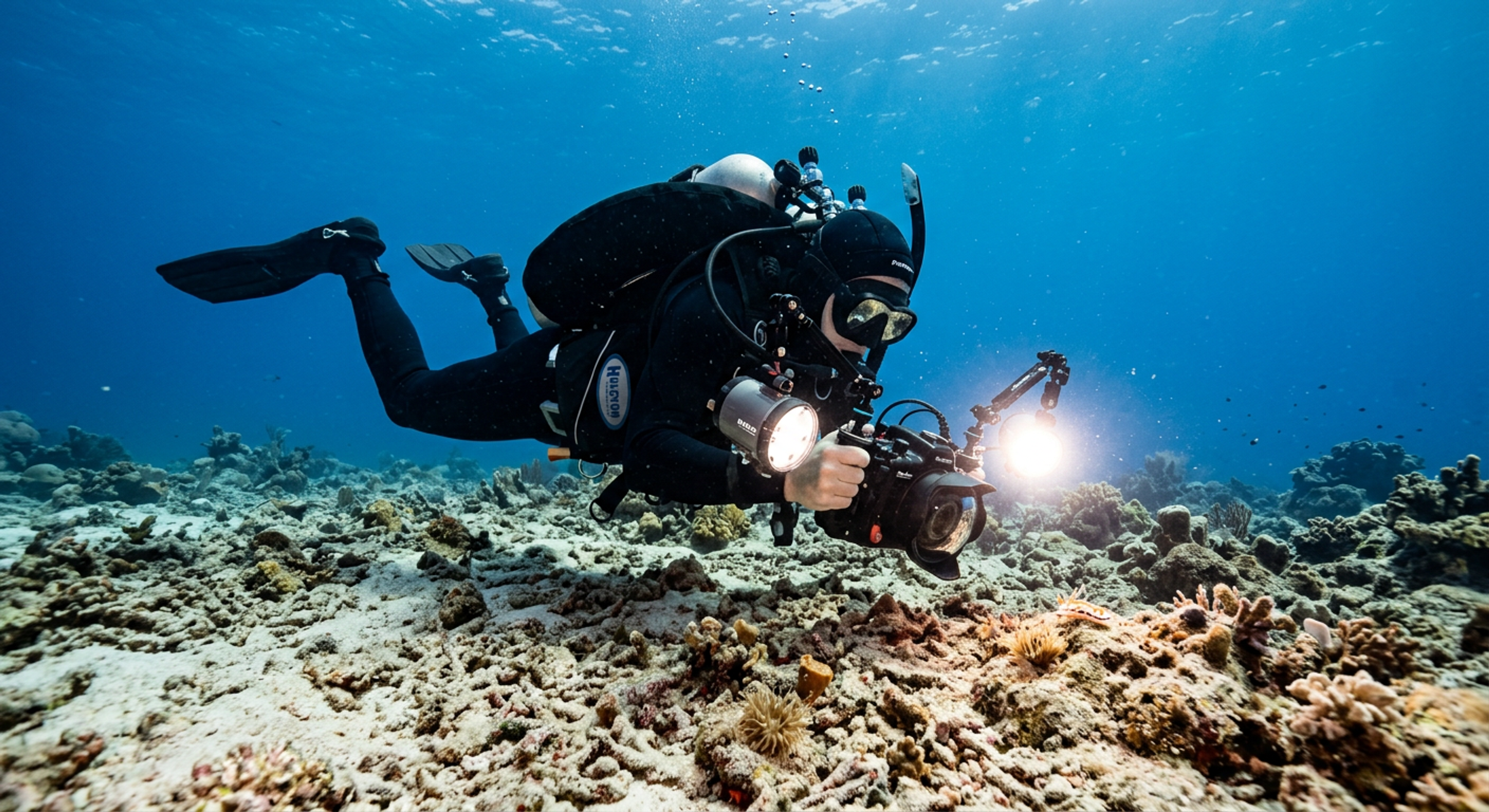
My regulator is vibrating against my front teeth. It is a subtle rattle that happens only when I am holding my breath just a fraction of a second longer than I should. My buoyancy control device is completely empty. I have dumped every single microscopic bubble of air from my wing. I am hovering exactly two inches above a patch of coarse sand and dead coral rubble at twenty meters deep.
My right index finger is resting on the shutter release of my camera housing. The metallic, stale taste of compressed air from a rented tank is completely forgotten. I am ignoring the slight trickle of cold water seeping into the neck seal of my wetsuit and the dull ache forming in my left calf muscle. All of my mental energy is focused on a creature the size of a grain of rice.
Welcome to Anilao.
As a local from North Sulawesi, I am fiercely loyal to the Lembeh Strait. Lembeh is the undisputed capital of muck diving. I love our dark volcanic sand. I love the sheer ugliness of our environment that suddenly yields the most spectacular marine life on the planet. But I have a confession to make. When I want a background that does not look like a literal pile of dirt, I pack my heavy pelican cases and fly to the Philippines.
Anilao is situated in the Batangas province. It is an absolute obsession for underwater macro photographers. You do not come here for whale sharks. You do not come here for manta rays. If you want to swim fast and cover miles of reef, you will be utterly miserable. Anilao is for the patient, the obsessive, and the slightly crazy divers who are willing to stare at a single rock for an hour.
Where Muck Meets the Reef
The diving environment here is strange and completely wonderful. In Lembeh, a muck dive is exactly what it sounds like. It is pure silt and black sand. Anilao offers something different. It is a hybrid.
You will drop down on a site like Secret Bay or Twin Rocks and find yourself swimming over standard coral reefs. There are colorful soft corals and healthy barrel sponges. But then you hit the rubble zones. These are slopes of broken coral, patches of green algae, and coarse white sand. To a novice diver, these transitional zones look dead. To someone with a 105mm macro lens and dual strobes, this is the most productive real estate in the ocean.
This combination of reef and rubble means the macro subjects here are extraordinarily diverse. You get the strange bottom dwellers that hide in the sand right next to the colorful nudibranchs that feed on the reef hydroids. Because the sand is lighter in color and heavier than the fine silt of Lembeh, you actually have to worry slightly less about catastrophic backscatter ruining your shot.
Backscatter is the absolute enemy of the underwater photographer. It happens when your strobes light up the suspended particles in the water between your lens port and your subject. In fine silt, one careless kick of a fin will cause a dust cloud that takes twenty minutes to settle. Anilao water is generally clearer. You still need perfect finning technique. Frog kicks only, please. But you can angle your strobes a bit more aggressively without illuminating a snowstorm of debris.
The Tiny Stars of Batangas
We need to talk about the local celebrities. The guides in Anilao have eyes like mantis shrimp. They can spot a translucent creature on a white rock from three meters away. I have learned to simply trust them. When my guide points at what looks like absolutely nothing, I do not argue. I just start adjusting my strobe arms and dialing in my exposure.
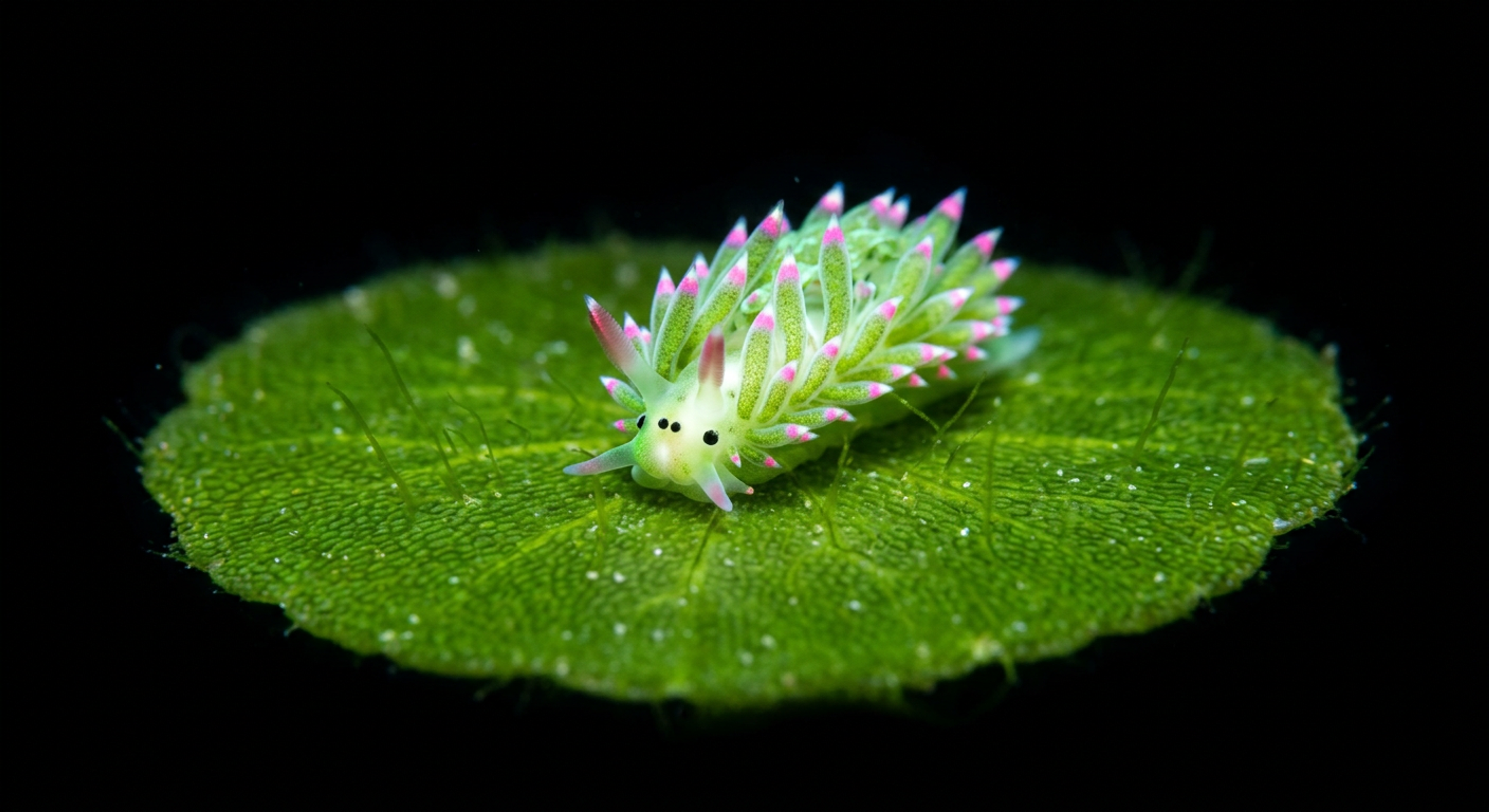
The Shaun the Sheep Nudibranch (Costasiella kuroshimae)
This is the creature that breaks the internet every few months. It is not actually a nudibranch. It is a sacoglossan sea slug. But we macro shooters just call it a nudi to save time.
The Costasiella kuroshimae looks exactly like a tiny, glowing green cartoon sheep with pink-tipped ears. Those ears are rhinophores which they use to smell their environment. The green color comes from the chloroplasts they steal from the algae they eat. They literally photosynthesize to survive.
Finding them is maddening. You have to look for Avrainvillea algae. This algae looks like a fuzzy, dark green ping pong paddle stuck in the sand. When you find the algae, you have to scan the edges for the slug.
To photograph them, you need serious magnification. A standard macro lens is not enough. I shoot a Nikon 105mm lens but for the Sheep I have to flip down a +15 diopter wet lens over my port. The depth of field at this magnification is razor-thin. If I shoot at f/8, only the tip of the slug's left rhinophore will be in focus while the eyes will be a blurry mess. I usually stop down to f/22 or even f/29. This requires immense light. I push my strobes to full power and angle them inward just enough to catch the translucent glow of the slug's body.
The Pikachu Nudibranch (Thecacera pacifica)
If you are going to have a sheep, you might as well have a Pokémon. The Thecacera pacifica is bright yellow with black bands and bright blue tips on its appendages. It genuinely looks like Pikachu.
Unlike the Sheep slug which sits on algae in the sand, the Pikachu nudibranch is often found clinging to bryozoans on the reef walls. This means you are often shooting them against a busy background.
This is where I like to use a snoot. A snoot is a funnel-like device you attach to the front of your strobe. It narrows the beam of light from a wide wash into a tiny, focused spotlight. It is incredibly frustrating to aim. You will miss your subject by a millimeter and your photo will be completely black. But when you hit the target, it is magic. The snoot illuminates only the yellow Pikachu nudibranch, allowing the busy coral background to fall away into pure shadow.
The Boxer Crab (Lybia tessellata)
Nudibranchs are great because they are slow. Crustaceans are a completely different level of stress.
The Lybia tessellata is a tiny crab that carries a living sea anemone in each of its front claws. When threatened, it waves these anemones around like a cheerleader with venomous pom-poms. The anemones (Triactis producta) sting predators and protect the crab.
I remember a dive at Arthur's Rock. My guide tapped his tank with a metal pointer. I swam over and he pointed to a piece of dead coral under a small ledge. I stared for five solid minutes. I finally saw the crab. It was no bigger than a thumbnail.
I spent eighty minutes with that single crab. I did not move. My camera was locked onto the rock. I was waiting for the perfect behavior shot. A photo of a Boxer crab just sitting there is boring. I wanted the crab to rear up and thrust its anemones forward. I checked my air pressure gauge. I had fifty bar left. Time was running out.
I hummed to myself to stay calm. The crab twitched. It stepped forward. It raised its claws perfectly symmetrical to the camera lens. I squeezed the shutter.
My strobes did not fire.
My sync cord had wiggled loose from the bulkhead of my housing. I let out a scream into my regulator that probably scared away every fish within a mile. I shoved the cord back in and prayed to the ocean gods and waited another ten minutes while my air ticked down to the red zone and my calves started to cramp. The crab eventually performed again and I got the shot. That perfectly sums up macro photography. It is ninety percent pure frustration and ten percent absolute euphoria.
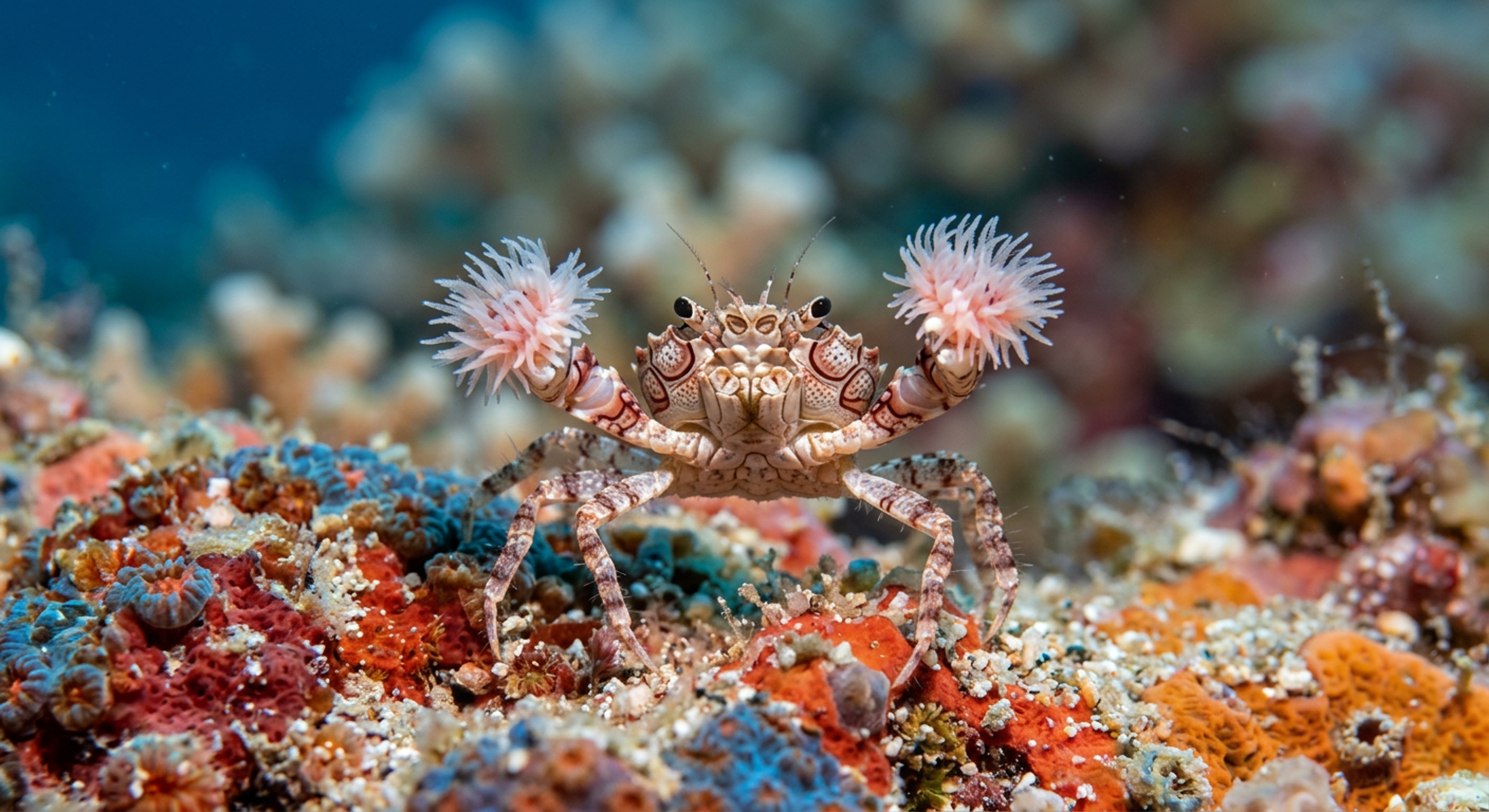 underwater. The crab is facing the camera, holding two small, fluffy-looking anemones in its front claws like pom-poms. The background is softly blurred coral rubble in dark, moody lighting.)
The Technical Approach to Anilao
If you are planning to visit this region, you cannot just show up with an action camera on a selfie stick and expect to capture these animals. You need the right tools and the right mindset.
Here is a quick breakdown of how I approach the three main stars of Anilao.
| Subject | Scientific Name | Typical Size | Habitat | My Go-To Lens Setup | Ideal F-Stop |
|---|---|---|---|---|---|
| Shaun the Sheep | Costasiella kuroshimae | 2mm to 5mm | Avrainvillea algae | 105mm Macro + SMC-1 Wet Lens | f/22 to f/29 |
| Pikachu Nudi | Thecacera pacifica | 15mm to 20mm | Reef walls, Bryozoans | 105mm Macro (No wet lens) | f/14 (with snoot) |
| Boxer Crab | Lybia tessellata | 10mm to 15mm | Under rubble, crevices | 60mm or 105mm Macro | f/16 |
The gear is only half the equation. The other half is buoyancy.
You will spend most of your dives hovering inches above the bottom. You cannot touch the living reef. You cannot stir up the sand. Some photographers cheat and dive overweighted to pin themselves to the bottom. I despise this practice. PADI and SSI standards dictate strict neutral buoyancy for a reason. Dragging lead across the bottom destroys the exact micro-habitats we are trying to photograph.
Instead of adding extra weight, I master my lung volume. I dump the air from my BCD until I am perfectly neutral. Then I exhale deeply, using the bottom third of my lung capacity to establish a stable, slightly negative hover. I use a blunt metal muck stick, placing just one finger on it, anchored gently in a patch of completely dead sand. I never use the stick on living coral. It acts as a pivot point for my body so I can keep the heavy camera housing perfectly still without resting my fins on the fragile ecosystem.
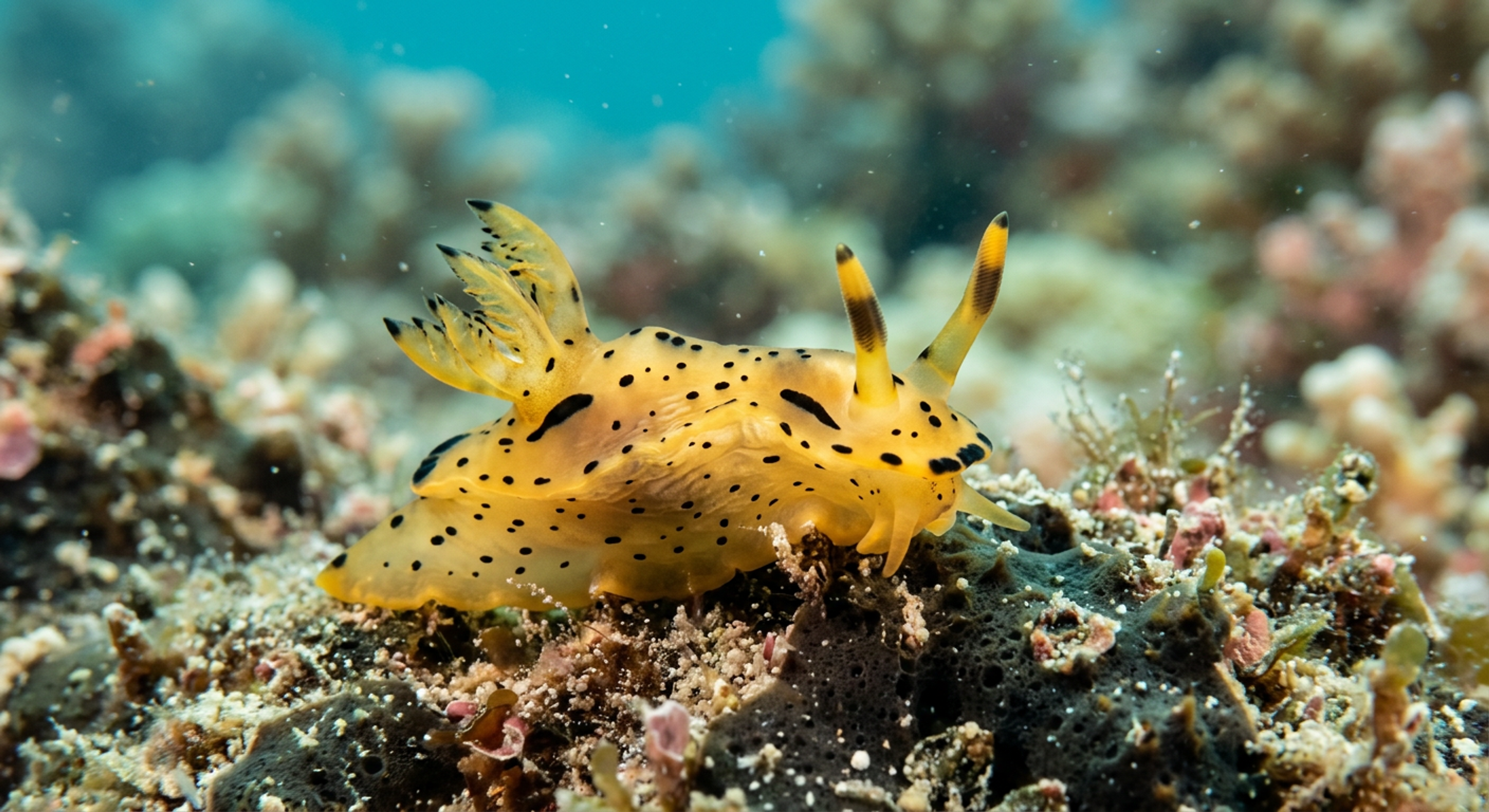 . The slug is bright yellow with black stripes and blue tips on its gills and rhinophores. It is crawling on a dark, textured sponge. The lighting is heavily snooted, creating a spotlight effect strictly on the nudibranch against a pitch black background.)
The Art of Slowing Down
Modern diving culture is often obsessed with covering distance. Dive briefings sound like military operations where we will swim to the point, hook in for the current, drift along the wall, and surface at the blue water marker.
Anilao rejects this philosophy entirely.
A good dive in Anilao might cover a total distance of twenty meters. You jump in, descend to the rubble field, and you crawl. You look at every single cranny. You look at the underside of dead leaves. You inspect the discarded coconut shells on the sandy bottom. You realize that a patch of algae the size of a dinner plate holds an entire functioning ecosystem of shrimp, crabs, and flatworms.
There is a deep meditation in this kind of diving. When you limit your physical movement, your eyes are forced to work harder. Your brain starts tuning out the big picture and tuning into the miniature details. The texture of a common sponge suddenly looks like an alien terrain. A tiny transparent ghost shrimp becomes the most fascinating creature on earth. A speck of dust that suddenly blinks. Magic.
My trips to Anilao always follow the same rhythm. On the first day, my eyes are still adjusted to the big world. I miss half the things the guide points out. By day three, my brain has recalibrated. I start finding nudibranchs on my own. I start anticipating the erratic movements of gobies. The cold water trickling down my spine does not bother me as much. The heavy camera housing feels completely weightless.
When I pack my wet wetsuit on the final day, smelling the familiar stench of damp neoprene and marine salt drying in the sun, I always feel a twinge of guilt. Lembeh is my home. Lembeh has my heart. But the sheer variety of subjects waiting in the colorful rubble of Anilao makes it a pilgrimage I have to make every year. There is always one more nudibranch I have not photographed perfectly yet. There is always one more minor f-stop adjustment I need to test.
The ocean is incredibly vast but the best parts of it are usually smaller than your fingernail. You just need the patience to stop kicking and start looking.