

Cold Water Diving: The Brutal Clarity of the North
Warm water is for bathing. Real diving happens where the water tries to kill you. A look at the crystal clear visibility, curious seals, and heavy gear required for Iceland and Norway.
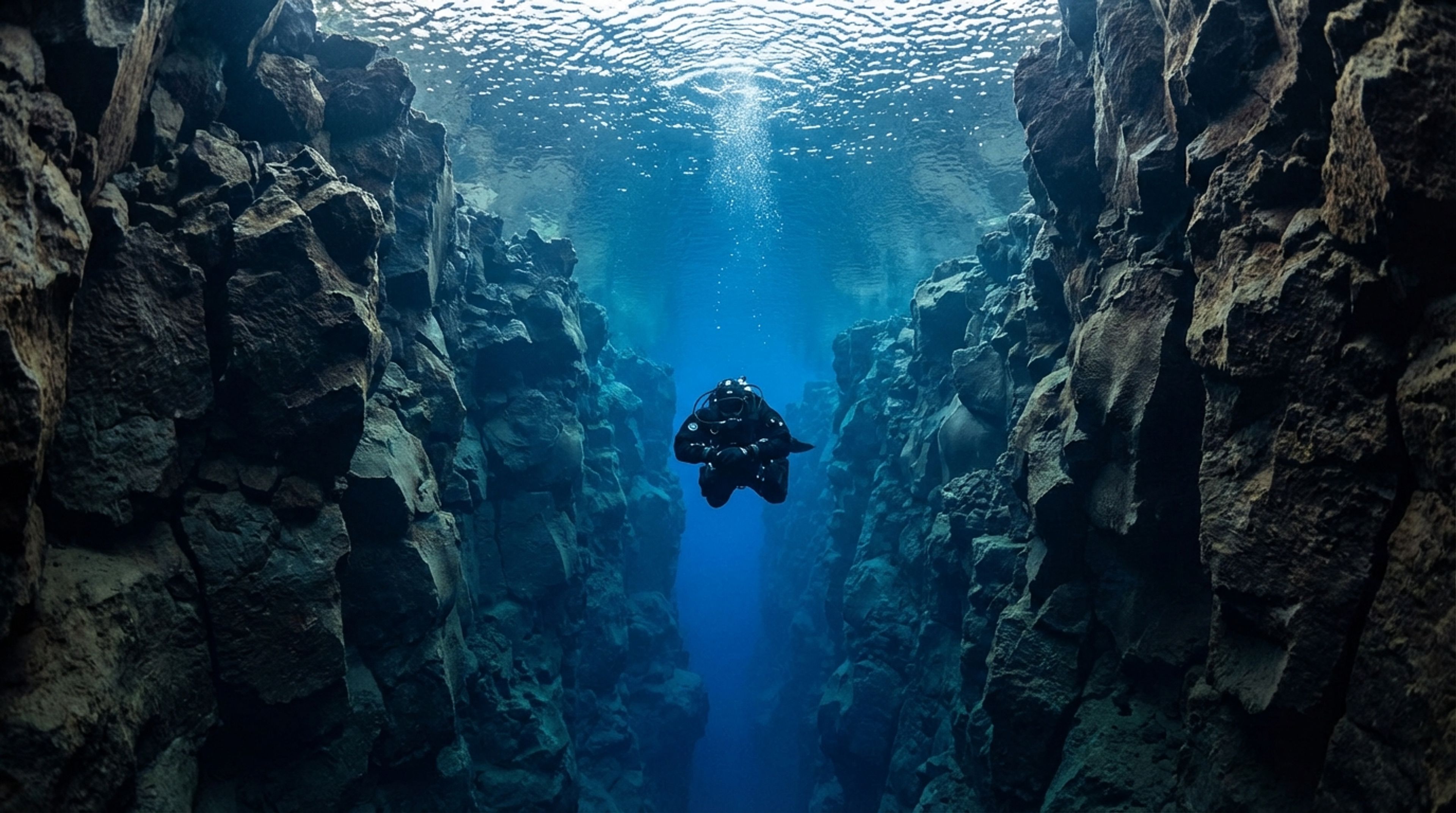
The first thing you feel isn't the cold. It is the shock.
You hit the water and for a split second your face burns. That is the exposed skin reacting to water that is two degrees Celsius. It feels like a slap. Then the numbness sets in. Your lips turn into rubber. Your regulator feels like a piece of foreign metal in a jaw you can no longer control.
This is good. This wakes you up.
People ask me why I dive in Norway or Iceland. They ask about the Maldives. They ask about the Great Barrier Reef. I tell them I don't like swimming pools. Tropical diving is soft. It is easy. You put on a rash guard and fall in. You look at colorful fish that have no survival instinct. You come up warm.
In the North, the ocean commands respect. If you make a mistake here, the thermodynamics will end you before you run out of air. But the reward is something you cannot find in the tropics. It is a visibility that breaks your brain and creatures that look like they survived the dinosaur age.
The Physics of Clarity
Cold water is heavy. It is dense. In places like Silfra, Iceland, or the fjords of Northern Norway, the water does not hold suspension like the warm soup of the equator. Algae struggles to bloom in the dark winter. Silt settles.
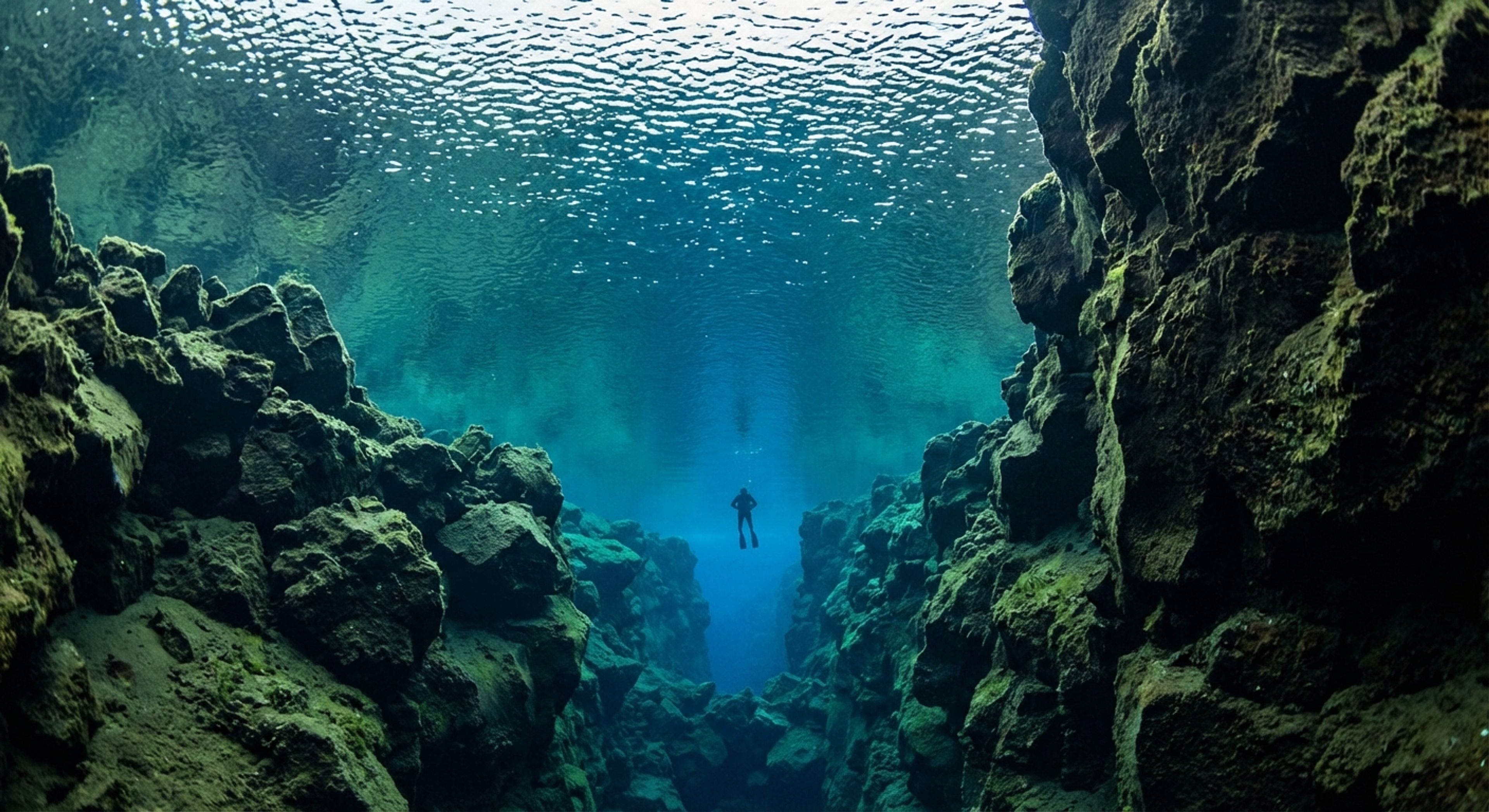
I remember my first dive at Silfra. It is a crack between the North American and Eurasian tectonic plates. The water there is glacial meltwater. It has been filtered through porous underground lava rock for thirty to a hundred years before it seeps into the lake.
The visibility is not just "good". It is infinite. You can see over 100 meters. When you descend, you do not feel like you are underwater. You feel like you are falling through air. The only thing reminding you of the medium is the drag on your gear and the bubbles rising up.
It is vertigo-inducing. You look down into the abyss of the crack and your brain screams that you are going to hit the bottom. But you float.
This clarity comes at a price. The water is 2°C to 4°C year-round. It is a sterile environment. There are no fish in the fissure itself. Just rock and green "troll hair" algae. It is a dead, beautiful void. It forces you to look inward. You hear nothing but your own breathing and the creaking of the tectonic plates if you are lucky enough to be there during a shift.
The Iron Forest, The Seals, and The Killers
Move away from the fresh water of Iceland to the salt of Norway's coast and things get dirty. They get alive.
The visibility in the Norwegian Sea during winter is still exceptional, often 30 to 40 meters. But here, the water is full of monsters.
We have the kelp forests. Laminaria hyperborea. These aren't the soft, flowing weeds you see in California. These are thick, leathery stalks that grow two meters high. In the current, they sway like a crowd of drunk metalheads.
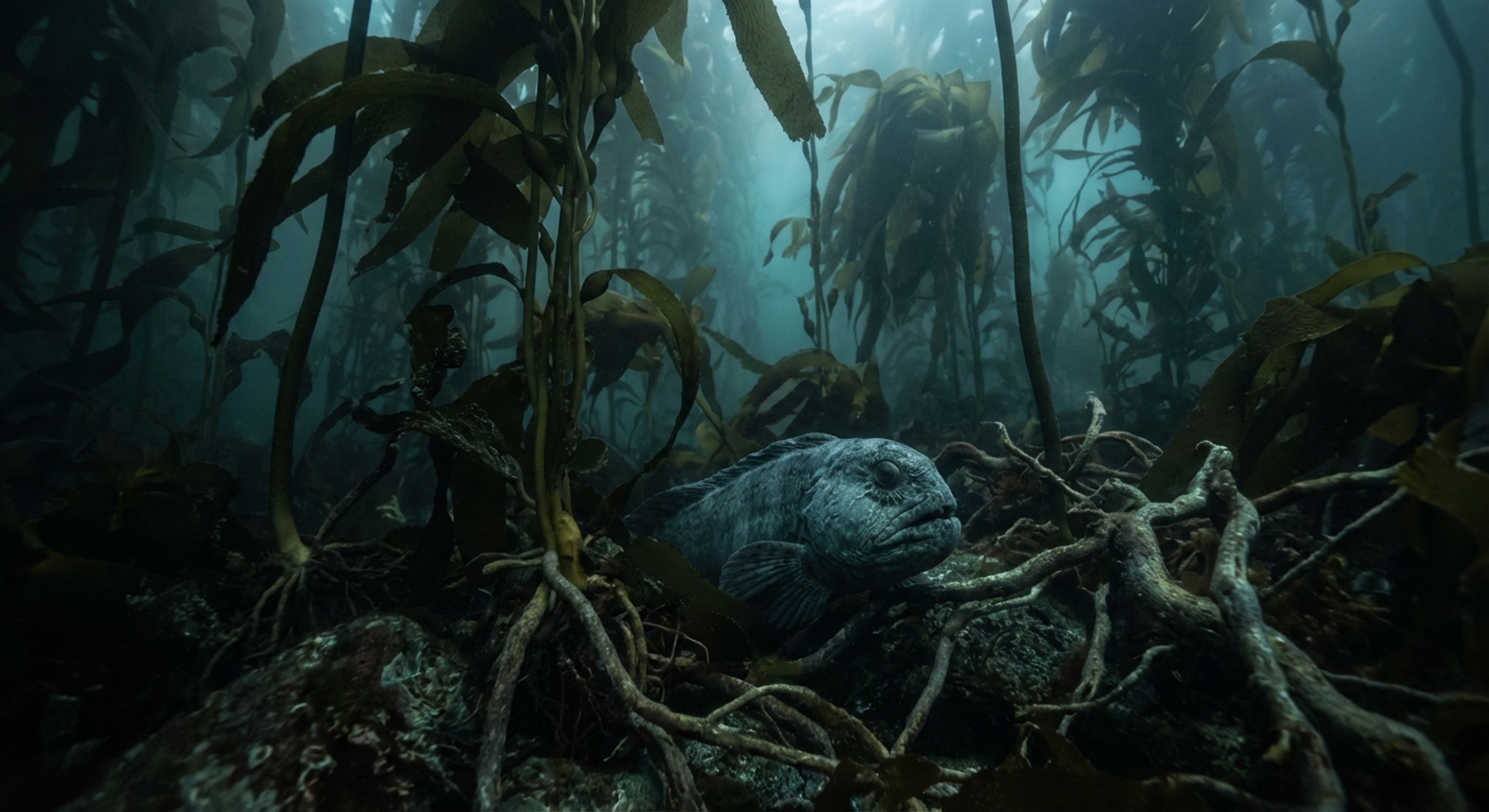
Navigating a kelp forest requires perfect buoyancy. If you crash into the bottom, you don't just kick up sand. You get tangled. The stalks are strong enough to rip a regulator out of your mouth if you panic.
Inside this forest, life is hard. We see the Wolffish (Anarhichas lupus). Ugly things. Grey, wrinkled skin and teeth made for crushing crabs and sea urchins. They don't swim away when you approach. They turn and look at you. They know they can bite through your drysuit boots. I respect that.
Then, there are the nuisances. The Harbor Seals.
While I inspect pipelines or check moorings, they often appear. People call them "sea puppies." I call them a hazard. They are fast, intelligent, and possess zero concept of personal space. A seal will chew on your fin tips. They will tug on your exhaust valve. In 3°C water, having a seal puncture your drysuit seal is not a joke; it’s a hypothermia sentence. I keep my eyes on them. They are cute until they disable your equipment.
And then, there are the Orcas.
Up in Skjervøy or Lofoten, the herring run in winter brings the killer whales. Tourists pay thousands of dollars to snorkel with them on the surface. Scuba diving with them is rare, bubbles tend to scare the herring, but it happens on quiet days.
I was on a dive near Tromsø three years ago. We were at 15 meters. The water went dark. A shadow blocked the sun. A male orca, dorsal fin collapsing slightly, cruised past us. He was massive. He looked at me with an eye that was disturbingly intelligent. He wasn't afraid. He was assessing if I was a seal. The white patch on my drysuit hood probably didn't help. I froze. He moved on.
That is the rush. You are not the top of the food chain here. You are a slow, clumsy guest.
Thermodynamics and Hardware
You cannot dive these waters with rental gear. Standard resort regulators will kill you.
Here is the physics: When high-pressure gas moves from your tank to your regulator first stage, it expands. Expansion causes cooling. This is the Joule-Thomson effect. If the water is already near freezing, this internal cooling drop can freeze the moisture in the air or the surrounding water.
Ice forms inside the piston or diaphragm. The valve gets stuck open. You get a free-flow.
A free-flow at 30 meters in 4°C water is an emergency. Your tank empties in less than two minutes. The bubbles are deafening. You cannot breathe easily because the air is forcing its way down your throat.
The Cold Water Rig
I only trust specific engineering for this.
| Component | Tropical "Pool" Gear | Arctic Tech Rig | Why? |
|---|---|---|---|
| First Stage | Piston (Unsealed) | Diaphragm (Environmentally Sealed) | Unsealed pistons flood with water. If that water freezes, the regulator fails. Sealed diaphragms keep the freezing water out of the mechanism. |
| Exposure | 3mm Wetsuit | Trilaminate Drysuit + 400g Thinsulate | Neoprene compresses at depth, losing insulation. Trilaminate does not. The argon or air layer keeps you warm. |
| Gloves | None / 2mm Wet | Dry Glove System | Wet hands become useless claws in 10 minutes. Dry gloves allow dexterity for bolt snaps and valves. |
| Tanks | Single AL80 | Twin Steel 12L or H-Valve | Redundancy. If one regulator freezes, you perform a valve shutdown drill and switch to the backup. |
I use Apeks MTX-R regulators. They are built based on military specs for freezing water. They breathe hard, but they don't freeze.
For the suit, I wear a Santi E.Motion Plus. It is durable. Underneath, I wear a heated vest. Some call it cheating. I call it extended bottom time. When your core temperature drops, your body pulls blood from your extremities to protect your organs. Your hands go numb first. Then your thinking slows down.
You become stupid when you are cold. You forget to check your gas. You forget your decompression stops. The heated vest buys me mental clarity.
The Pain of the Claw
Let me talk about the hands. This is the weak point.
Even with dry gloves, the cold creeps in. The air inside the glove compresses as you descend. You have to equalize your gloves by pushing air from your suit past your wrist seals. If you forget, you get "suit squeeze" on your hands. The latex clamps down. Blood flow stops.
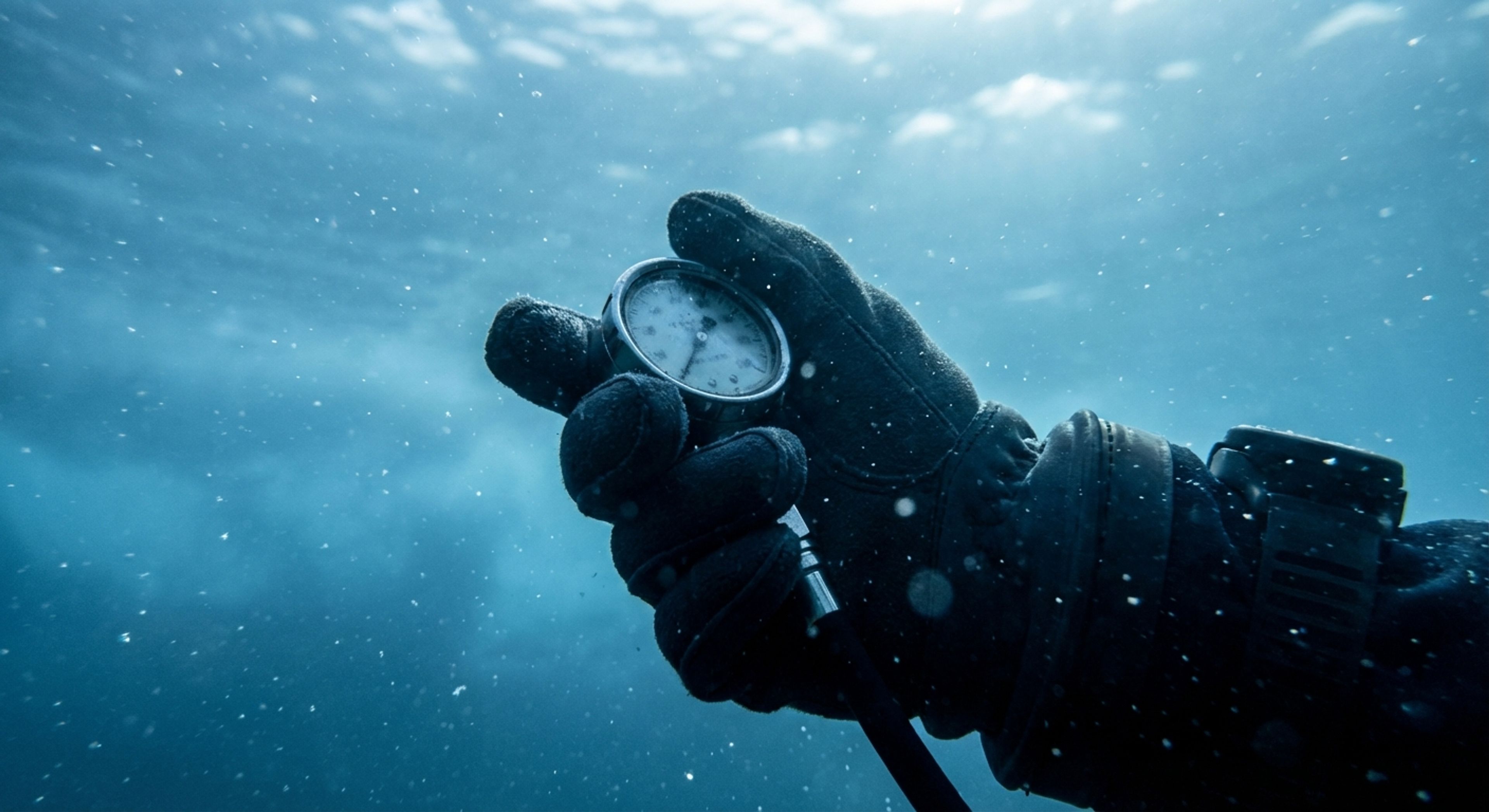
I had a dive where my dry glove seal failed. Water flooded the left hand. It was 3°C water. Within five minutes, my hand was a useless block of meat. I couldn't operate my inflator hose. I had to end the dive.
Surfacing with a flooded glove is agony. As the blood returns to the frozen fingers, it feels like someone is hitting your hand with a hammer. We call it the "screaming barfies" in the industry. The pain is so intense it makes you nauseous.
But you dry off. You drink black coffee. You check the seal. You go back in.
Why We Do It
Why suffer the freezing gear, the heavy lead weights, the pain, and the darkness?
Because of the silence.
In the tropics, there is always noise. Snapping shrimp. Boat engines. Other divers banging tanks.
In the Norwegian winter, deep down, it is silent. The snow on the surface muffles the sound. The density of the water seems to absorb noise. You are alone with the physics of the dive.
There is a specific feeling when you surface after a 45-minute runtime in freezing water. You break the surface. It might be snowing. The air is crisp and sharp. You drag your heavy body onto the boat. You unzip the drysuit. Steam rises from your undergarments.
You feel invincible. You survived an environment that wanted to turn you into an ice cube. You saw the kelp forests standing guard in the gloom. You saw the clarity of the tectonic crack.
It is raw. It is industrial. It is real diving.
Keep your warm water. I'll take the ice.