

Diving Palau: Blue Corner Sharks and Jellyfish Lake
Hook into the ripping currents of Blue Corner and drift through millions of golden jellyfish. To dive in Palau is to submit to the ancient laws of the ocean.
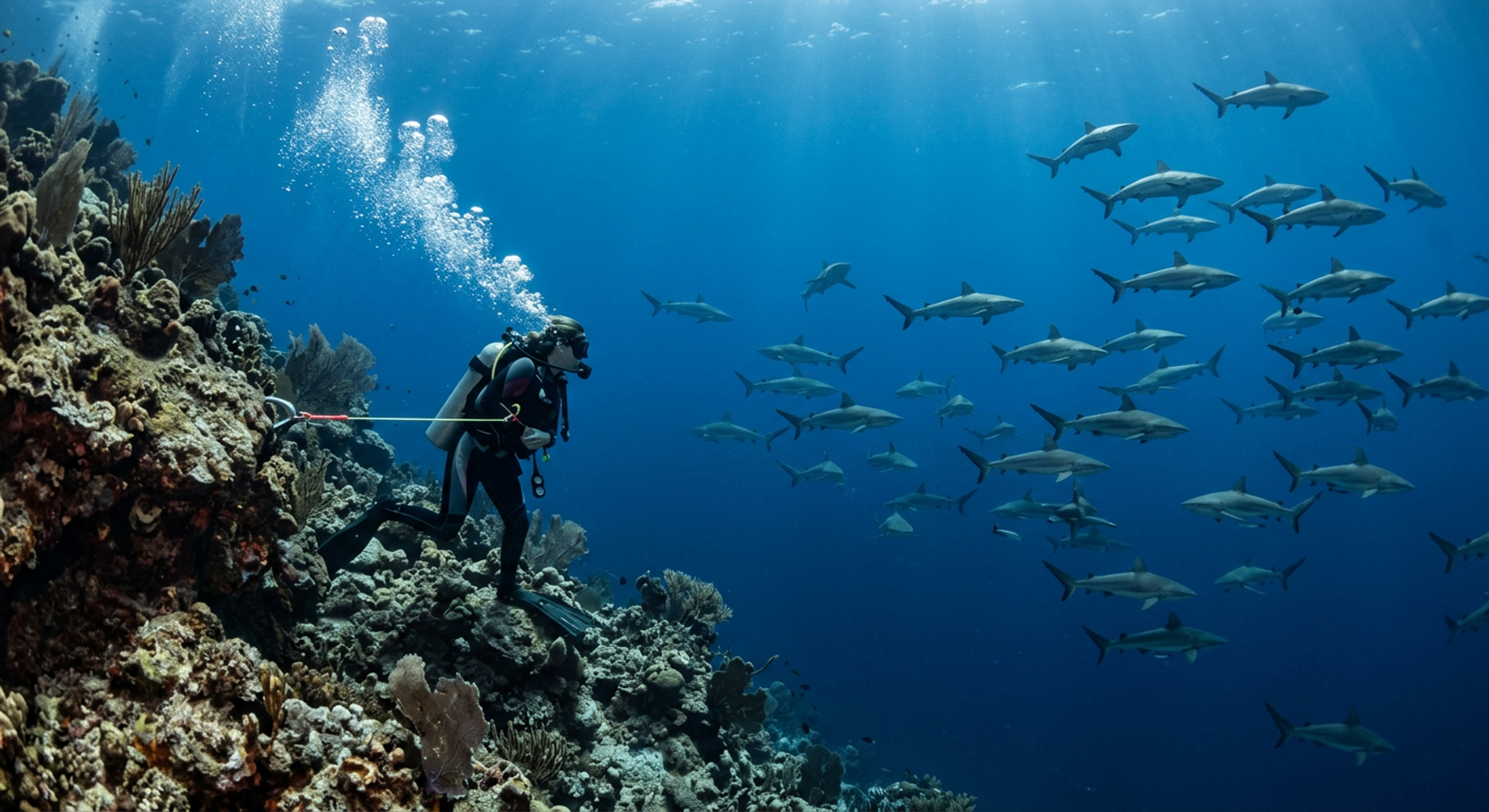
The current hits you like a freight train the second you drop over the plateau at eighteen meters. You do not fight it. You cannot fight it. You kick down hard, grab a dead piece of limestone rock, and deploy your reef hook. The nylon lanyard snaps taut. The taste of metallic compressed air fills your dry mouth. You taste salt leaking through your mask skirt. You put a tiny burst of air into your BCD to establish positive buoyancy. Suddenly you are flying underwater. You are a kite anchored in a hurricane of seawater.
Welcome to Blue Corner.
Foreign magazines like to call our home God's Aquarium. They print glossy photos of the pristine visibility and the massive schools of pelagic fish. But standing on the deck of my patrol boat in the Philippine Sea, I smell the heavy salt, the drying neoprene of my wetsuit, and the raw diesel exhaust. I know the reality of this ocean. It is not an aquarium. An aquarium is a glass box where humans are in control. Out here on the edge of the Ngemelis wall, the ocean is in absolute control. You are just a guest in our ancestral garden.
The Mechanics of the Hook Dive
Blue Corner is a jutting peninsula of reef that sticks out into the open ocean. Deep upwellings crash into this vertical wall. The water is forced upward and across the plateau. It brings cold, nutrient-rich water from the abyss right into the sunlight. Small fish come to eat the plankton. Big fish come to eat the small fish.
Then the sharks arrive.
Hundreds of Carcharhinus amblyrhynchos. Grey reef sharks. They do not struggle in the ripping current. They surf it. They glide with a terrifying, effortless grace just feet away from your mask. You will see whitetip reef sharks resting on the sandy patches, but the grey reef sharks own the water column. You must check your air gauge constantly here. Breathing hard in a heavy current drains your tank faster than you think. You must watch your no-decompression limits because the adrenaline will make you forget.
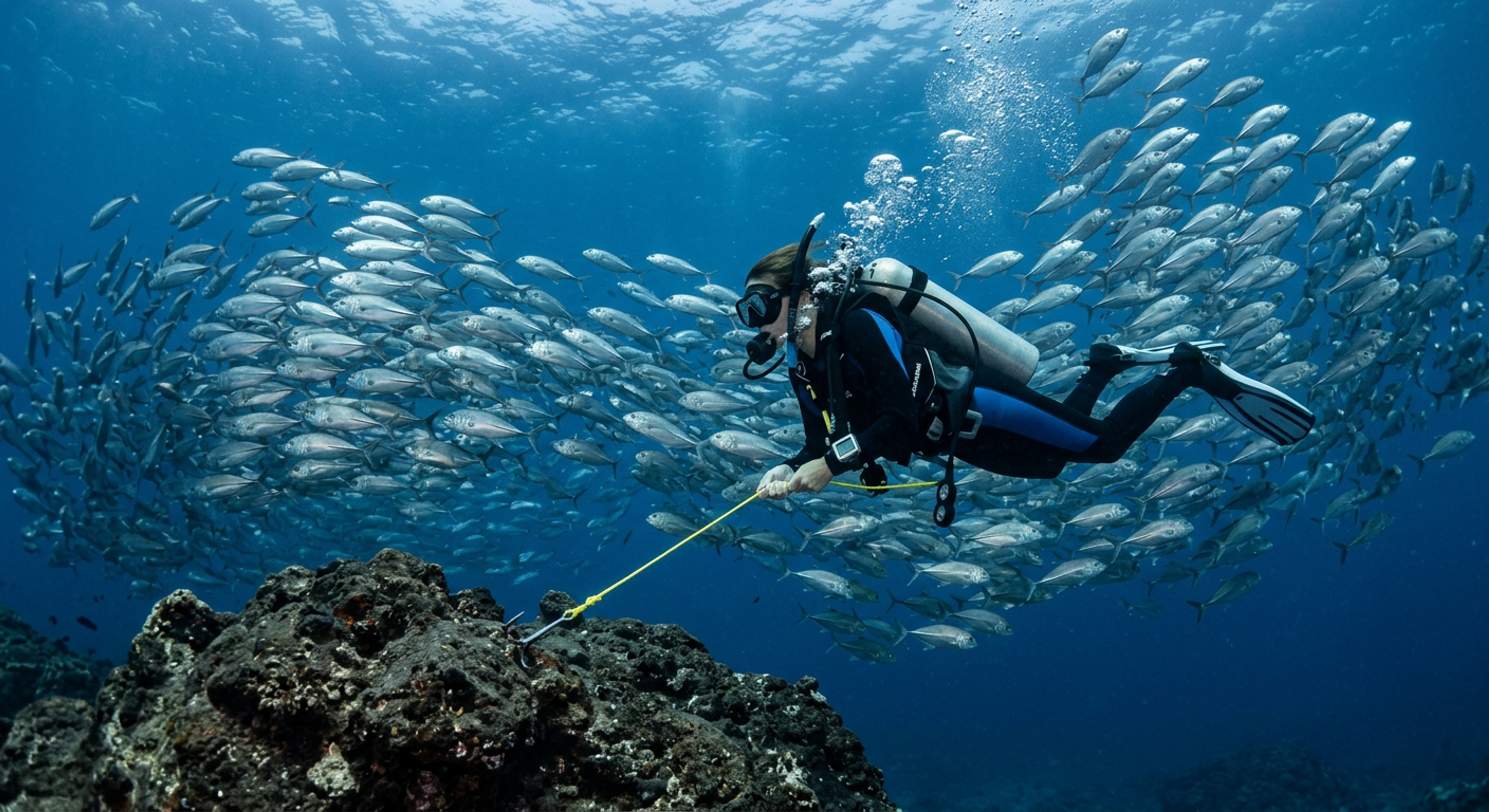
We invented the reef hook right here in Palau. We had to. Years ago, divers would try to hold onto the reef with their bare hands to watch the sharks. They wore gloves. They crushed the delicate polyps. They broke off branching corals that took decades to grow. It made me furious to see tourists tearing up our home just to get a photograph.
So the reef hook was born. It is a simple barbless metal hook on a piece of webbing. You find a patch of dead rock. You hook in securely. You float above the living reef without touching a single living organism. If I catch you kicking the coral or grabbing it with your hands on my patrol, I will personally pull you out of the water and cut your dive trip short. We do not tolerate disrespect on the reef.
I remember being fifteen years old holding a wooden spear gun in the cold thermocline. My father brought me to the very edge of the Ngemelis wall on a slack tide. We were hunting snapper for a village feast. A massive grey reef shark came far too close to my fins. My heart hammered in my chest. I raised my spear. My father pushed my arm down immediately. He looked me in the eyes underwater and shook his head.
"They own the water," he told me later on the boat. "We only borrow what they leave behind."
The Golden Ghost Town of Jellyfish Lake
If Blue Corner is the chaotic hunting ground of the ocean, Ongeim'l Tketau is its silent sanctuary. You probably know it as Jellyfish Lake.
Getting there requires sweat. You leave the boat at the dock in the Rock Islands. You hike up a steep limestone trail through the dense jungle. The air is thick. You smell damp earth, rotting leaves, and the heavy humidity of the tropics. You will sweat straight through your rash guard.
Then you clear the crest of the hill and see the lake. It is a deep, emerald green basin entirely surrounded by jungle.
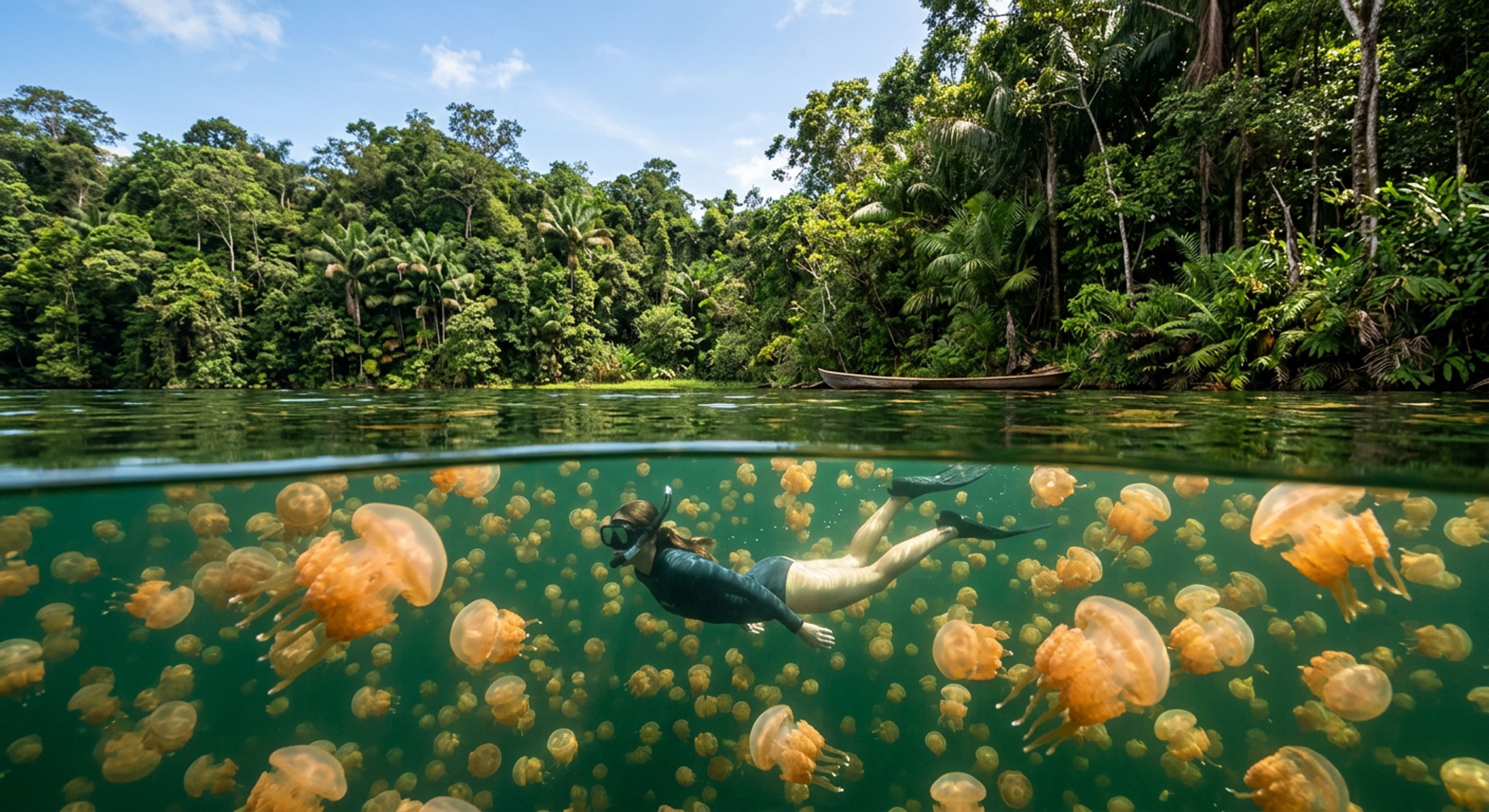
When you slide into the water, the silence is absolute. You swim out toward the center, following the sunlight. That is where they wait. Millions of golden jellyfish. Their scientific name is Mastigias papua etpisoni.
These creatures are isolated in this marine lake. Over thousands of years, they lost their potent stinging nematocysts because they had no predators to fight off. They do not hunt. They farm. They have a symbiotic relationship with algae living inside their tissues. Every day, they migrate across the lake, following the sun so their algae can photosynthesize. At night, they sink down to the chemocline to absorb nutrients.
You cannot scuba dive here. It is strictly forbidden. At about fifteen meters deep, there is a layer of pink bacteria. Below that sits a massive concentration of dissolved hydrogen sulfide. It is lethally toxic. Scuba diving is banned because your exhaust bubbles would disrupt the stratified layers of the lake and mix that deadly gas upward into the fresh water. If you ever swam into it, the hydrogen sulfide would absorb directly through your skin into your bloodstream and kill you. You only snorkel. You stay on the surface.
You must move carefully. No thrashing. You use slow, gentle frog kicks. These animals are fragile like wet tissue paper.
In 2016, a severe El Niño drought hit Palau. The lake temperature spiked. The golden jellyfish almost completely vanished. It broke my heart to patrol a dead lake. Some tourists complained about not getting their perfect vacation photos. I told them to be quiet and pray for rain. Nature does not owe you a photo opportunity.
Slowly, the rains returned. The polyps resting on the lake bottom survived. The jellyfish came back by the millions. But it proved how fragile this ecosystem is. This is why we are so strict about sunscreen. Chemical sunscreens poison the water. If you do not wash off your toxic lotions before entering the lake, you are killing the very magic you came to see.
Bul and the Palauan Pledge
People complain about our prices. Every visitor to Palau must pay a one hundred dollar Pristine Paradise Environmental Fee. They say it makes Palau an exclusive, expensive destination.
Good.
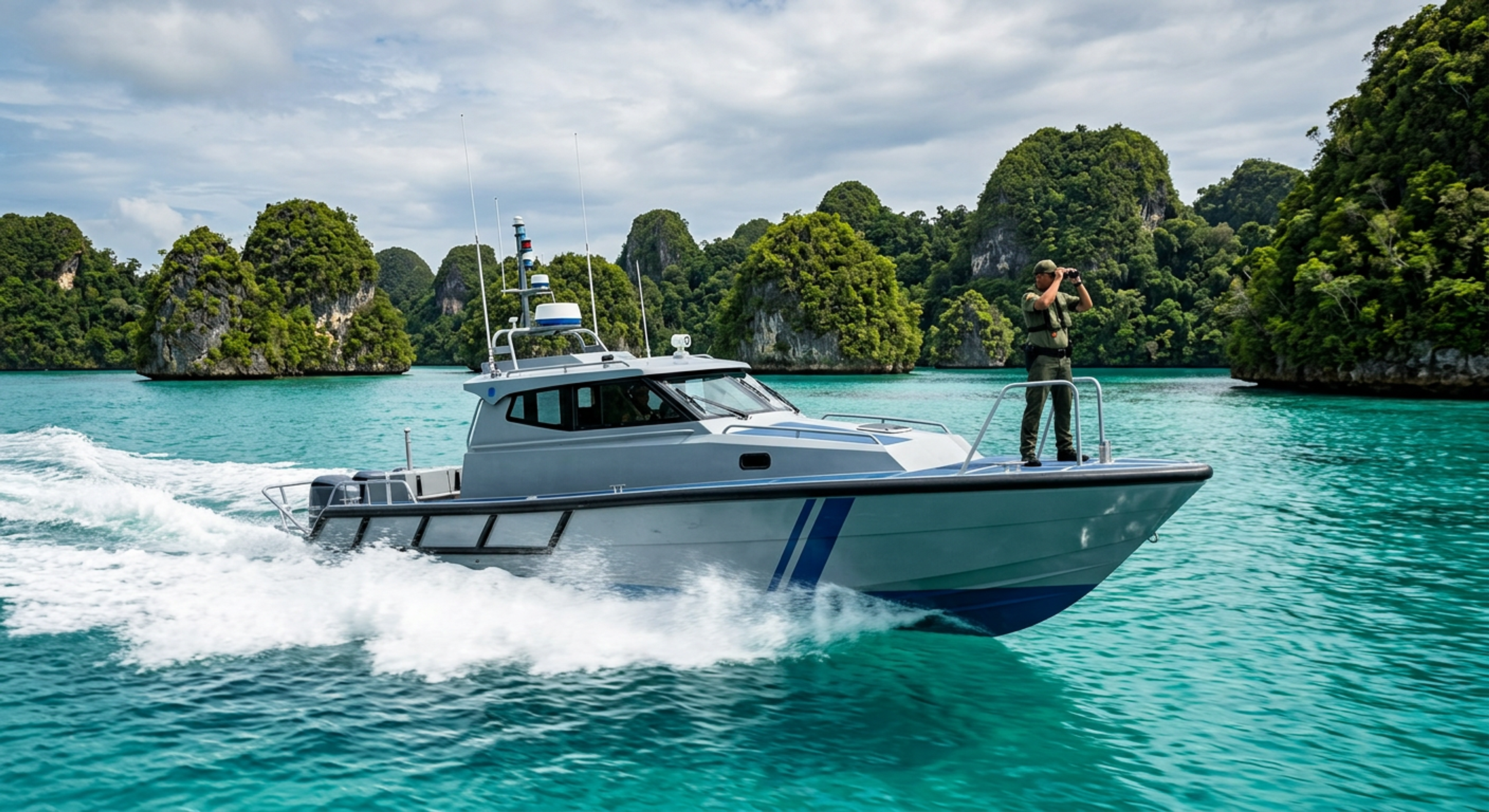
If you cannot afford to contribute to the protection of the ocean, you have no business visiting it. That money funds our marine sanctuaries. It pays for the fuel in my patrol boat. It buys radar systems to catch illegal fishing fleets sneaking into our waters at night.
When you arrive at the airport in Koror, an immigration officer stamps a pledge into your passport. You have to sign it. The Palauan Pledge is a promise written to the children of Palau. You promise to tread lightly, act kindly, and explore mindfully. You promise not to take what is not given. It is not a marketing gimmick. It is a legal contract with our future.
This strict protection is not new to us. It is deeply rooted in our culture. We call it Bul.
Long before foreign scientists came here with clipboards and terms like Marine Protected Areas, our traditional chiefs practiced Bul. When the village elders noticed that the fish stocks were dropping on a particular reef, the highest ranking chief would declare a Bul.
It was an absolute taboo. All fishing in that area was banned. No exceptions. No excuses. If you violated the Bul, the punishment was severe. You would lose your boat, your catch, and your standing in the community. The reef was left alone in total silence for months or even years. The fish spawned. The coral recovered. The balance returned.
Today, the Palau National Marine Sanctuary is just a modern version of the ancient Bul. We closed off eighty percent of our exclusive economic zone to commercial fishing. Half a million square kilometers of ocean where the sharks, the tuna, and the turtles are safe from industrial hooks and nets.
I used to hunt these waters with a spear. I know where the groupers hide. I know the exact ledges where the lobsters retreat during the full moon. Now I hunt the poachers who try to steal from our sanctuary.
Diver Expectations vs Palauan Law
We expect a lot from our visitors. I have compiled a strict list of rules that separate the respectful divers from the careless tourists. Review it before you pack your gear.
| The Diver's Action | Tourist Assumption | The Palauan Law (Ranger Enforcement) |
|---|---|---|
| Using Sunscreen | "I need SPF 50 so I don't burn on the boat ride." | Only reef-safe sunscreens are permitted. All others are confiscated. Better yet, wear a long-sleeve rash guard. |
| Deploying Reef Hook | "I can hook anywhere to get a good photo of the sharks." | You hook ONLY on barren, dead rock. Hooking live coral results in immediate termination of your dive. |
| Gloves | "I wear gloves to keep my hands warm and safe." | Gloves are banned for all sport divers. If you cannot control your buoyancy without grabbing the reef, stay out of the water. |
| Souvenirs | "It's just one dead shell from the beach." | Nothing leaves the island. Not a shell, not a piece of sand, not a dead coral skeleton. Leave it for the hermit crabs. |
| Jellyfish Lake Kicking | "I need to kick hard to swim to the other side." | Slow, gentle frog kicks only. Thrashing destroys the delicate bells of the jellyfish. |
You might think I sound harsh. I am. The ocean is harsh. It does not forgive mistakes and it does not survive abuse.
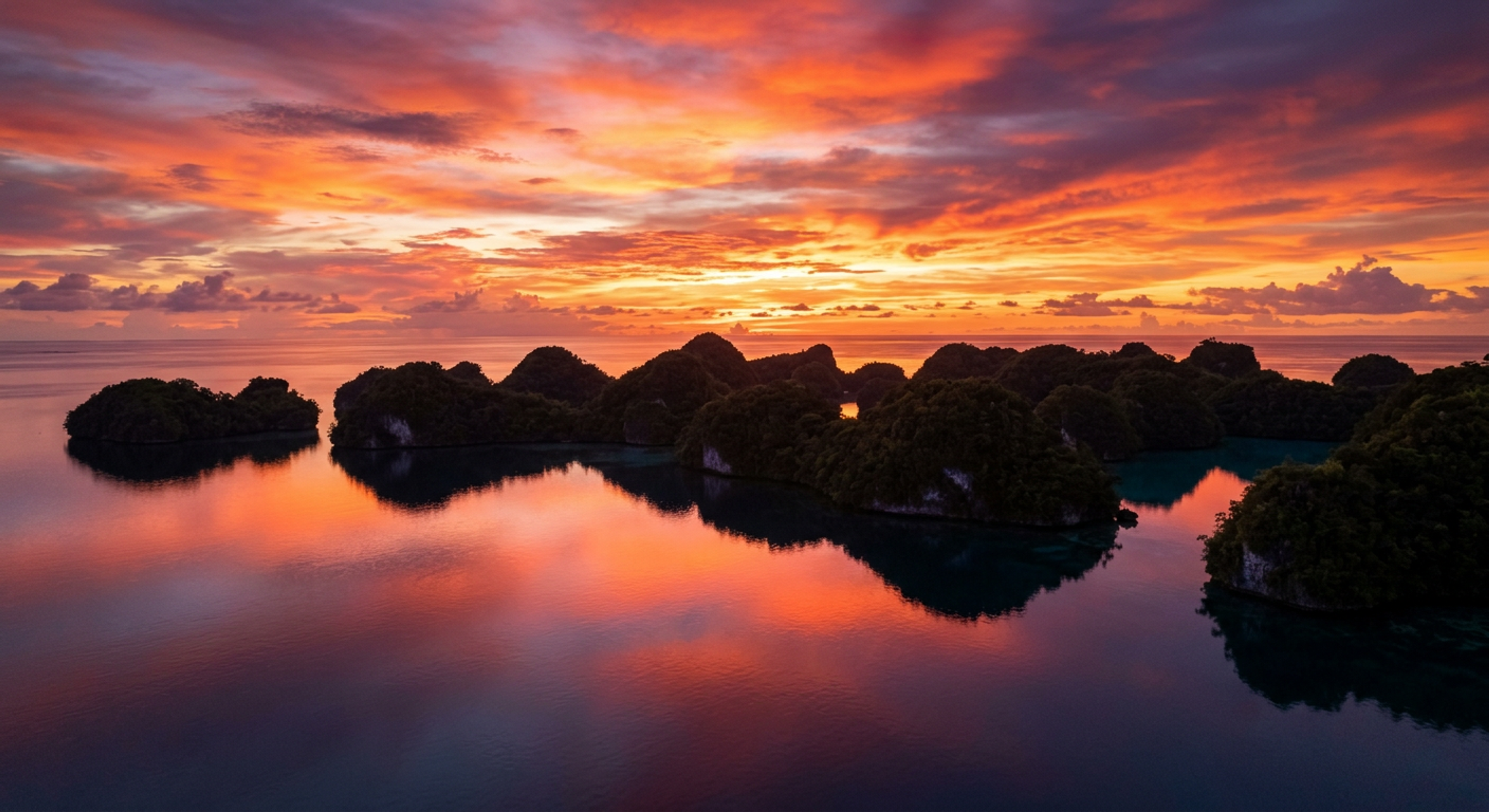
When you drop into Blue Corner and feel the immense power of the Pacific Ocean trying to tear you off the reef, you finally understand your place in the world. You are small. You are fragile. The sharks watching you from the deep blue are perfectly adapted to this violent, beautiful environment.
Come to Palau. Bring your mask. Bring your reef hook. Sign the pledge in your passport. Let the current carry you over the most vibrant reefs on earth. But remember the law of Bul. Remember whose garden you are swimming in. Leave no trace, touch absolutely nothing, and respect the old ways.
The reef will outlive us all if we just give it the respect it demands.