

Don't Be Stupid: Why You Must Do BWRAF Every Single Time
You think you are expert? You think you don't need to check gear? Hay naku. Listen to Tatay. The ocean does not care about your ego or your fancy computer. Read why BWRAF saves lives before you splash.
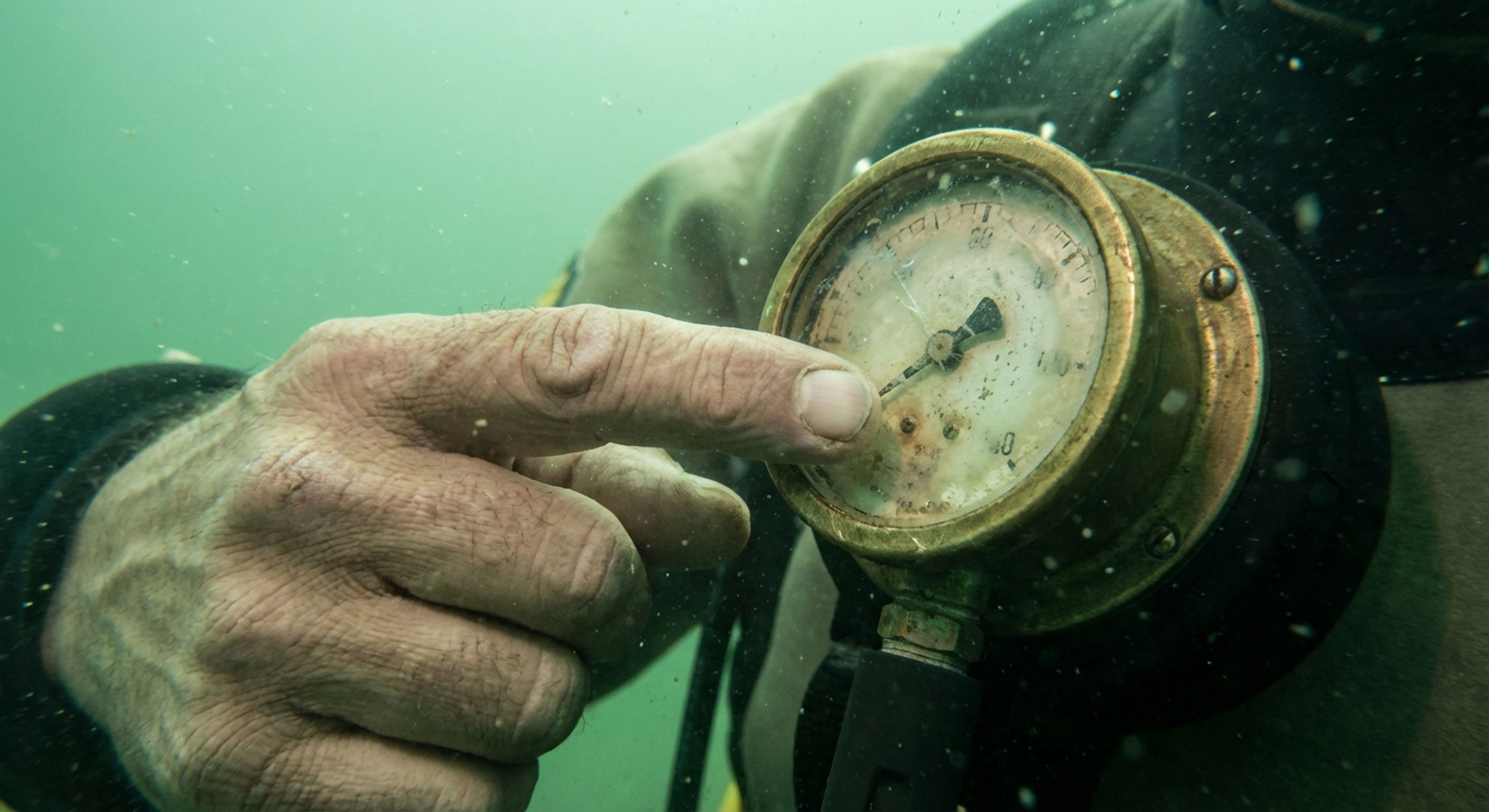
Hay naku. Divers these days. I watch them on the banca. They have the newest gear. Shiny regulators that look like spaceships. Computers that talk to satellites and make coffee. Fins that look like broken scissors. You know the ones. Split fins. Useless in a real Batangas current.
They spend one hour taking pictures of themselves with the GoPro on the boat. "Look at me! I am a diver! #OceanLife!" But when the boat captain shouts "Site is here! Get ready!", what happens? Chaos. Total chaos.
They rush. They put the wetsuit on inside out. They put the mask on the forehead (bad luck! That is the sign for "I am in distress", you dummy). They stand up, wobble around, and jump.
Splash.
Then two minutes later, I see them bobbing on the surface like confused coconuts. "Tatay Santiago! I forgot my weights!" or "My tank is slipping!" or "My air is not working!"
Susmaryosep. It makes my head hurt. It makes my blood pressure go up.
You think because you have 50 dives you are an expert? You think because you have a plastic card that says "Rescue Diver" you don't need to check? The ocean does not care about your certification card. The ocean is heavy. It is strong. It is 800 times denser than air. If you are stupid, the ocean will keep you.
We need to talk about the Buddy Check. The BWRAF. PADI teaches you "Begin With Review And Friend" or "Bruce Willis Ruins All Films". I don't care what silly words you use to remember. Just do the work. It is not optional. It is life support.
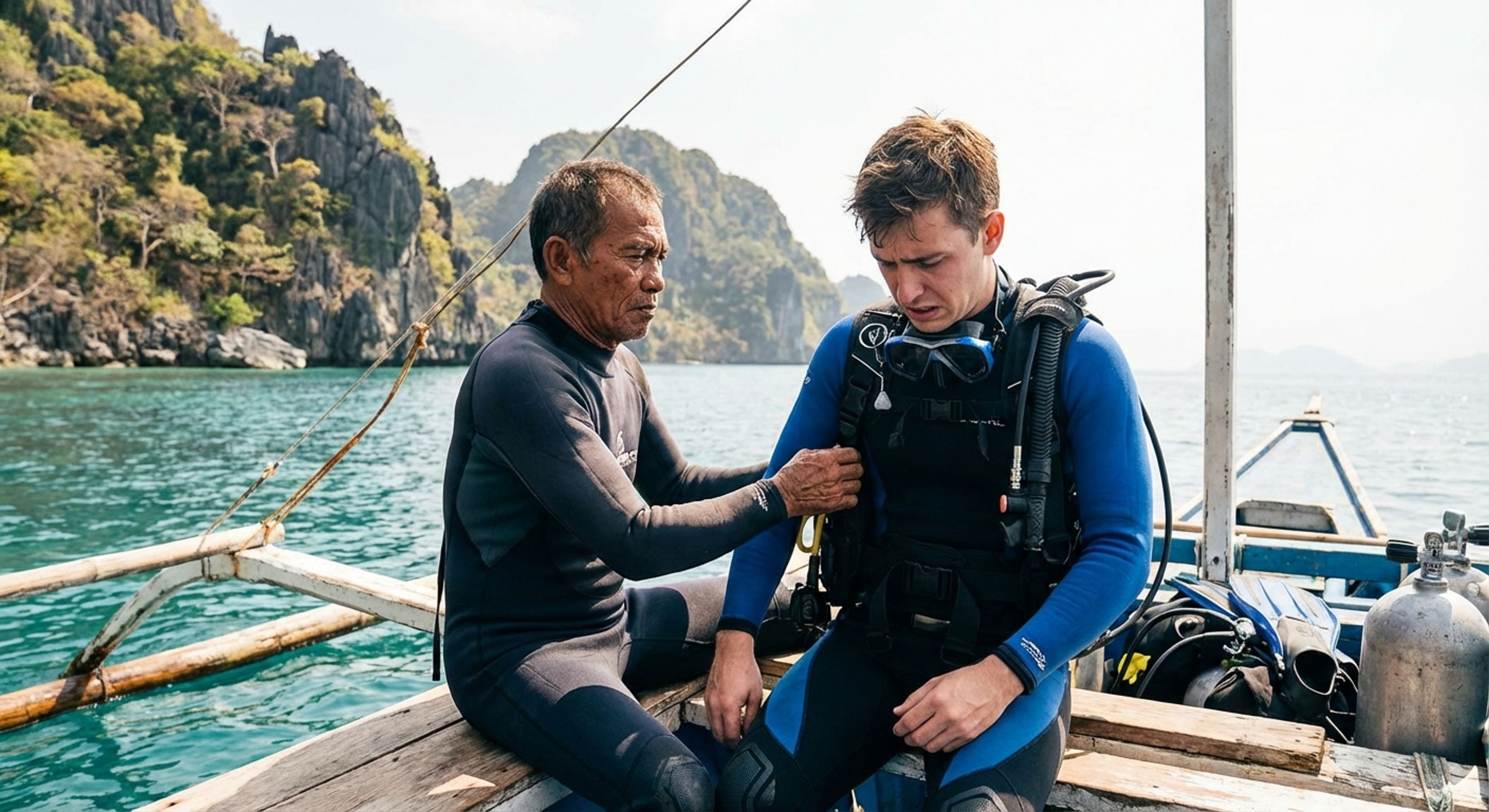
The Story of "Fast Eddie"
You listen to me now. This is not a joke. I want to tell you a story about why I am so grumpy about this.
Back in 1989, I was guiding in Anilao. We had a group from the city. Rich guys, bankers maybe. They had gear I never saw before, shiny and yellow. One guy, let's call him Eddie. He was loud. He smoked big cigars. "Santiago, let's go deep! I want to see sharks! I want to go to 40 meters!"
Eddie was always the first one in the water. He didn't like to wait. He said buddy checks were for students. "I checked my gear in the hotel, Tatay," he told me. "Don't worry."
Sus. I should have stopped him. I should have grabbed his tank valve. But I was young. I was not Tatay yet. I let him go.
We dropped in at Mainit Point. The current there? It is not a swimming pool. It is a washing machine. We went down fast, negative entry, to get out of the surface chop. At 20 meters, I look at Eddie. Something is wrong.
He is thrashing. He is kicking the coral (terrible trim). He is trying to breathe, but he is looking at his gauge and hitting it with his hand. Like he is trying to fix a broken television.
I swim to him. I grab his vest. I look at his eyes. They are big. Like dinner plates. White all around the pupils. Panic. Pure panic.
I give him my octopus. My secondary regulator. He takes it and breathes like a vacuum cleaner. Huuuuh-Paaah. Huuuuh-Paaah. We go up slow. No safety stop, no time. He was too scared. We surface.
On the boat, I check his tank. The pressure gauge says 200 bar. Full tank. But he had no air. Why?
I touch the valve knob. It was barely open. Just a crack. Maybe one quarter of a turn.
You see, physics does not lie. When you check the pressure on the boat, the gauge says 3000 PSI (200 bar). It looks full. But if the valve is only open a tiny bit, the air cannot flow fast enough when you are deep. On the surface? It works fine. At 20 meters? The pressure squeezes everything. You take a big breath, the needle drops to zero because the air cannot get through the small crack fast enough. You get no air. You think your tank is empty.
Eddie almost died because he was too lazy to turn a knob and watch a needle.
If his buddy had checked him? If they did the A in BWRAF? They would see the needle move when he breathed. They would know.
Never happen again on my boat. Now, if you don't check, you don't dive. You can sit on the boat and get a tan.
B - BCD (Buoyancy Control Device)
This is the first step. B. It stands for BCD. But to me, it stands for "Be Careful, Dummy".
You check the inflation button. Does air go in? Psst psst. Good. You check the deflation button. Does air go out? Good.
But that is not enough. You must check the oral inflator too. What if your low-pressure hose explodes? It happens. I have seen hoses rot from the inside. If the hose fails, you need to blow into the vest with your mouth to float. Test it. Blow in it. Make sure the valve doesn't stick.
But the most important part of B? The straps.
I see so many divers with loose tank bands. Especially with rental gear. The nylon gets wet, it stretches. They jump in the water, the tank slides out. Clunk. Now the tank is hanging by the hoses, banging on the back of their knees. Very dangerous. If the tank drops too low, the first stage hits your head. Or it breaks the valve on a rock.
The Lift Test: Stand behind your buddy. Hold the tank handle. Lift the whole kit up. Shake it. If the BCD moves but the tank stays still? Good. If the tank slides inside the strap? Fix it. Wet the strap and tighten it again. Do not be lazy.
Also, check the dump valves. The pull strings on the shoulder and the butt. Sometimes salt crystals stick them shut if you didn't wash your gear last time (I know you didn't). Pull them gently. Make sure they seal back up.
W - Weights
This is where the new gear makes me angry.
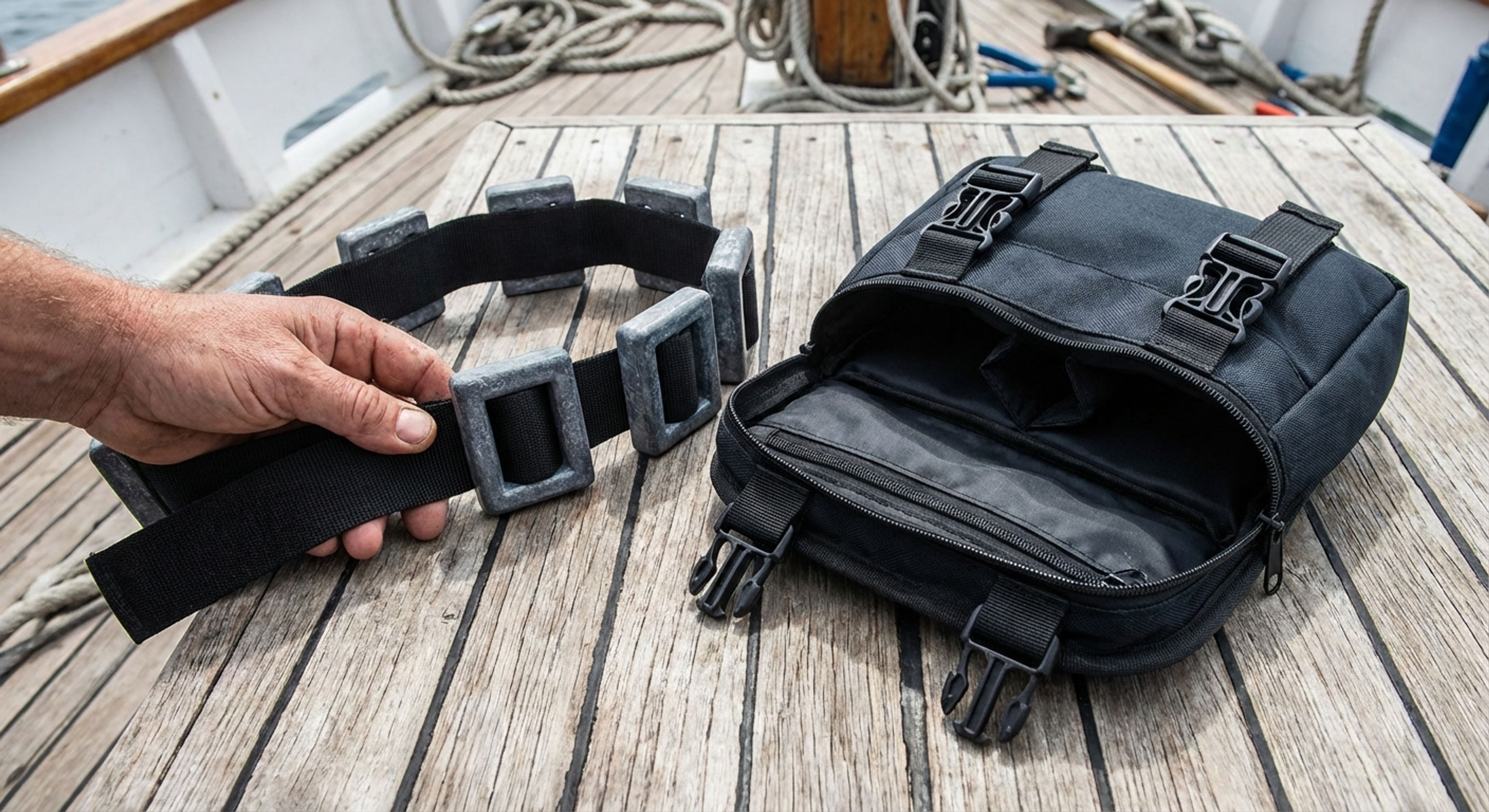
In the old days, we had a belt. A piece of stiff nylon webbing and blocks of lead. Simple. Reliable. If you need to drop it, you pull the buckle with the right hand, you throw it away. Gone. You float.
Now? Everyone has "integrated weights". Pockets with clips and zippers and Velcro and buttons. Hay naku. Too complicated.
I see divers lose these pockets all the time. They jump in, the pocket falls out because it did not "click". It sinks to 50 meters. Now they cannot go down. Dive over. Everyone on the boat is angry at you.
Or worse. They panic underwater. They try to drop weights. But the clip is stuck. Or they don't know how to pull it because every brand is different.
For W, you must show your buddy how your weights work. "Look buddy, you pull this handle. Then you drop it."
The Click Test: Check that the pockets are clicked in. Don't just look. Pull on them. Hard. If they come out on the boat, they will come out in the water. Listen for the click.
And if you wear a belt? Right hand release. Always. The buckle must open with your right hand. If you put it on backwards, and I try to rescue you in a panic, I will pull the wrong way. The belt stays on. We both die. Right hand release. No discussion.
R - Releases and Ribbons (Clips)
This is about the BCD clips. The shoulder straps. The belly strap (cummerbund). The chest strap.
Check that they are tight. Not too tight, you need to breathe. But snug. If your BCD is loose, the tank rolls around on your back like a monkey. It ruins your buoyancy.
Why is this important for safety? Because if you have a problem, I need to get you out of that jacket. If you are unconscious on the surface, I need to strip that gear off you to do CPR on the boat.
If your clips are hidden under hoses, or under your camera gear, or under a bunch of fancy dangly things you bought at the dive show... I cannot help you.
Keep it clean. "Streamlined" is the word. Don't look like a Christmas tree. Tuck in your gauge. Tuck in your octopus. If you drag your gear on the coral, I will pull you out of the water myself.
A - Air
This is the big one. The one that almost killed Fast Eddie.
Do not just look at the number. The number lies.
Step 1: Look at the SPG (Submersible Pressure Gauge). It should say 200 bar or 3000 psi. Full. Step 2: Put the regulator in your mouth. Step 3: Take a deep breath. A hard breath. Watch the needle.
- If the needle stays steady? Good. The valve is open.
- If the needle drops down and then comes back up? The valve is only half open. Or the tank filter is clogged. Bad.
- If the needle drops and stays down? You forgot to turn the air on. You are breathing the residual air left in the hose. Two more breaths and you suffocate.
You must do this while looking at the gauge. Your buddy looks too.
The Smell Test: Taste the air. Put the reg in your mouth and breathe. Does it taste like oil? Like exhaust? Like rotten eggs? If the air tastes bad, do not dive. It means the compressor was dirty or the filters are old. Carbon monoxide has no taste, but oil does. If you smell oil, maybe there is other bad stuff too. Tell the captain immediately.
The Octopus Check: Do not forget the alternate air source. Breathe from it. Press the purge button. Does it freeflow? Does it deliver air? Don't wait until your buddy is out of air at 30 meters to find out your spare regulator is full of sand.
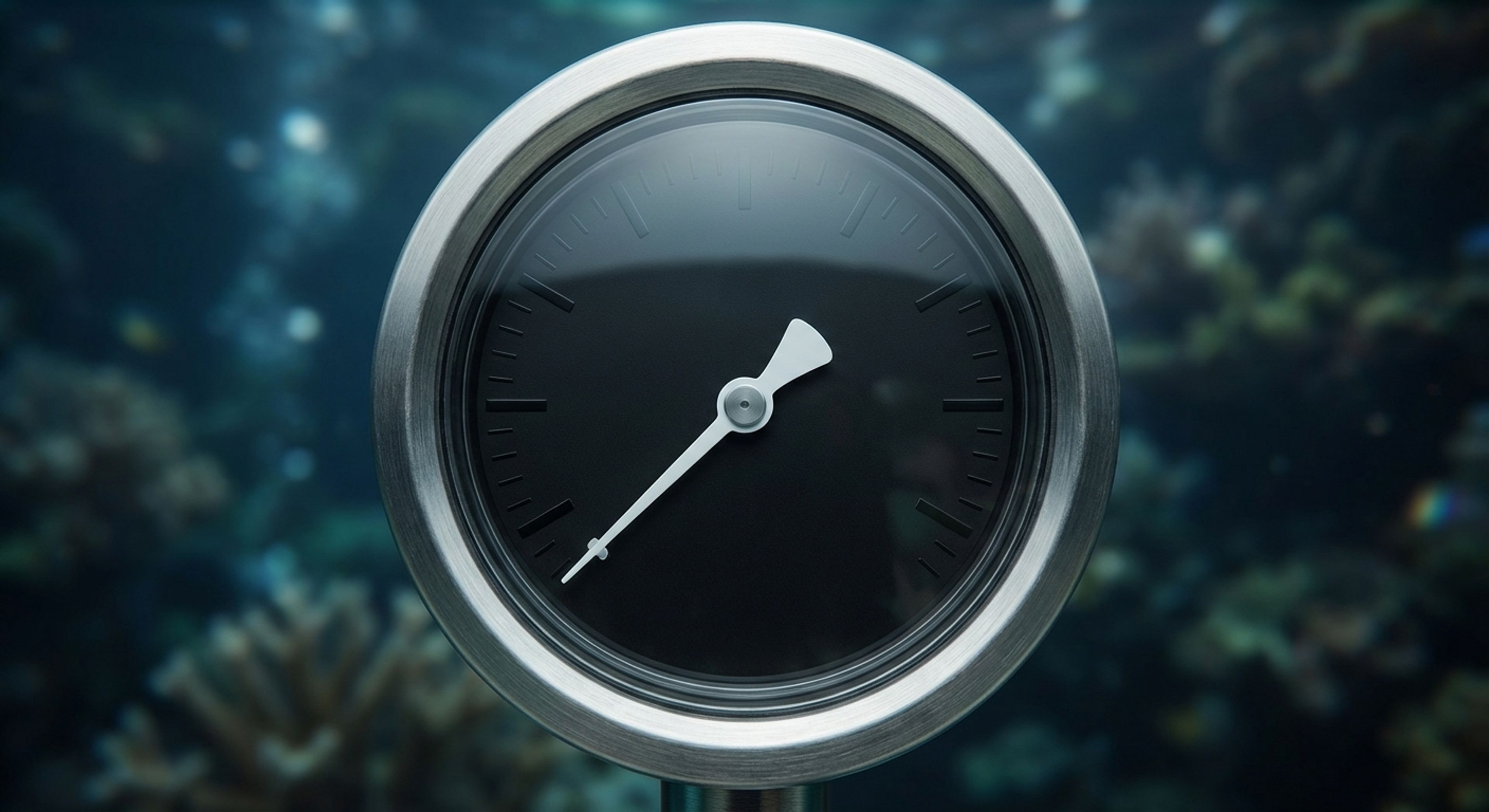 underwater. The needle is pointing to the red zone, near zero. Bubbles are rising around it. The background is dark blue water.)
F - Final Check (Final OK)
This is the last moment. You are standing on the edge.
Check the mask. Is it clean? Did you spit in it? (Don't use the baby shampoo, spit is better. The enzymes work best. And it is free). Check the fins. Are the straps good? If a strap breaks in a current, you are swimming in circles. Check the computer. Is it on? Is it set to the right mix? If you are diving Nitrox and your computer says Air, you will have a problem. If you are diving Air and it says Nitrox, you might get bent. Check it.
But the most important Final Check is not gear. It is the eyes.
Look at your buddy. Look in their face. Are they sweating too much? Are they breathing fast? Are they fumbling with their clips? Are they looking around nervously? Maybe they are hungover from too much Red Horse beer last night. Maybe they are scared of the waves. Maybe they have a cold and cannot equalize.
If your buddy does not look ready, you do not go. "Final OK" means "Are you okay in the head?"
It Is Not For You
You know, many divers tell me: "Santiago, I know my gear. I have been diving for 10 years. I don't need you to touch my stuff."
This is selfish thinking. It is dangerous thinking.
The Buddy Check is not for you. It is for your buddy.
If my O-ring blows at 30 meters, I need YOU to have good air. If I run out of air, I need YOUR octopus to work instantly. If I get tangled in a fishing net, I need YOU to have a knife or shears that you can reach. If I pass out, I need YOU to know how to drop my weights so I don't sink to the bottom.
When you skip the check, you are telling your buddy: "I don't care about your safety. I only care about getting in the water fast to take photos."
That is not a diver. That is a tourist.
Listen to Tatay
The ocean is beautiful. I love it more than the land. I have lived underwater for 40 years. But I respect it. I fear it a little bit. That fear keeps me alive.
The sea is always working. The currents in the Philippines are always pushing. The pressure is always squeezing. The only thing keeping you alive is your equipment and your brain.
If your brain is lazy, your equipment will fail.
So next time, before you do the big "Giant Stride" entry, stop. Look at your friend. Touch their BCD. Check their weights. Pull their straps. Smell their air. Look in their eyes.
It takes two minutes. It gives you a lifetime of diving.
Don't be a lazy diver. Be a survivor. Now, go wash your wetsuit. It smells like pee.