

Galapagos Scuba Diving: Darwin's Heavy Metal Ocean
Forget flat blue water. The Galapagos will hammer you with freezing thermoclines and washing machine currents. This is where you earn your fins.
Roll backward. Hit the water. Vent your BCD completely. Kick straight down into the black.
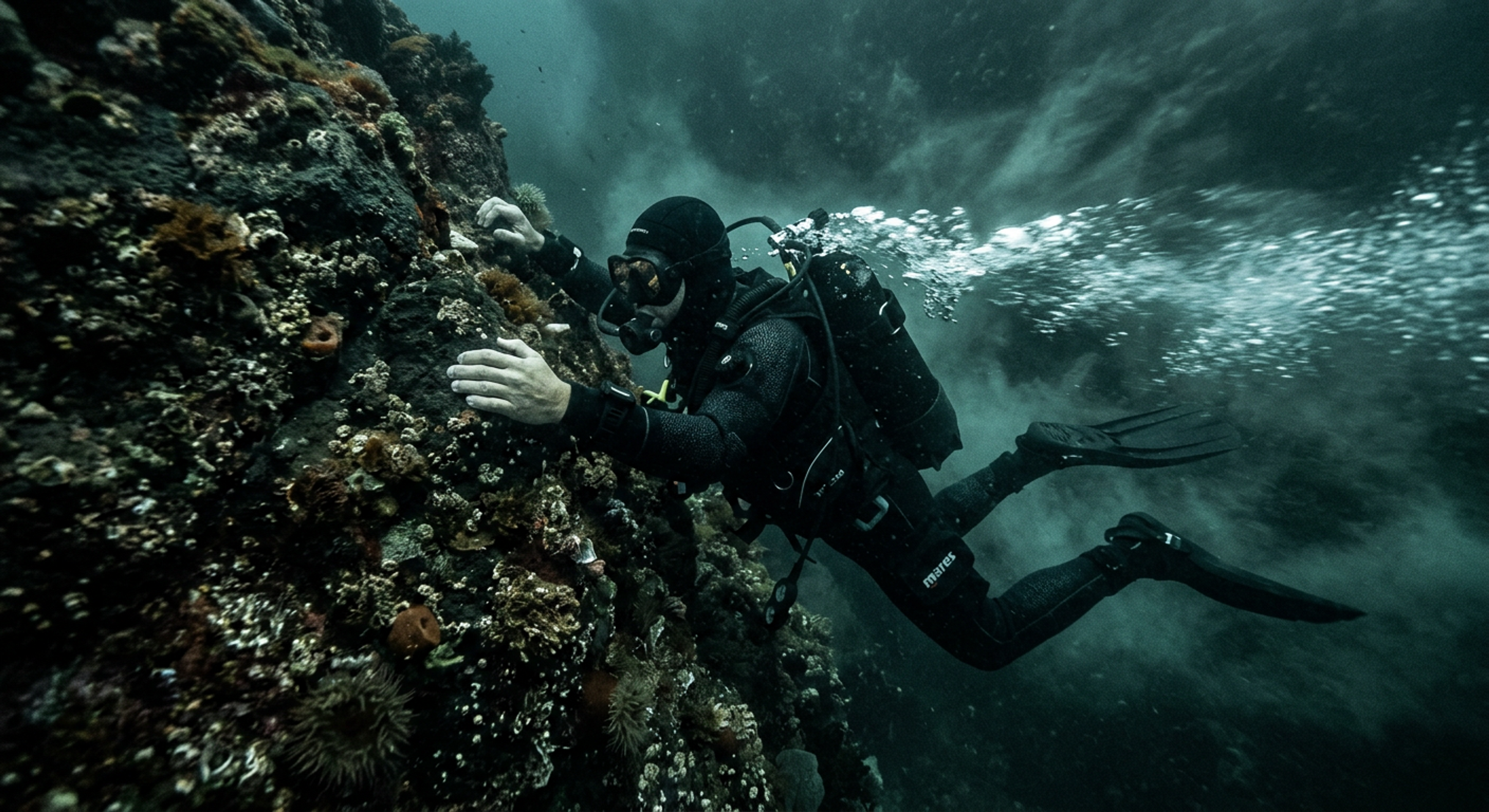
You have exactly five seconds to drop beneath the surface chop before the current sweeps you out into the open Pacific. There is no anchor line. There is no gentle descent. You plunge. The water hits your face like a wet slab of concrete. Fourteen degrees Celsius. The cold shoots straight through your neoprene hood and buries itself in your jawbones. You taste salt, old rubber from your regulator, and the metallic tang of your own adrenaline.
Welcome to the Galapagos Islands.
This is not a vacation. You do not come here to float over pretty coral gardens or take macro photos of nudibranchs. You come here to face the heavy metal of the ocean. You come here to get hammered by surge, blinded by upwellings, and dragged by currents that feel like a runaway freight train. The Pacific here is brutal. It is untamed. It demands absolute physical readiness. If you are weak, the ocean will expose you. If you panic, the ocean will consume you.
We dive at the exact coordinates where tectonic plates grind together and massive ocean currents collide. The Humboldt Current brings freezing, nutrient-dense water up from Antarctica. The Cromwell Current slams into the volcanic rock from the west. The Panama Flow dumps warm tropical water on top of it all. The result is a violent, chaotic mixing zone.
We call it the washing machine.
The Darwin Draft
You endure the cold. You fight the currents. You suffer the bruised knuckles from holding onto barnacle-covered rocks. You do all of this because the payoff is absolute insanity. The sheer biomass in these waters breaks your brain. We are not looking for tiny creatures. We are looking for giants.
The Wall of Muscle
Far to the north lie Wolf Island and the Pillars of Evolution. The famous rock bridge collapsed back in 2021, but underwater, this zone remains the undisputed apex of pelagic diving.
You drop down to twenty-five meters. You find a rock. You hold on. You wait.
The thermocline hits you. The water temperature drops five degrees in a matter of seconds. The visibility drops. The water turns a thick, soupy green. Then the shadows appear.
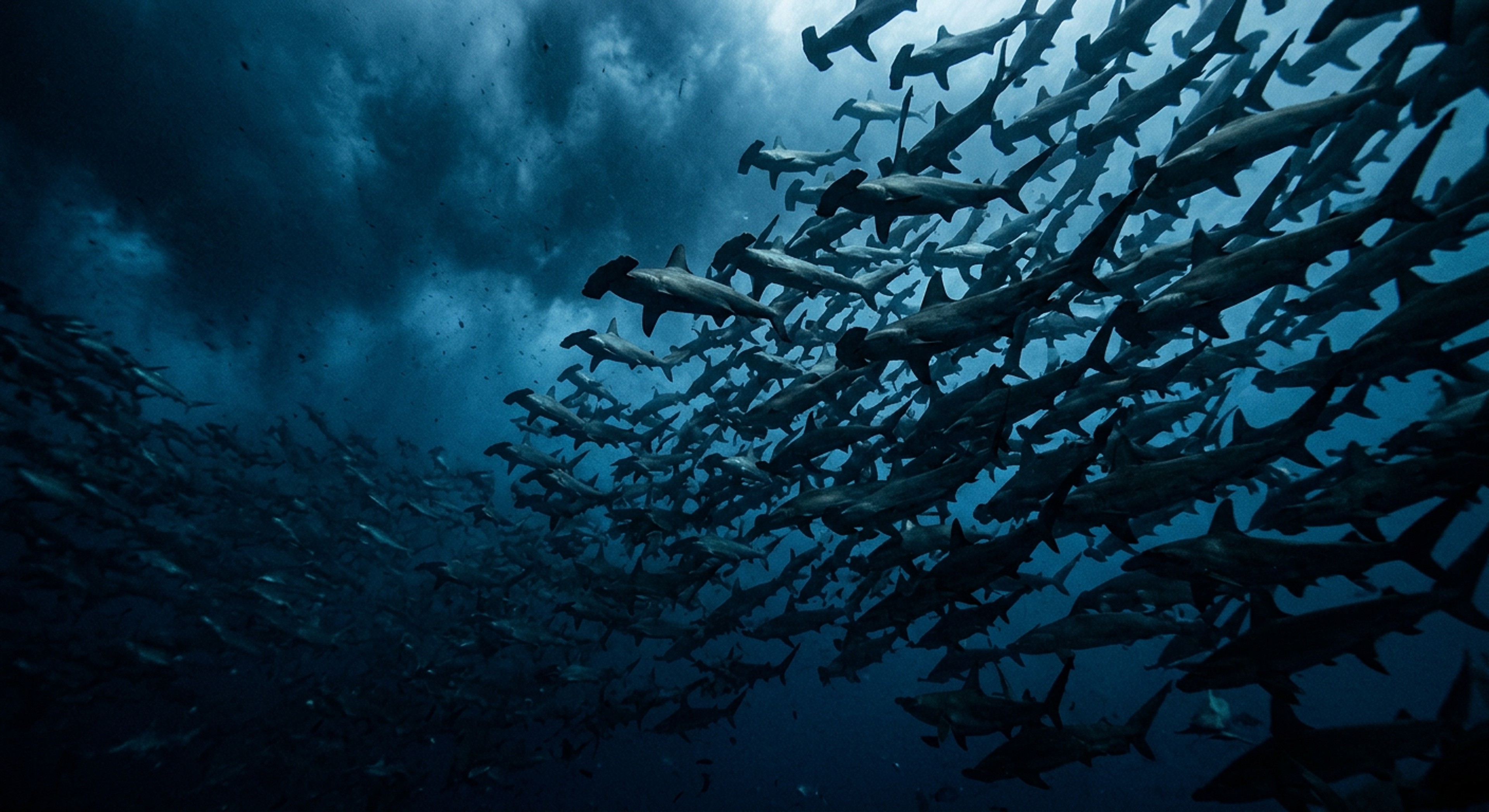
Scalloped hammerheads. Not ten. Not twenty. Hundreds.
They swim in a massive, overlapping formation that blocks out the sun. They look like prehistoric fighter jets. Thick grey bodies, sweeping tails, eyes pushed out on those bizarre cephalofoils. They do not care about the current. They glide effortlessly through water that is actively trying to rip your mask off. You watch them pivot and flex. They come to the cleaning stations to let butterflyfish pick parasites off their skin. You kneel in the rubble, freezing, breathing hard, and you watch a river of apex predators flow past your head. It makes you feel incredibly small. I live for that exact feeling.
Godzilla's Cousins
We move to Cabo Douglas on the western edge of Fernandina Island. The rules change here. You are shallow. Ten meters at most. But the surge is a nightmare.
The Pacific swells crash directly into the volcanic coastline. The energy transfers underwater. You are thrown forward three meters. You hold your breath, brace your fins, and wait to be sucked backward three meters. You repeat this cycle over and over. It takes brutal core strength just to maintain your position.
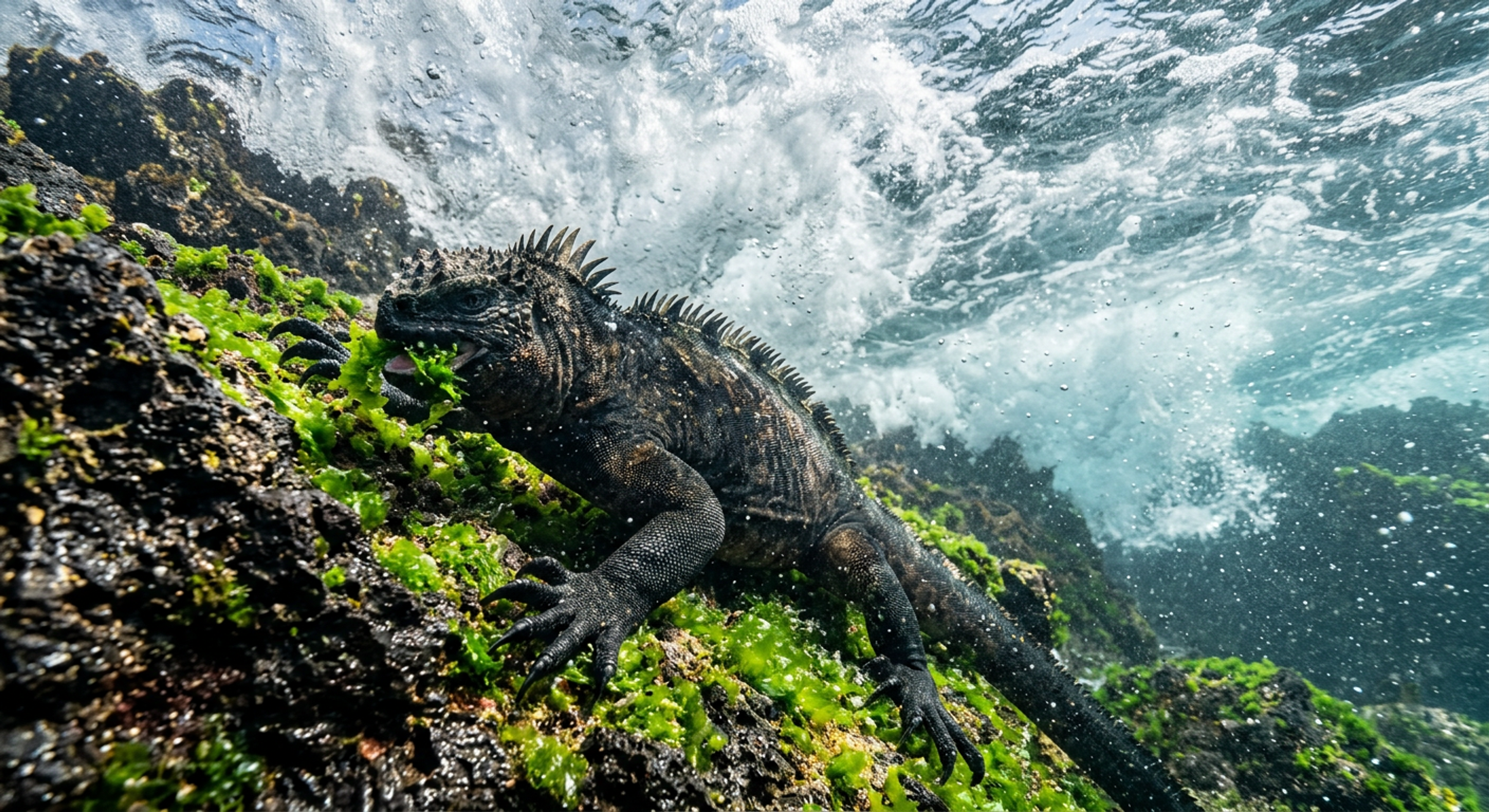
You look at the boulders. They are covered in marine iguanas.
These are the only marine lizards on the planet. They look like tiny, angry Godzillas. They dive into the freezing water, hook their massive razor-sharp claws into the rock, and chew thick green algae right off the reef. They ignore the crashing surge. They ignore us. They stay under for up to thirty minutes, their black scales blending perfectly with the dark basalt. Watching a reptile hold its breath in freezing, violently moving water to eat sea grass is something you will only see right here.
The Deep Weirdos
Punta Vicente Roca is where things get truly strange. The water here is usually the coldest on the entire itinerary. You do a negative entry right against a sheer cliff wall that drops hundreds of meters into the abyss.
You fall into the dark green gloom. Down to thirty meters. The pressure squeezes your suit tight against your skin. The cold is a physical ache in your joints.
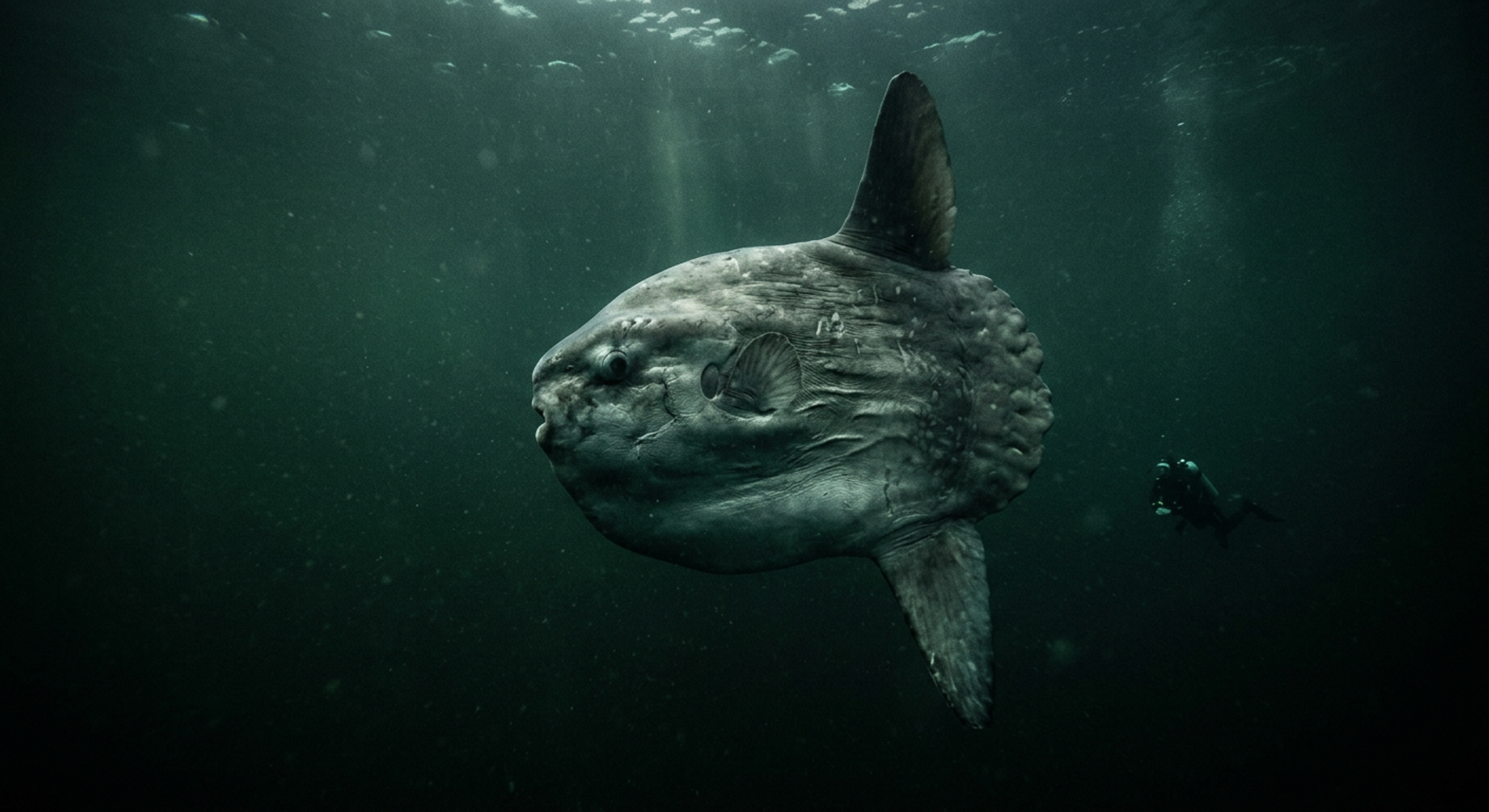
You are looking for the Mola alexandrini. The giant oceanic sunfish. Many divers mistakenly call them Mola mola, but the true giants swimming off Isabela Island are the Southern sunfish.
They look like a mistake of evolution. A massive, flat disc of grey flesh with no tail fin, just huge dorsal and anal fins flapping synchronously. They can weigh two tons. They rise from the freezing deep to be cleaned by halfmoons and wrasses. When you spot one, it feels like an alien encounter. A massive, unblinking eye stares at you as this giant saucer hovers in the gloom. You have to kick hard against a downwelling just to stay at thirty meters, all while staring at a fish that defies every rule of aerodynamics.
The Gear and The Grind
Do not show up on my boat with split fins. Do not show up with a flimsy three-millimeter wetsuit. You need armor. You need propulsion.
You need rigid, heavy fins to cut through the heavy water. You need a seven-millimeter wetsuit that fits perfectly. A hood is mandatory. Kevlar gloves are mandatory. We grab onto raw volcanic rock to avoid being swept into the blue. Your soft hands will be shredded in seconds without them.
Here is a breakdown of what you face at our primary sites. Memorize it.
| Dive Site | Current Level | Water Temp (°C) | Target Species | Survival Rule |
|---|---|---|---|---|
| Wolf Island | Brutal / Washing Machine | 18 - 24 | Hammerhead sharks, Eagle rays | Vent BCD fully, kick down instantly. |
| Pillars of Evolution | Heavy / Sweeping | 20 - 25 | Whale sharks, Silky sharks | Stay behind the rocks. Do not drift up. |
| Cabo Douglas | Extreme Surge | 15 - 18 | Marine iguanas, Sea lions | Brace your core. Time your kicks with the surge. |
| Punta Vicente Roca | Downwellings | 13 - 16 | Giant sunfish, Seahorses | Watch your depth gauge constantly. |
A Hard Lesson in the Blue
I have seen the Galapagos break overconfident divers. I see it every single season.
A few years ago, we were diving the northern islands. The current was absolutely ripping from the southeast. During the briefing, I looked every diver in the eye. I told them to drop fast, get to fifteen meters, find a rock, and hold on. I specifically warned them about the downwelling on the corner of the reef.
We had a guy on board. Let us call him Dave. Dave had five hundred dives in the Caribbean. Dave had a camera rig the size of a microwave. Dave thought he knew better than the guide.
We rolled in. I vented and kicked down. I looked back. Dave was at five meters, floating like a cork, messing with his strobe arms.
The current grabbed him instantly. It swept him over the reef and straight into the downwelling zone.
I left the group clinging to the rocks and kicked out into the blue. I had to sprint. My lungs burned. My calves screamed against the stiff rubber of my fins. I hit the edge of the downwelling and felt the water grab my fins and pull downward. I saw Dave’s exhaust bubbles. They were not going up to the surface. The current was so strong it was pulling his bubbles straight down into the deep.
Dave was in full panic. He was kicking wildly. His eyes were huge behind his mask. He was at twenty-five meters and dropping fast.
I dumped all the air from my BCD, dropped like a stone, and slammed into him from behind. I grabbed his tank valve to establish control. I hit his BCD inflator. I hit mine. Nothing happened. The downwelling was stronger than the lift of our wings. I considered dumping his lead weights. But shooting up out of control from twenty-five meters would likely give us both severe decompression sickness or a lung overexpansion injury.
I had to kick. I kicked with everything I had. I dragged his heavy camera rig, his dead weight, and my own gear against a force that wanted to bury us both. We crawled up the water column meter by meter. My computer beeped angrily. My air supply plummeted. It took three agonizing minutes to break out of the downward pull and reach the safety of the shallow reef.
We surfaced. Dave threw up saltwater and breakfast. He did not touch his camera for the rest of the trip.
The ocean does not care about your logbook. The ocean does not care how expensive your camera is. If you do not respect the power of the Pacific, it will crush you.
Earning Your Fins
This is why the Galapagos is the ultimate goal.
It strips away the comfort. It forces you to focus entirely on your breathing, your buoyancy, and your physical endurance. You earn every single sighting. You freeze, you fight, you bleed a little bit on the rocks.
But then a fifty-foot whale shark eclipses the sun above you. Or a pod of bottlenose dolphins blasts through a wall of hammerheads. Or a sea lion spins in your bubbles, mocking your slow human movements.
In those moments, the cold disappears. The burning in your legs fades away. You realize you are sitting in the raw, beating heart of the ocean. You are watching the gears of the planet turn. There is no zoo here. There is no controlled environment. It is pure, unfiltered survival.
Train your legs. Check your gear. Accept the cold.
When you are ready for the heavy metal, the islands will be waiting. Just remember to vent your BCD before you hit the water.