

Ear Pain? Hay Naku! How to Equalize Like a Real Diver
Your ears hurt? That is because you are lazy. Tatay Santiago teaches you how to clear your ears properly using Valsalva, Frenzel, and Toynbee. Stop crying and read this.

Hay naku. Yesterday I have a guest. A young man from the city. He has the newest dive computer. It looks like a spaceship on his wrist. He has the split fins. You know, the ones that look like a fish tail cut in half? Useless. No power in current.
But okay. I take him down. We go to the Canyons here in Puerto Galera. Strong current. Good diving. We descend maybe three meters. Three meters only! And he starts waving his hands like a drowning chicken. He points to his ear. He makes a face like he ate a sour mango.
I signal him. "Equalize." He shakes his head. We go up. Dive is over. Five minutes. Waste of tank. Waste of boat gas.
He says to me on the boat, "Tatay Santiago, my ears hurt so much. Maybe the water is too heavy today."
Sus maryosep. The water is the same heavy as it was forty years ago. The problem is not the water. The problem is you do not know how to fix your ears. You rely on technology but you forget your own body.
Listen to me. I will teach you. No fancy words. Just how to dive without your head exploding.
The Anatomy: The Little Tube in Your Head
You think your ear is just the thing on the side of your head for hanging sunglasses? No. Inside is a machine.
There is the outer ear. Water goes in there. That is fine. Then there is the eardrum. It is a thin skin. Like the top of a drum. It seals the inside from the water.
Behind the drum is the Middle Ear. This is an air space. Air. Not water.
When you go down, the water pushes on the drum. Pressure increases. Boyle's Law. I don't like physics but you must know this. Pressure goes up, volume goes down. The air inside your middle ear shrinks. The water pushes the eardrum IN. That is the pain. That is the squeeze.
If you do nothing, the drum will stretch. It will hurt. If you are stupid and keep going down, it will burst. Pop. Cold water rushes in against the inner ear. You get dizzy because the cold water confuses your balance sensors (vertigo). You vomit in your regulator. Not good.
To fix this, we need to put more air into that middle ear space to push the drum back out.
But how? The middle ear is sealed... mostly.
There is a small hose. We call it the Eustachian tube.
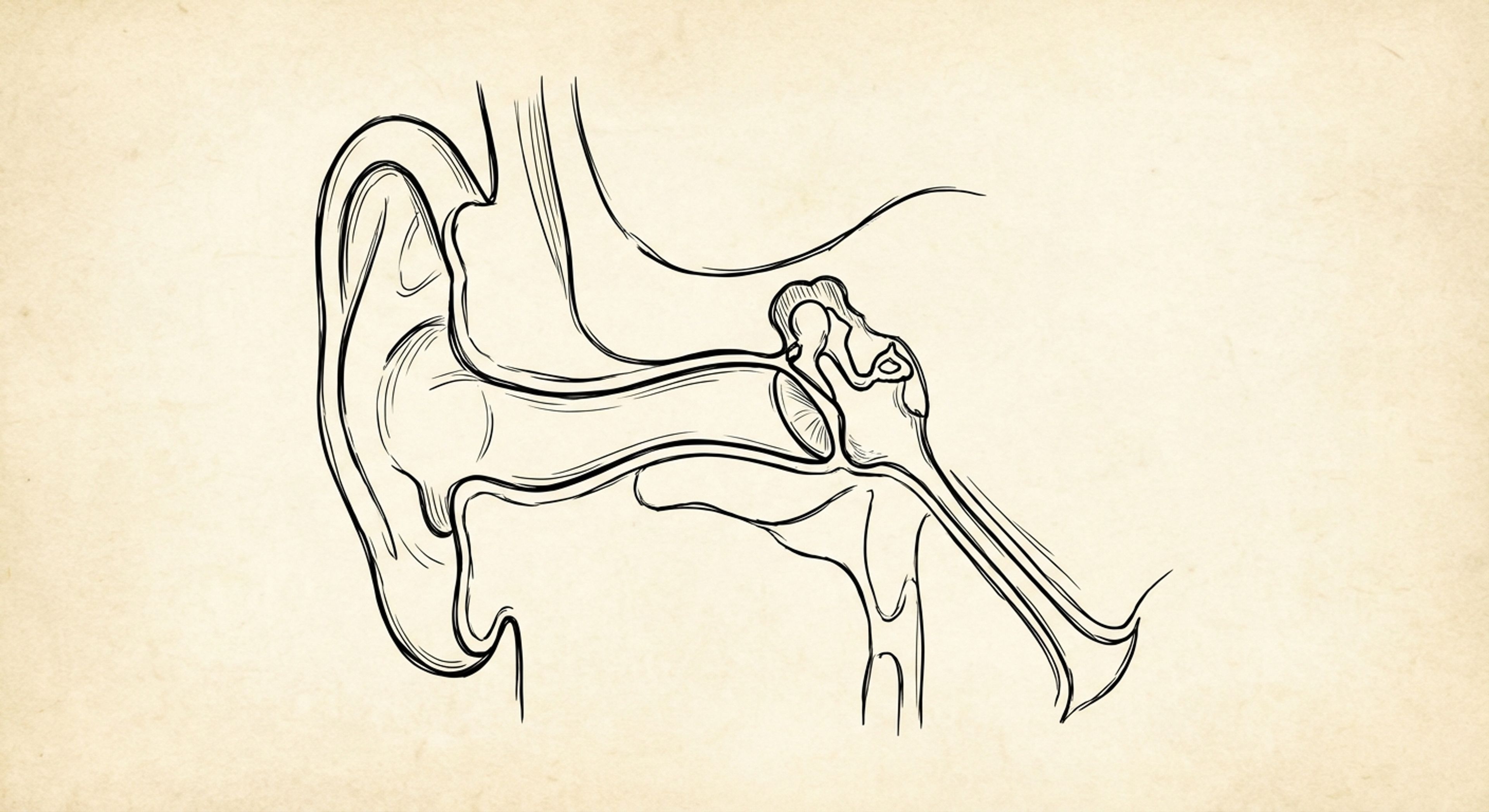
This tube connects your middle ear to the back of your throat. Usually, it is closed. It is flat. Like a deflated tire inner tube. If it was always open, you would hear your own voice booming inside your head too loud.
When we equalize, we are trying to force this tube open. We send air from the throat, through the tube, into the middle ear. Pop. Pressure is equal. No pain.
But you people wait too long. You wait until the pressure clamps the tube shut. Then you blow and blow and nothing happens.
The Golden Rule: Early and Often
This is where you make the mistake. You jump in the water. You look at the fish. You look at your fancy computer. You swim down to five meters. Then you feel pain. Then you try to pinch and blow.
Too late!
When you wait, the pressure from the outside is already squeezing the Eustachian tube shut. It is like trying to open a door when a carabao is leaning against it from the other side. Hard work.
You must equalize before you feel pain.
- Before you splash: Equalize on the boat. Gently. Make sure the tubes open ("pop").
- On the surface: Equalize before your head goes under.
- Every half-meter: Do not wait for meters. Every time you breathe out, you equalize.
If you wait for the pain, you are already failing. The tissue in the tube gets swollen. It locks up. Then you push harder. You hurt your ears more.
Technique 1: The Valsalva Maneuver
This is what they teach you in the Open Water class. It is the most common. It is also the one you do wrong.
How to do it:
- Pinch your nose nostrils closed. Tight.
- Close your mouth.
- Blow air gently into your nose.
Since the nose is closed, the air has nowhere to go. It forces the Eustachian tubes open.
The Santiago Warning: Do not blow like you are blowing up a truck tire! I see divers face turn red. Eyes popping out. Veins in the neck big like ropes.
Sus! If you blow too hard, you can damage the inner ear. You can rupture the Round Window. If that breaks, fluid leaks out. You lose hearing. You get ringing in the ears (tinnitus).
Blow gently. Like you are blowing a tissue paper off a table. If it does not open, stop. Do not force it.
Technique 2: The Toynbee Maneuver
Sometimes the Valsalva does not work. Or maybe you are ascending and feel a "reverse block" (I will talk about this later). The Toynbee is gentler. It feels more natural.
How to do it:
- Pinch your nose closed.
- Swallow.
That is it. Just swallow.
When you swallow, the muscles in your throat pull the Eustachian tubes open. At the same time, your tongue pushes a little air up.
This is good if your ears are sensitive. It is very good for equalizing on the way up if you get stuck. But sometimes, when the air in your tank is dry, it is hard to swallow. Your mouth is like the desert.
Try to wiggle your jaw side to side while you swallow. It helps.
Technique 3: The Frenzel Maneuver
Ah, now we talk about skill. The freedivers use this. The spear fishermen in my village use this. We didn't know it was called "Frenzel". We just call it "The Tongue Push".
This is better than Valsalva. Why? Because you do not use your lungs. You do not strain your chest. It is safer for your heart and your inner ear.
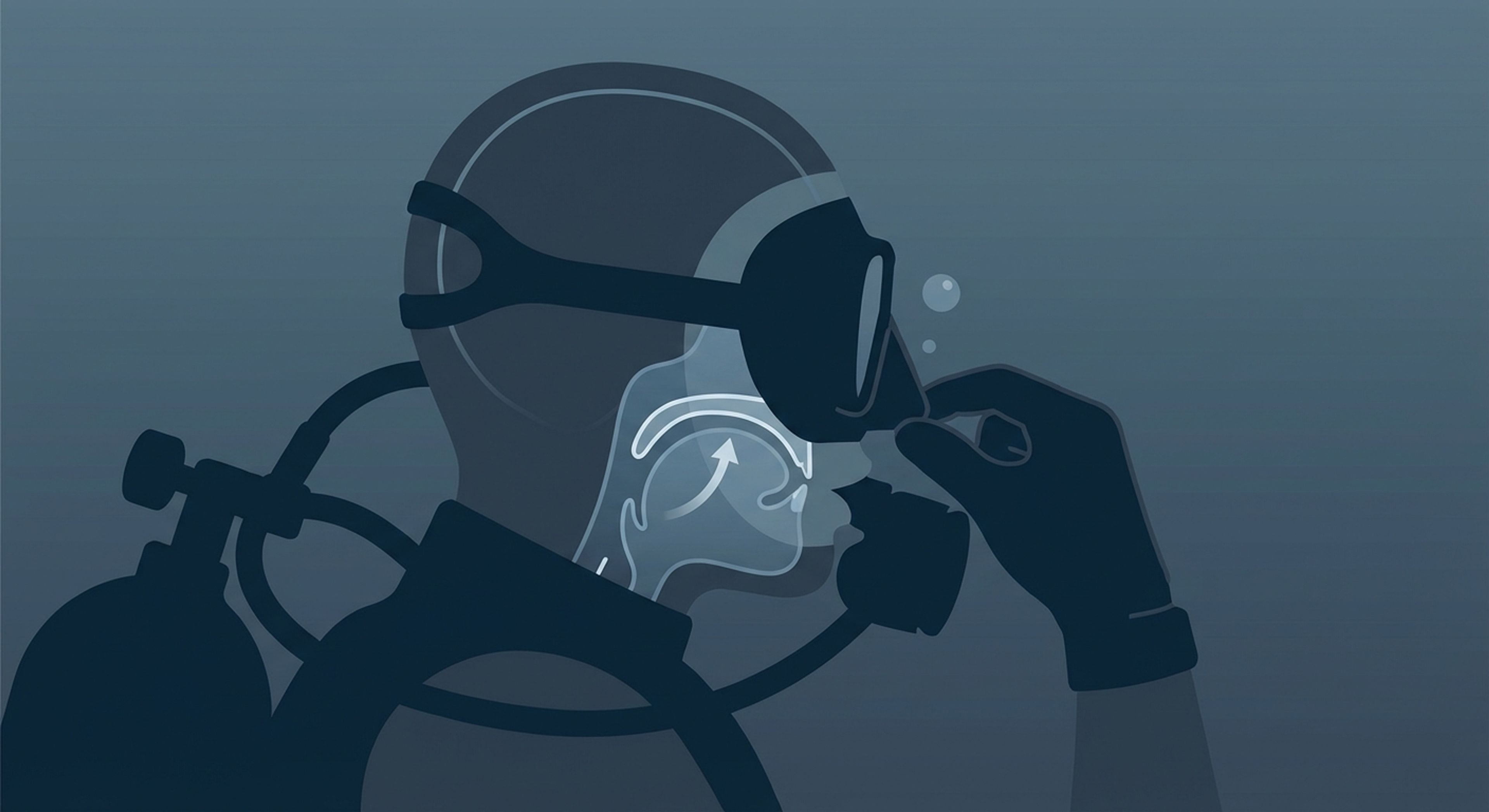
How to do it:
- Pinch your nose.
- Close the back of your throat (the glottis). Like you are about to lift something heavy.
- Make the sound of the letter "T" or "K".
- Use your tongue as a piston. Push the back of your tongue up against the roof of your mouth.
This traps a little pocket of air in your throat. Your tongue squeezes this air into the nose. Nose is closed. So air goes to ears.
It is quick. Click-click. Like that. You can do it fast. It uses very little energy.
If you want to be a real diver, learn this. Practice in front of the mirror. It looks stupid. But it works.
Comparison of Techniques
I make this table for you. Because I know you like to look at data instead of the ocean.
| Technique | How it works | Good For | Bad For |
|---|---|---|---|
| Valsalva | Pinch and blow from lungs | Beginners. Easy to learn. | Can cause injury if blown too hard. Uses chest pressure. |
| Toynbee | Pinch and swallow | Sensitive ears. Reverse blocks. | Hard to do with dry mouth. Slower. |
| Frenzel | Pinch and tongue piston | Advanced divers. Freedivers. Very safe. | Hard to learn. Requires tongue control. |
What If It Does Not Work?
So you try Valsalva. You try Toynbee. You wiggle your jaw. You look like a fish eating peanut butter. But the ear still hurts. The pressure is still there.
Stop.
Do not go down. Do not think "Maybe it will pop in a minute." It will not.
- Signal your buddy. Stop the descent.
- Go up. Ascend one or two meters. Just a little bit. Until the pain is gone.
- Try again. Gently. Stretch your neck by tilting your head away from the blocked ear. Sometimes this stretches the tube open.
- No luck? Abort.
This is the part nobody likes. You paid for the boat. You woke up early. You put on the tight wetsuit. But if you cannot clear your ears, you cannot dive.
If you force it, you will rupture the eardrum. Do you know how long that takes to heal? Months. No diving for months. Infection. Pain. Maybe surgery.
Is one dive worth losing your hearing? Is it worth staying dry for six months?
Don't be a hero. The ocean will be there tomorrow. The coral is not going anywhere (unless the dynamite fishermen come, but that is another story).
A Note on "Reverse Block"
Sometimes, you go down fine. But when you come up... Aray! Pain.
The air in your middle ear expanded on ascent (Boyle's Law again), but the tube is stuck closed. The air cannot get out. It pushes the eardrum OUT. This is Reverse Block.
If this happens:
- Do not shoot to the surface. Your ear will explode.
- Stop. Go DOWN a little bit until pain stops. This recompresses the air.
- Use the Toynbee (swallow) or wiggle your jaw. Do not blow! Blowing adds more air. You want air out.
- Ascend very, very slowly.
Tatay Santiago's Final Advice
You know, back in the day, we didn't have these soft silicone masks. We had hard rubber. We smelled like old tires. We didn't complain.
But we respected the body.
If you have a cold? Do not dive. The mucus blocks the tube. If you took a decongestant medicine? Be careful. If the medicine wears off underwater, the tissue swells up again and you get reverse block. Bad news.
Take care of your ears. Keep them clean. After the dive, rinse with fresh, clean water. Do not put alcohol or fancy drops in if your ear hurts, if you have a small tear, alcohol will burn like fire. Just clean water.
Practice the Frenzel while you are watching TV. Pinch your nose. Click. Make the ears pop. Get control of those muscles.
Next time you come to dive with me, I don't want to see you waving your hands at three meters. I want to see you gliding at twenty meters, looking at the Pygmy Seahorse.
Now go. Wash your gear. Don't leave it in the sun.
Hay naku. Kids these days.