

How to Spot a Death Trap: 3 Signs of a Safe Dive Shop
The ocean is trying to crush you. The only thing keeping you alive is your gear and your team. Here is how to tell if a dive shop respects physics or if they are just gambling with your lungs.
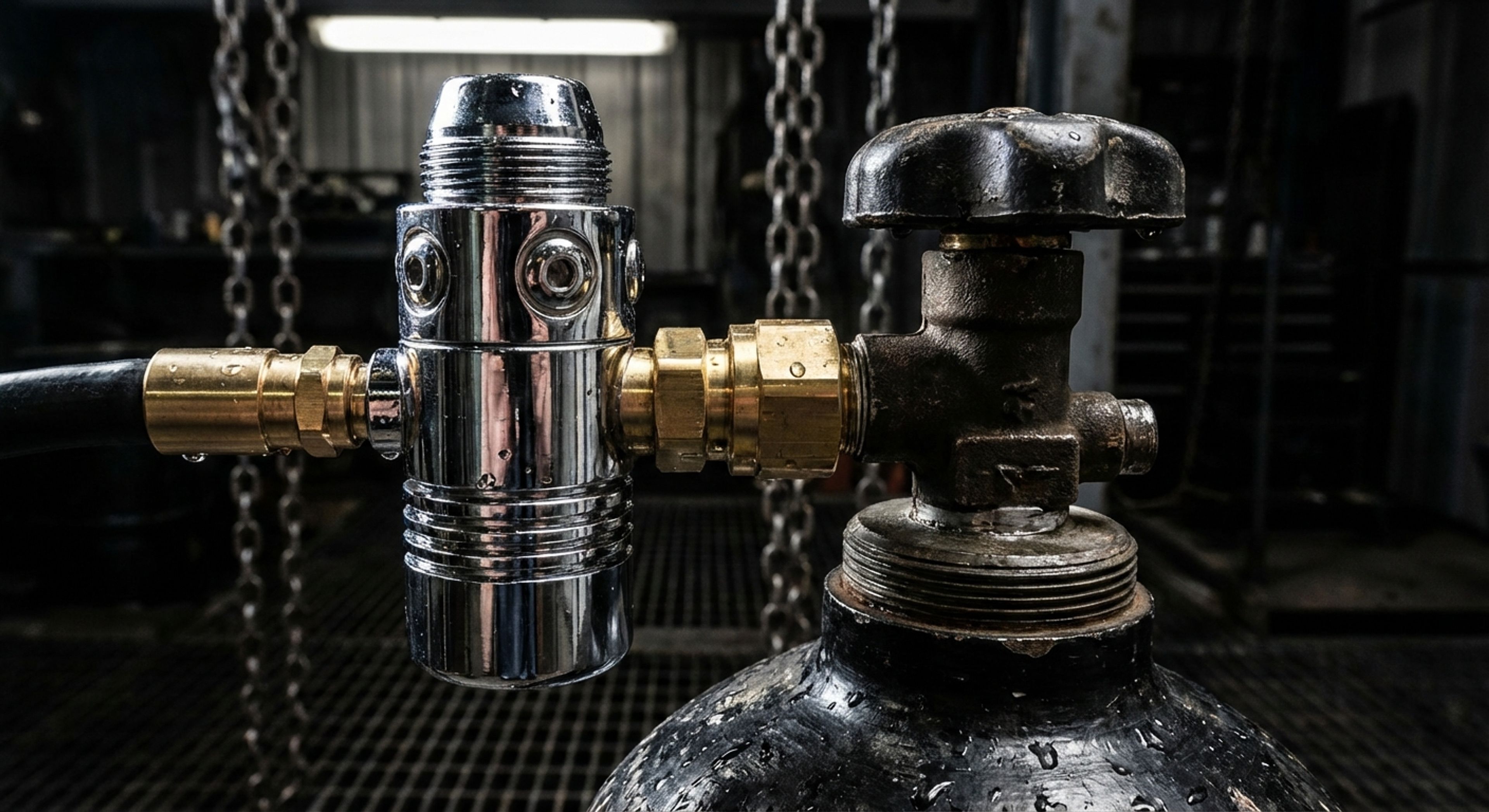
The North Sea does not forgive mistakes. At 150 meters down, inside a diving bell, you learn very quickly that "good enough" is a lie. "Good enough" gets you bent. "Good enough" gets you dead.
I see you vacation divers. You fly to warm places. You put on your board shorts. You think diving is just swimming with a tank. It is not. You are entering a hostile environment where pressure forces nitrogen into your tissues and water tries to fill your lungs. The only reason you survive is technology and procedure.
When I am not in saturation, I sometimes dive recreationally. I hate the warm water. It feels wrong. But what I hate more is seeing how recreational dive shops operate. They run cattle boats. They push numbers. They cut corners to save a few dollars on O-rings and compressor filters.
You need to know how to look past the smiling staff and the free coffee. You need to look at the hardware and the protocols. If you are walking into a shop, here is how you check if they are going to kill you or bring you back.
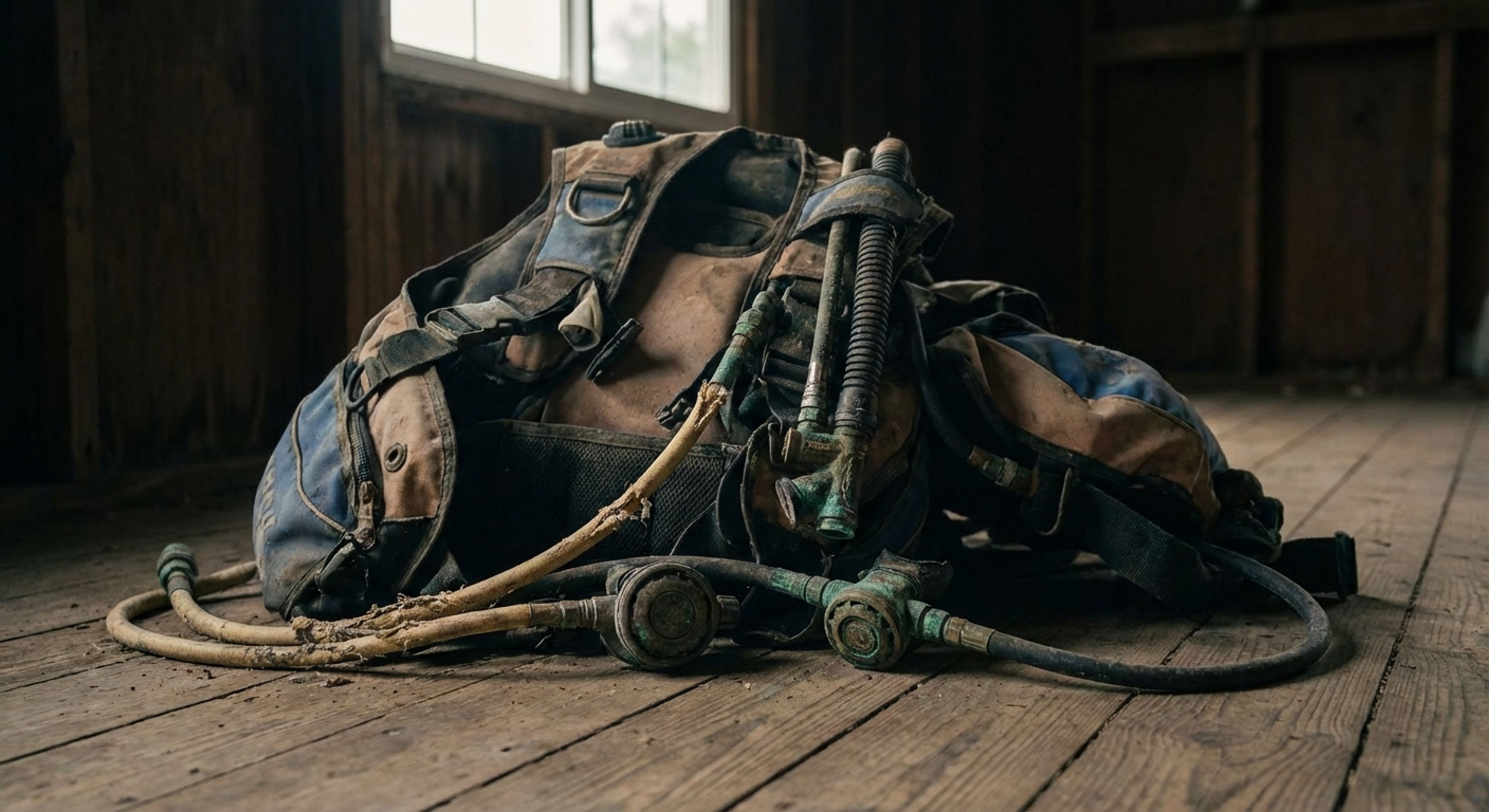
1. The Rental Gear: Look for the Green Death
I have my own gear. I trust my life to my regulators because I service them myself. Most of you rent. You are putting a device in your mouth that must deliver air at ambient pressure perfectly, every single breath. If it fails, you bolt to the surface and risk a lung expansion injury, or you drown. Simple.
Do not just grab the regulator they hand you. Inspect it. Look at the first stage (the heavy metal part that screws onto the tank). Look at the filter inlet.
Is it shiny and silver? Good. Is it green or crusty? That is corrosion. That is salt water inside the mechanism.
If I see green corrosion on a first stage, I walk out. It means they do not wash their gear. It means the internal piston or diaphragm is probably pitted. It means the air delivery could stutter when you are at 30 meters and your work of breathing increases.
Check the hoses. Bend them near the crimping. Do you see small cracks in the rubber? That is dry rot. A blown low-pressure hose underwater is a violent event. At depth, it can drain an aluminum tank in minutes.
Look at the mouthpiece. I don't care about the hygiene as much as the mechanics. Is it secured with a proper zip tie? I have seen mouthpieces held on with rubber bands. You pull, the regulator comes out, the mouthpiece stays in your teeth. You inhale water. Panic follows.
The SPG Test Before you get on the boat, put the regulator on a tank. Pressurize it. Watch the needle on the Submersible Pressure Gauge (SPG). Take a hard, fast breath from the regulator while watching the needle. Does the needle dip and recover? If it moves significantly, the valve is not open fully, or the filter is clogged. The flow is restricted. Do not dive that regulator.
2. The Briefing: A Plan or a Bedtime Story?
In commercial diving, we spend hours planning a dive that lasts 30 minutes. We calculate gas mixtures. We discuss bailouts. We know exactly who does what if the umbilical gets severed.
In recreational diving, I often hear this: "Okay guys, we jump in here, follow me, look at the turtle, come up with 50 bar. Let's go!"
This is negligence.
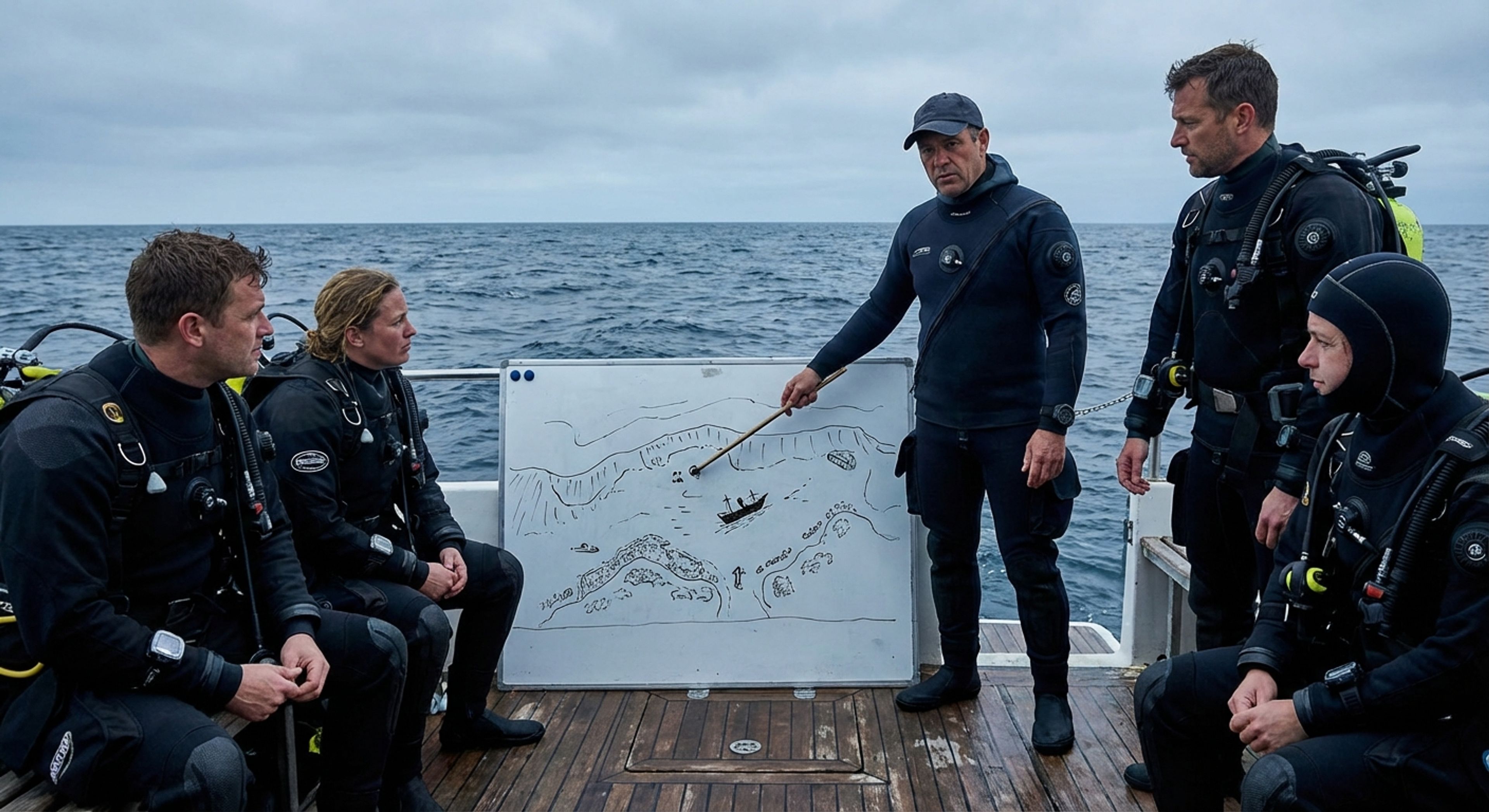
A dive briefing is a survival contract. It needs to establish the rules of engagement with the physics of the site. If the divemaster just points at a map and jokes about the lunch menu, pack your bag.
A professional briefing must cover the failure points.
- Gas Management: Not just "come up at 50 bar." What is the turn pressure? At what pressure do we leave the bottom?
- Currents: Which way is it flowing? What happens if it changes? If we get swept off the reef, do we drift or fight?
- Lost Buddy Procedure: This is the most critical part. The universal standard is to search for one minute, then surface safely. If this is not agreed upon before the splash, you will have one diver on the boat and one diver drowning at depth looking for his friend.
I remember diving in Indonesia once. The guide barely spoke. We dropped into a negative entry drift. The current was ripping, maybe 4 knots. Half the group got blown off the ridge immediately. They surfaced in blue water, miles from the boat. The boat driver didn't see them for an hour because there was no plan for separation.
The guide was busy looking for a pygmy seahorse. I deployed my SMB and signaled the boat. The others were lucky. Luck is not a strategy.
3. The Oxygen: The Ghost in the Corner
Nitrogen is a slow poison. We accept this risk every time we descend. Decompression Sickness (DCS) is not just for deep divers. It can happen at 18 meters if you are dehydrated, tired, or just unlucky.
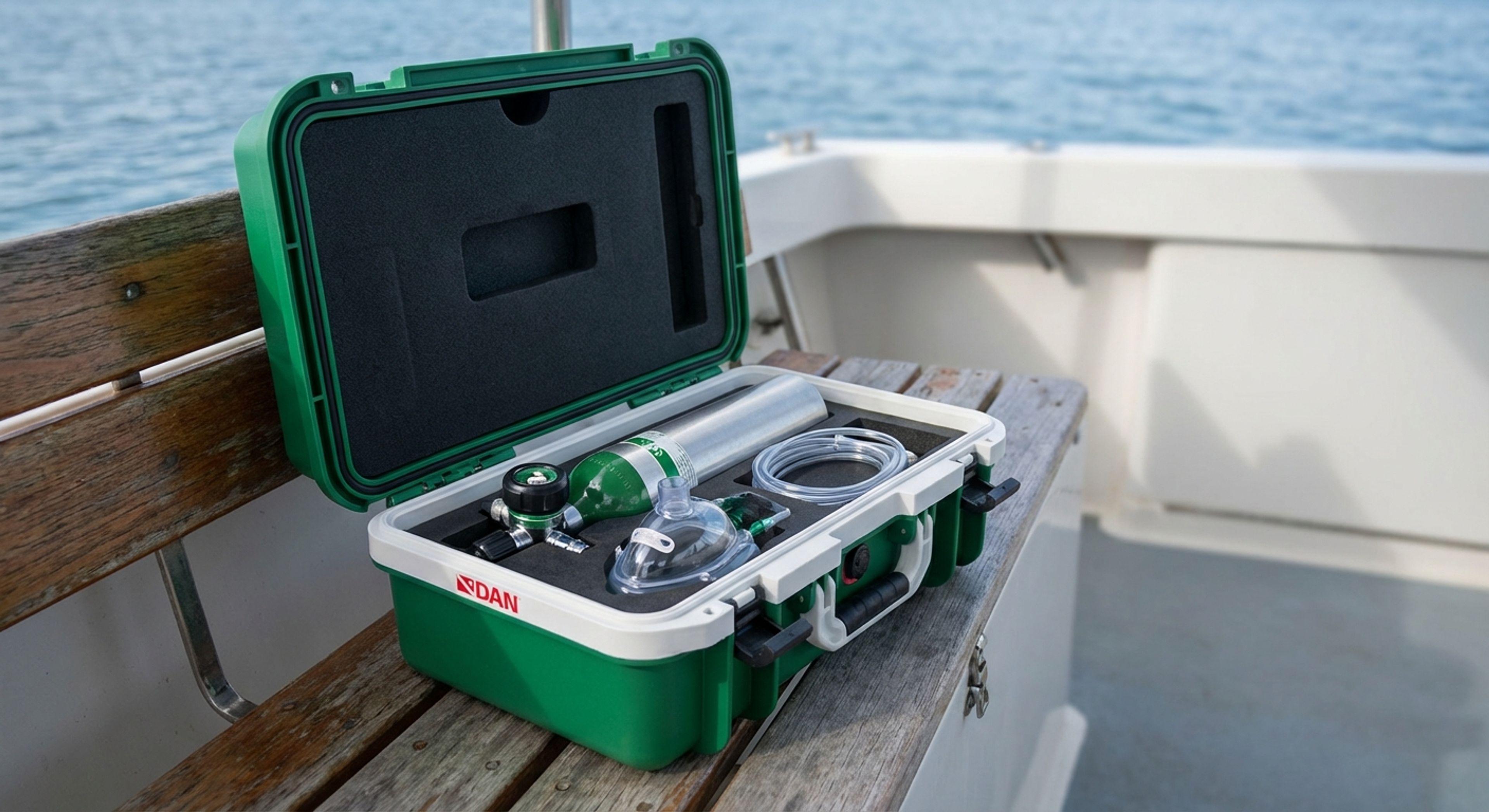
The only immediate treatment for DCS on a boat is 100% pure oxygen. Not fresh air. Oxygen. It flushes the nitrogen out. It saves brain cells. It prevents paralysis.
Every dive boat claims they have an "Emergency Kit." Ask to see it.
I do this every time. I ask the captain: "Show me the O2 unit." Usually, they have to dig it out from under a pile of life jackets or beer coolers. That is strike one. It needs to be accessible in seconds.
Then, check the tank. Is it full? You would be surprised how many "safety tanks" are empty because no one checked them since last season. Does it have a demand valve or a non-rebreather mask? A simple nasal cannula (the clear tubes for your nose) is useless for a bent diver; it doesn't provide a high enough concentration of oxygen. You want a demand valve (like a regulator) or a bag-valve-mask.
If the shop owner gets annoyed that you are checking their safety gear, that is the biggest red flag of all. A professional is proud of their safety gear. A cowboy is embarrassed by it.
The Comparison Table
I like data. Here is the difference between a shop that wants your money and a shop that wants your survival.
| Feature | The Death Trap | The Professional Shop |
|---|---|---|
| Rentals | Green corrosion, frayed hoses, leaking inflators. | Clean, serviced annually, records available. |
| Briefing | "Follow me, have fun." | Currents, gas turn-points, lost buddy drill, emergency signals. |
| Oxygen | Buried, rusty, empty, or missing. | Prominent, checked daily, proper demand valve. |
| Compressor | Intake near the exhaust (CO poisoning risk). | Clean filters, air purity tested quarterly. |
The Hidden Cost of Low Prices
There is a war for your wallet. In places like Thailand, Philippines, or Mexico, shops sit next to each other fighting for customers. They drop prices.
"Dives for $25!"
Stop. Think about the overhead. Boats burn diesel. Compressors burn electricity and oil. Regulators need service kits that cost money. Divemasters need a living wage.
If the price is too low, the math does not work. So where do they cut? They don't change the compressor filters. This is terrifying.
If the compressor filter is saturated, oil vapor gets into your tank. Or worse, Carbon Monoxide (CO). CO binds to your hemoglobin 200 times stronger than oxygen. At depth, under pressure, the partial pressure increases. You feel fine. You feel happy. Then you pass out and drown without warning.
CO itself is odorless, but it often accompanies exhaust fumes or burnt oil. I once tasted air in the Caribbean that tasted like exhaust. I aborted the dive immediately on the surface. The shop manager told me I was crazy. I demanded a refund. He refused. I told the other divers on the boat to smell their air. Three of them realized it smelled like oil. We saved them from a toxic headache or worse.
Cheap diving is the most expensive activity on earth if you pay with your nervous system.
The Bottom Line
You are not buying a tour. You are renting life support.
When you walk into a dive shop, ignore the t-shirts. Ignore the cool stickers. Listen to the sound of the operation. Does the staff look tired or focused? Is the gear floor wet but the gear room organized? Is the briefing a discussion or a lecture?
If your gut tells you something is wrong, listen to it. The ocean is cold, dark, and indifferent. It does not care if you got a discount. It will take you if you give it the chance.
Be paranoid. Check your gear. Demand oxygen availability. And if the air tastes like a truck exhaust, don't breathe it.
Stay wet. Stay safe.