

Mapping Xibalba: Light, Limestone, and the Halocline
The Yucatan jungle hides collapsed limestone voids filled with crystal water. Dropping into these ancient sinkholes reveals a strictly ordered geometry of stalactites, distorted thermoclines, and Mayan artifacts.
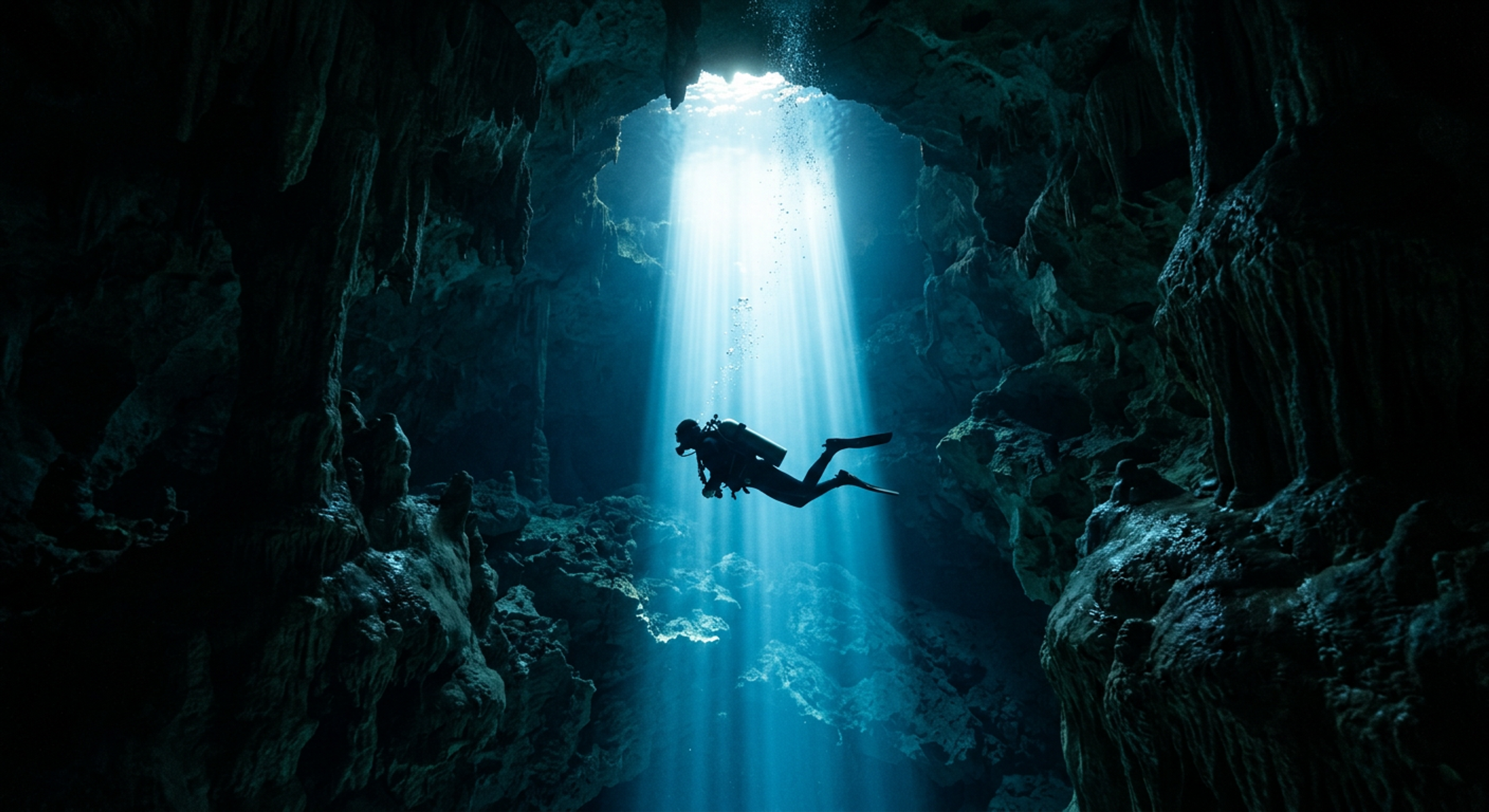
The Yucatan jungle is a chaotic mess of humidity, biting insects, and decaying roots. You stand at the edge of a collapsed limestone sinkhole sweating through your undersuit. You carry fifty kilos of life support equipment on your back. Twin steel cylinders press into your spine. The heavy backplate restricts your shoulders. The smell of neoprene baking in the sun mixes with the sour scent of rotting vegetation. The air is thick enough to chew. The local guides hack away at the vines with machetes while tourists in bright swimsuits splash clumsily in the shallow edges of the water.
I ignore them. I check my primary light, my backup lights, my primary regulator, and my redundant air supply. In cave cartography, there is no room for error. You verify your gear because the environment is actively trying to kill you. The jungle above is noise and heat. The void below is absolute silence and cold geometry.
You step off the wooden platform and the gravity disappears. The shock of the twenty-four degree Celsius freshwater hits your face. The chaos of the jungle vanishes instantly. Below the surface is pure, absolute structural order.
Most people know the cenotes around Cancun and Tulum as beautiful tourist attractions. They see the photographs of divers floating in laser beams of sunlight. Those shafts of light are undeniably beautiful. They cut through the crystalline water like solid pillars of white hot energy. The water is so clear it feels like you are suspended in midair. But the light is just the foyer. The actual architecture of the earth begins where the light dies.
The Bones of the Earth
The entire Yucatan peninsula is essentially a massive flat sponge made of porous limestone. Over millions of years during the Pleistocene epochs, the global sea levels rose and fell dramatically. When the oceans retreated, this limestone plateau was left dry. Rainwater mixed with carbon dioxide in the air and the soil. It became mildly acidic. This weak carbonic acid slowly ate away at the subterranean rock. It carved out massive underground caverns beneath the jungle floor.
Water dripped from the ceilings of these dry caves for thousands of years. Each drop deposited a microscopic ring of calcite. Slowly, centimeter by centimeter, stalactites grew downward. Stalagmites pushed upward. Sometimes they met in the middle to form massive, cathedral like columns. Then the ice caps melted again. The sea levels rose. The water table pushed upward and flooded these dry caves, preserving them perfectly in time. In some places, the ceilings of these flooded caverns grew too thin and collapsed. These sinkhole collapses are the cenotes. They are open wounds in the earth.

The ancient Maya called this flooded subterranean system Xibalba. The entrance to the underworld. The Popol Vuh, the foundational text of the Maya, describes Xibalba as a place of fright. They were not entirely wrong. Geologically speaking, a cenote is a window into a buried, suffocating epoch. The Maya believed the gods of death resided in these dark waters. They threw offerings into the sinkholes to appease them. Jade, gold, pottery, and human sacrifices all went into the void.
I remember surveying a deep restriction in Cenote Holtun back in 2018. We were laying line at about thirty-five meters down in a section the open water cavern divers never see. It was full cave territory. No natural light. A hard ceiling of rock between us and the sky. My primary light caught a hollow shape resting on a limestone shelf tucked behind a massive stalagmite column. I swam closer and adjusted my buoyancy to hover inches above the shelf. It was a human skull. It was partially calcified into the rock itself. Next to it lay a shattered clay vessel.
The skull was small. A child. It had been sitting in the dark, submerged in freezing water, for over a thousand years. I did not touch it. Underwater archaeology operates on strict rules. You do not disturb the artifacts in Xibalba. We simply mapped its coordinates on our slates, took a few reference photos, and backed away. You document the dead. You do not move them.
The Halocline Illusion
If you dive deep enough in many of these coastal systems, you encounter one of the strangest physical anomalies on the planet. The halocline.
Because the Yucatan is a porous limestone shelf bordering the ocean, seawater pushes inland through the deep subterranean fractures. Freshwater from the jungle rain collects on top of it. Saltwater is denser and heavier than freshwater. Therefore, the freshwater floats on top of the saltwater. They do not mix. Unless a careless diver kicks violently through the boundary, the two layers remain distinctly separate.
At around fifteen to eighteen meters in many cenotes, you hit this boundary.
It looks like a layer of liquid glass suspended in the dark. As you descend from the freshwater, you hit the halocline. Your vision suddenly blurs. The difference in salinity changes the refractive index of the water. Light bends erratically. Everything shimmers and distorts. If you look at your dive buddy across the halocline layer, they look like a funhouse mirror reflection. Their head might appear completely detached from their torso. It is deeply disorienting to the brain.

Then there is the physical sensation. The freshwater above is around twenty-four degrees Celsius. The saltwater below is noticeably warmer, usually around twenty-six degrees. You feel the sudden rush of heat seep through your drysuit undergarments as you drop through the glass floor. If you happen to have a slight leak in your regulator mouthpiece, you will instantly taste the sharp, metallic salt on your tongue.
The transition is abrupt. One second you are in cold, crystal clear drinking water. The next second you are swimming through warm, blurry ocean water deep underground.
A Comparison of the Water Columns
For a cartographer, understanding the layers is critical for plotting the flow of the aquifer. The water density affects our depth gauges and our survey calculations. Here is the typical breakdown of the water columns we encounter in the coastal cenotes.
| Feature | The Freshwater Zone (Above) | The Saltwater Zone (Below) |
|---|---|---|
| Depth | Surface to ~15 meters | Below ~15 meters |
| Temperature | 24°C (75°F) | 26°C (79°F) |
| Visibility | Infinite, highly transparent | Highly variable, often limited by sulfur clouds |
| Salinity | Drinkable (0-1 ppt) | High salinity (35 ppt) |
| Buoyancy Shift | Baseline reference | Highly positive (requires venting gas) |
| Dominant Formations | Bright white stalactites, tree roots | Darker rock, bacterial mats, hydrogen sulfide |
The buoyancy shift is the most immediate technical challenge for any diver crossing the halocline. Saltwater is denser. When you drop below the halocline into the saltwater zone, the upward force on your body increases. You suddenly become positively buoyant. If you are perfectly neutrally buoyant in the freshwater, crossing into the saltwater will make you float upward immediately. You must instantly vent gas from your buoyancy compensator or your drysuit to maintain your depth. If you fail to adjust, you will bounce right back up into the freshwater like a cork. This yo-yo effect can easily lead to a dangerous loss of buoyancy control.
The Deadly Silt and the Careless Diver
This brings me to my greatest irritation. The cavern tourists.
The open water divers who come to Cancun to do guided tours in the daylight zone of the cenotes are often completely unprepared for the environment. They treat the cavern like a shallow coral reef. They cycle their legs in wide, aggressive flutter kicks. They drop their knees. They let their fins strike the bottom. They flail their arms when they lose balance.
Nothing destroys the ancient architecture of a cave faster than a careless diver.
The floor of a cenote is rarely solid rock. It is almost always coated in a thick layer of fine, undisturbed silt. This is decades of decaying organic matter, bat guano, and pulverized limestone. It has the consistency of fine talcum powder. If you drop a single fin blade into that silt, it explodes like a bomb of grey smoke. It ruins the visibility instantly. That smoke will hang in the water column for hours. Sometimes it takes days to settle back to the bottom.

In the open cavern zone where the tourist guides operate, a silt out is just an annoyance. It ruins the vacation photos. The tourists simply swim toward the giant glowing entrance to escape it. But back in the true cave, past the daylight zone, a silt out is lethal.
If you are five hundred meters back in a tight tunnel and you kick up the floor, you lose all visual reference. The water turns into a thick grey milk. Your powerful primary lights bounce off the suspended particulate matter right back into your eyes. You cannot see the ceiling. You cannot see the floor. You cannot even see your own hand pressed against your mask. Panic sets in fast. Untrained divers lose the physical guideline. They swim in circles. They swim into dead end pockets. They run out of gas. They die.
Neutral buoyancy is not a suggestion in overhead environments. It is a strict mandate of survival.
I spend most of my life suspended in absolute darkness. You learn to control your breathing with microscopic precision. Inhale to rise an inch to clear a fragile, thousand year old stalactite. Exhale slowly to drop an inch to slide beneath a tight restriction. You bend your knees at a rigid ninety degree angle. You keep your fins elevated above your torso at all times. You learn the modified frog kick. A slow, precise pushing of water straight backward. No downward force. No wasted energy. You move like a ghost through the corridors of limestone. You leave absolutely no trace that you were ever there.
If you do lose visibility, cave diving agencies like PADI and TDI have absolute rules. You drop your hand to the continuous braided nylon guideline running back to the exit. You form an OK signal around the line with your thumb and forefinger. You do not pull it. You do not drag it. You simply maintain tactile contact and follow it out, blindly, foot by foot. You trust the line over your own disoriented brain.
The Cartography of the Void
We map these systems by tying thin nylon lines to the rock. We establish a permanent breadcrumb trail to the surface. We run our survey tapes along these lines. We hover motionless in the water column, writing numbers on plastic slates with waterproof pencils. We take our compass headings. We record the azimuths, the exact depths, the distance between tie off stations.
Back on the surface, I will spend hours plotting these vectors into a computer. I watch the subterranean map grow. I watch the tunnels connect. We slowly build a three dimensional model of an aquifer that stretches for hundreds of kilometers beneath the jungle floor. Every single movement underwater is calculated to support this goal. The cave does not care about your ego. The rock does not forgive a mistake.
The End of the Light
The guided cavern dives always end at the same place. The guides signal their groups to turn around. The tourists swim back toward the massive cenote entrance. They swim toward the spectacular green glow of the jungle canopy filtering through the water. They take their final photos in the sunbeams.
I do not follow them.
My dive partner and I hover at the warning sign. It is a grim reaper poster mounted securely on the rock. It warns open water divers to go no further. It explicitly states that there is nothing in the cave worth dying for. We check our pressure gauges one last time. We calculate our rule of thirds. One third of our gas to penetrate, one third to exit, one third held in absolute reserve for emergencies. We signal each other with our primary lights. A slow, deliberate circle on the rock wall. OK.
Then we turn our backs to the sun. We kick gently, horizontally, perfectly trimmed out, past the warning sign.

We slip into the permanent darkness. The temperature drops. The walls close in until they are inches from our shoulders. The geometry of the tunnel becomes tight and sharp. The noise of the tourists fades away completely.
Sometimes, when we are thousands of feet back into the system, I stop to tie off a survey station. I turn off my primary light for just a moment. I cover my backup lights with my hand. The absolute blackness rushes in. It is a darkness so pure it feels heavy against the skin. You can hear nothing but the rhythmic, mechanical hiss of your regulator feeding you air. You are suspended in a pocket of water that has not seen the sun since the ice age. It is the void. It is the most peaceful place on Earth.