

Night Diving Is Not a Ghost Story: Why You Must Switch Off the Lights
Everyone asks me, 'Malik, aren't there sharks in the dark?' My friend, the dark is where the ocean wakes up. Let me show you the blooming corals, the hunting lionfish, and why the night is actually the most colorful time to dive.
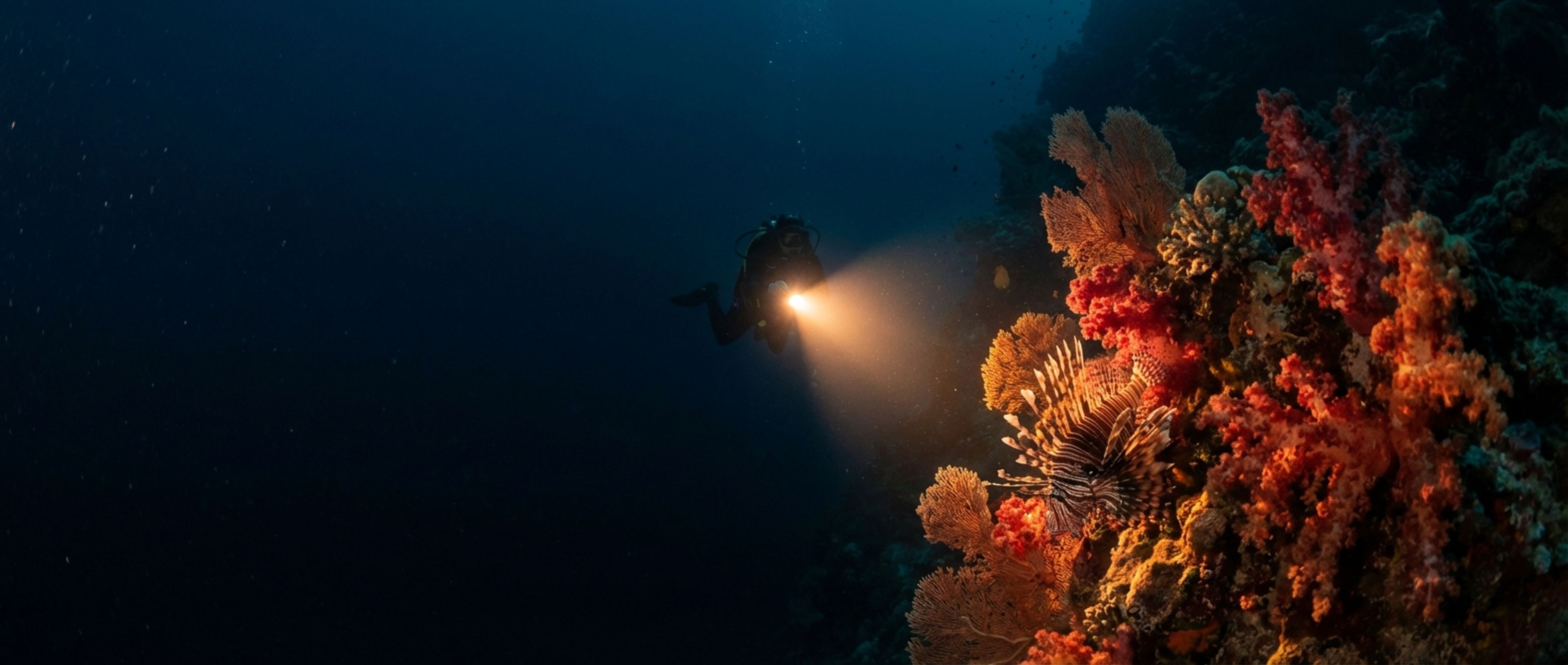
My friend, welcome. Sit. The Bedouin tea is hot, and the sugar is plentiful.
Look out there at the Gulf of Aqaba. It is black now. Pitch black. The mountains of Saudi Arabia are just shadows against the stars. I see you looking at the water with that little shiver in your shoulders. I know what you are thinking.
You are thinking about the movie Jaws. You are thinking about the cold. You are thinking that if you jump in there, something with big teeth is waiting to snack on your fins.
Listen to Malik. The ocean at night is not a haunted house. It is a garden that only blooms when the sun goes down.
I have guided thousands of dives here in Dahab. The Blue Hole, the Canyon, the Lighthouse. But my favorite dives are always the ones where we roll backward off the boat into the ink. Why? Because during the day, the sun steals the color. The water acts like a blue filter. Everything below 10 meters is blue, grey, maybe a little green.
But at night? You bring the sun in your hand. Your torch reveals the true reds and oranges that the daylight hides. And the creatures... ah, my friend, the ocean has a night shift, just like a busy hotel.
Let me tell you why you must stop being afraid of the dark and come with me tonight.
The Changing of the Guard
When the sun sets behind the Sinai mountains, a whistle blows underwater. The day shift goes to bed. It is actually quite funny to see.
The parrotfish, you know the colorful one that crunches on the coral? He finds a little cave. He does not just sleep. He opens his mouth and spins a sleeping bag made of his own mucus. It looks like a clear jelly balloon. He sleeps inside it to mask his scent so the eels cannot smell him. If you shine your light on him, you see him snoozing in his bubble. Do not wake him. He is tired from eating rocks all day.
But while he sleeps, the hunters wake up.
The Hunters and the Flowers
During the day, the Lionfish just hangs around. He looks bored. He looks like he is waiting for a bus that never comes. But at night? He is a wolf. His fins spread wide. He uses your torchlight to hunt, herding the small fish against the reef wall. Snap. Gone. Watching a Lionfish hunt is like watching a ballet dancer who is also an assassin.
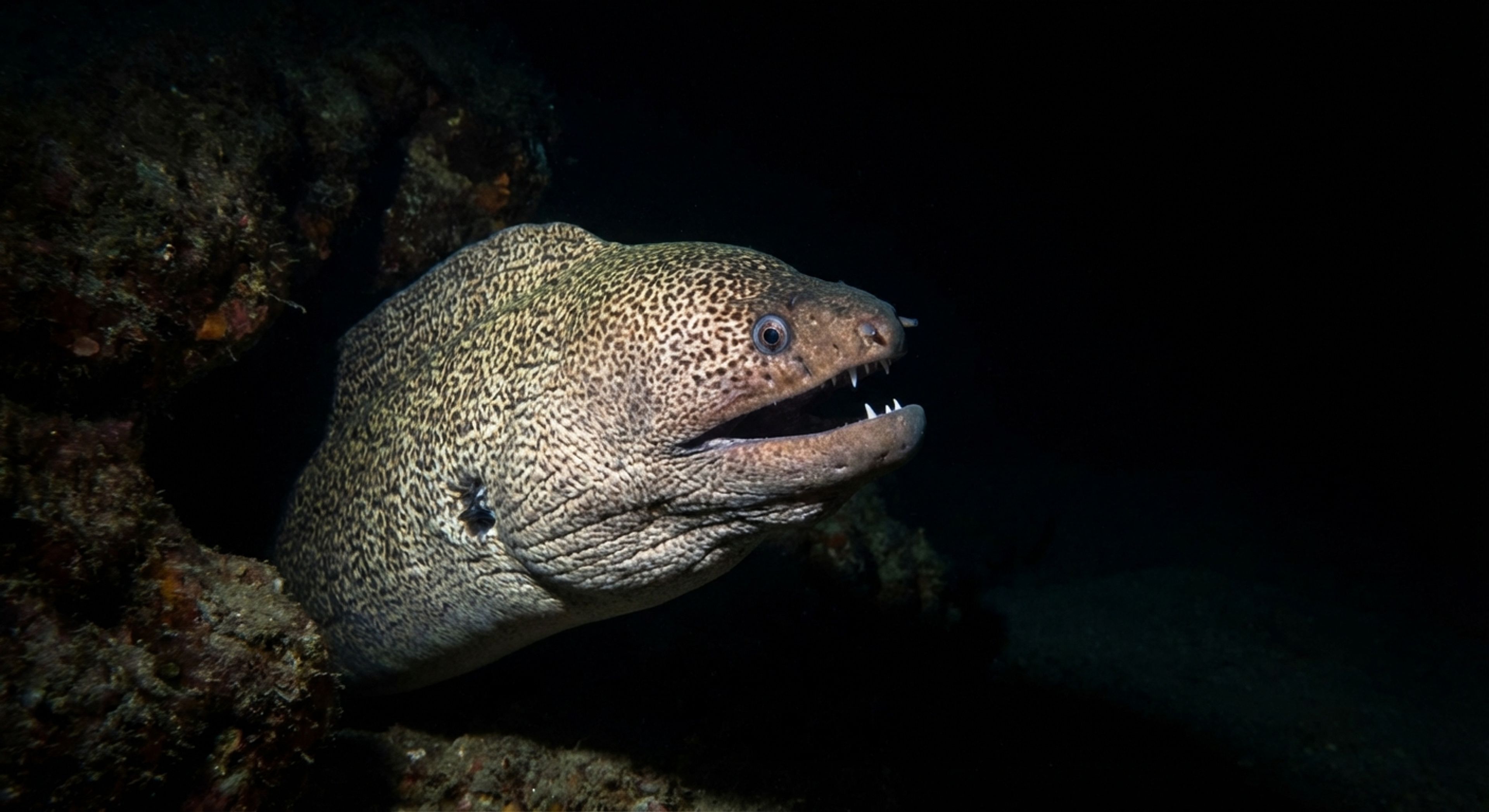
And the Moray Eels. In the day, they are shy. They just show you their heads. At night, they swim free. A Giant Moray swimming next to you is a ribbon of pure muscle. It is beautiful, not scary.
But the biggest surprise? The rocks. The hard corals. During the day, they look like stone. At night, they are hungry animals. The coral polyps open up to catch plankton. A hard brain coral transforms into a fuzzy ball of millions of tiny flowers. The colors explode. Yellows, bright oranges. It is alive.
Bringing Your Own Sun: The Gear You Need
You do not need to be a tech diver to go night diving. You just need to be prepared. When we dive the Canyon at night, I check my divers' gear twice.
Here is the truth: You are dependent on your equipment more than in the day. If your mask floods in the day, you see blurry light. If your light dies at night, you see nothing. Nothing at all.
The Holy Trinity of Light
- The Primary Light: This is your main torch. It should be strong, but not like a car headlight. If it is too bright, you scare the fish and you blind your buddy. You want a tight beam to cut through the water.
- The Backup Light: This is non-negotiable. It stays in your BCD pocket. If your main light fails (and batteries do die, my friend), you do not panic. You reach into your pocket, you pull out the backup, turn it on, and you signal your buddy to abort the dive. We go up together. Safe.
- The Tank Signal Light: We call this the "firefly." It is a small battery strobe or a chemical glow stick attached to your tank valve. It is not for you. It is for me, your guide. When I look back, I see four or five little green or red stars following me. If I don't see your star, I know I have to find you.
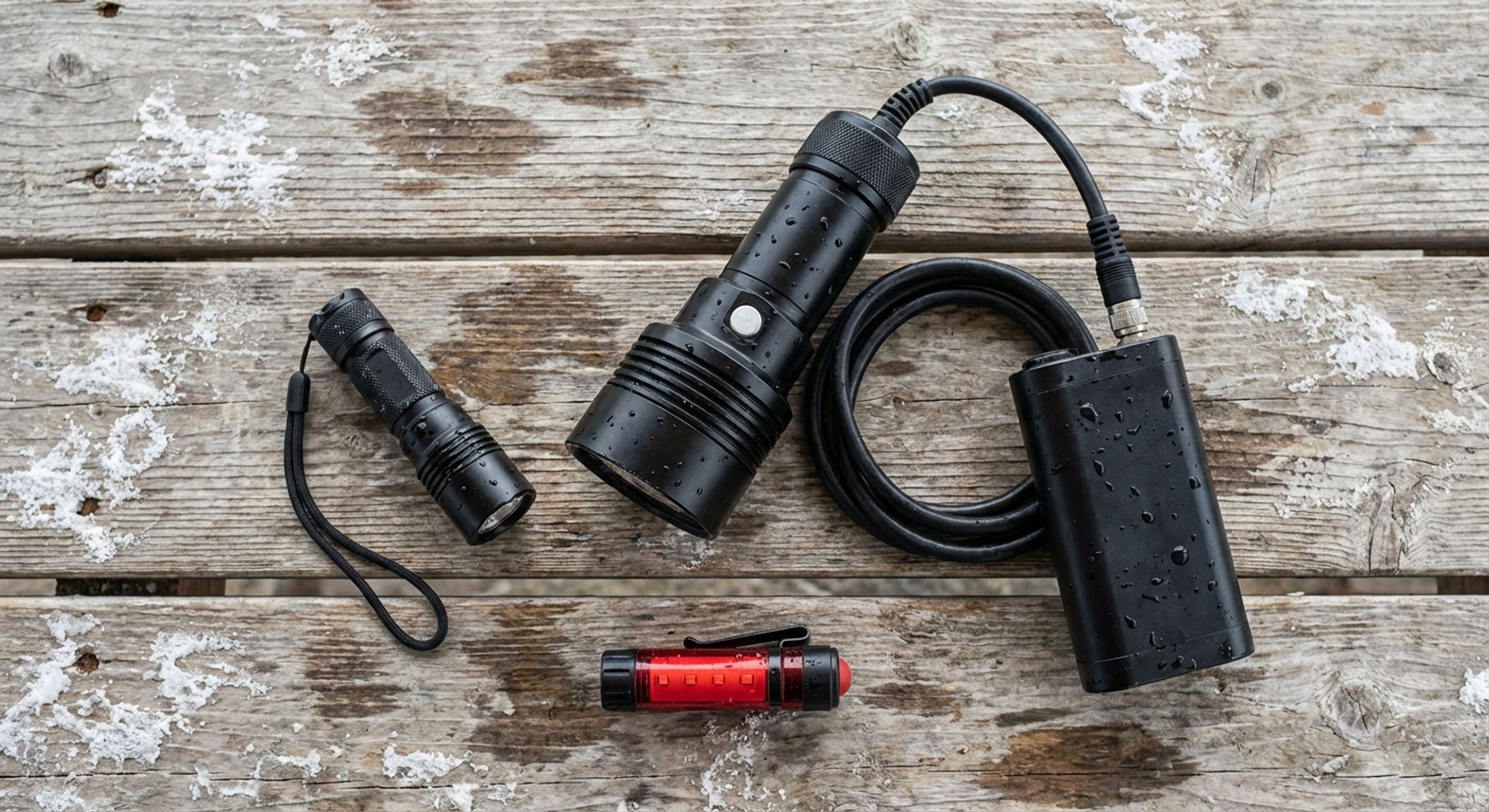
Here is a simple table to help you understand the difference in preparation:
| Feature | Day Diving | Night Diving |
|---|---|---|
| Vision | Peripheral vision is wide. You see everything. | Tunnel vision. You only see what you light up. |
| Colors | Filtered by depth (mostly blue). | True colors (reds/oranges) because light source is close. |
| Buddy Check | Look over your shoulder. | Look for their light beam or tank marker. |
| Navigation | Use landmarks and reef shape. | Use compass and depth gauge. Landmarks disappear. |
Speaking Without Talking
This is where new divers get confused. In the day, if you want to ask your buddy if they are okay, you make the "OK" sign with your hand.
At night, if you make the hand sign in the dark, you are just waving at the ghosts. Nobody sees it.
You must talk with your light. But please, never, ever shine your light in your buddy's eyes. This is the rudest thing you can do underwater. It ruins their night vision for five minutes. They will hate you.
The Language of Light
- The Circle: You draw a circle on the sandy bottom or the reef wall with your light beam. This means "OK." It is a question and an answer. I circle, you circle back. We are good.
- The Horizontal Wave: Moving the beam side to side on the floor. This means "Attention!" Look at me. If moved rapidly and violently, it means distress.
- Hand Signals: To show a hand signal (like "low air" or "shark"), you must shine your light on your own hand. You shine the torch against your chest and make the sign in the spotlight so your buddy can see it.
It feels clumsy at first. Like learning to dance with heavy boots. But after ten minutes, it becomes natural.
The Fear and The Magic
I will tell you a secret. The first time I night dived, I was scared. I was a young boy in Dahab. My father threw me in. I thought the sea monsters were waiting.
The fear comes from the unknown. When you jump in, you feel disoriented. The surface is black, the bottom is black. You might feel a little vertigo. This is normal. Trust your instruments. Look at your depth gauge.
But then, you turn on your light. You see the sand. You see a crab running sideways. The world shrinks. In the day, you look everywhere. You look for the whale shark, the turtle, the boat. Your mind is racing.
At night, you only look at the small circle of light in front of you. It is meditation. You breathe slower. You move slower. You focus on the tiny shrimp cleaning the eel's teeth. You stop worrying about the sharks in the deep water because you cannot see them, so they do not exist in your mind.
The Sparkles in the Blue Hole
One time, I took a group to the Blue Hole. We went down to 15 meters. I signaled everyone to gather in a circle on the sandy shelf. I told them on the boat beforehand what we would do.
I gave the signal: Shield your lights.
We pressed our lights against our chests to hide the beams. Total blackness. The kind of black that has weight. You can hear your own heart beating in your ears.
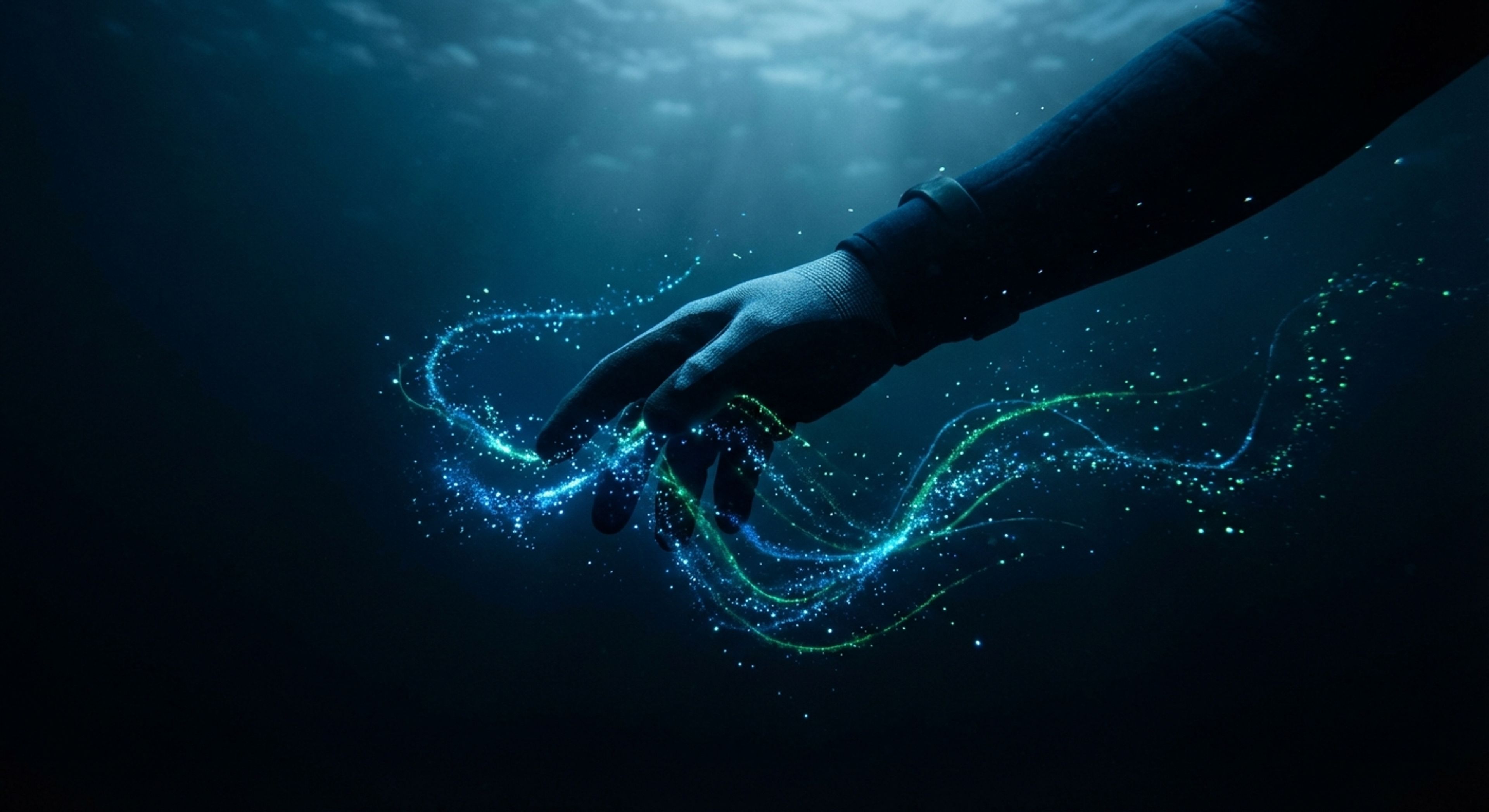
Then, I waved my hand through the water. Sparkles.
Bioluminescence. The plankton in the Red Sea glows when you disturb it. We spent five minutes just waving our arms like children, making trails of green fire in the water. It was like floating in deep space. We were not underwater anymore; we were astronauts.
Come, The Water is Warm
The sea at night is usually calmer. The wind dies down. The waves stop slapping the shore.
Do not let the fear of the dark keep you on the dry land. The ghosts you are afraid of are not there. Instead, you will find the Spanish Dancer, a big red nudibranch that swims by undulating its skirt like a flamenco dancer. You will see the basket stars uncurl their arms to catch the current.
You will see the ocean as it is when we humans are not looking.
So, finish your tea. The tank is full. The batteries are charged. Let’s go see what the fish are doing.
Yallah, let's dive.