

Scuba Diving Okinawa & Ishigaki: Mantas & USS Emmons
Trading the warm Maldivian atolls for the East China Sea brought me face to face with familiar winged shadows. Japan offers a masterclass in meticulous dive hospitality alongside pelagic magic.
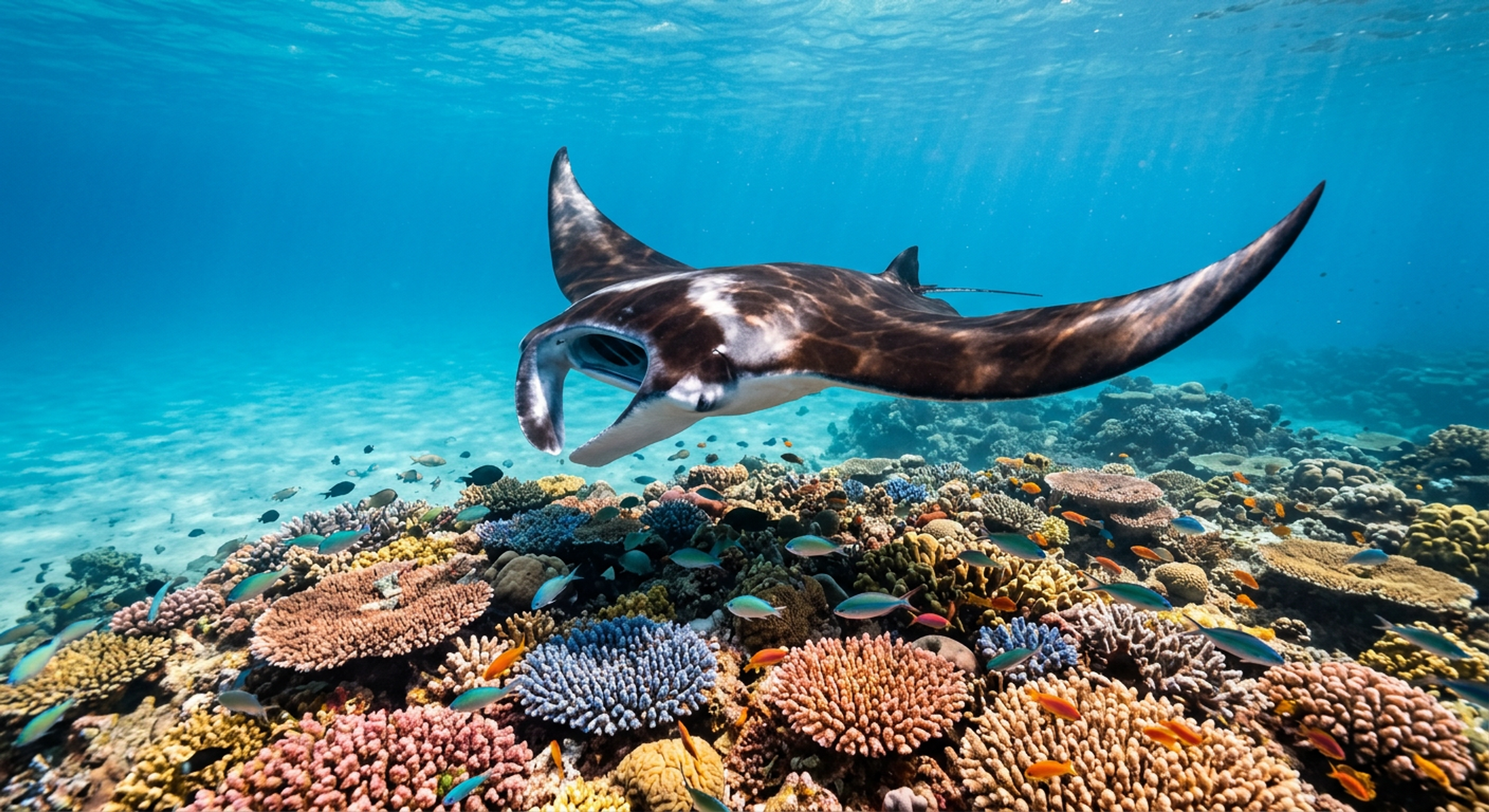
The water off Kabira Bay has a distinct chill when you first roll backward off the skiff. It bites just a little through my five millimeter wetsuit. I am a long way from the bathwater temperatures of my home in the Baa Atoll. Down at twelve meters, kneeling on a sandy patch framed by hard corals, the waiting begins. We watch the cleaning station. The rhythmic breathing of twenty divers sounds like Darth Vader breathing in stereo.
Then a shadow falls over the reef.
A reef manta ray (Mobula alfredi) glides into view. It banks over the coral head with the practiced grace of a seasoned dancer. Even after a lifetime spent guiding luxury liveaboards in the Maldives, my heart still skips a beat at the sight of those massive cephalic fins. The wait is always worth it.
The Art of Japanese Dive Hospitality
As a Cruise Director I am obsessed with details. My life revolves around tide charts, crisp white towels, and ensuring my guests have hot ginger tea the second they surface. I consider my crew in the Maldives to be the gold standard of luxury diving. But stepping onto a Japanese dive boat in Ishigaki gave me serious pause. The level of meticulous care here is staggering.
Let me paint a picture for you. The briefings are not just spoken. They are illustrated on waterproof whiteboards with tiny magnetic divers showing exact positioning. Every piece of rental gear looks brand new and smells faintly of baby shampoo. When you climb back up the ladder after an hour in the surge, a crew member is right there. They do not just take your fins. They hand you a steaming cup of barley tea and a perfectly folded warm towel.
Japanese hospitality is famous on land but seeing it applied to the wet salty chaos of scuba diving is pure magic. They anticipate your needs before you even register them. Safety is an absolute religion here. The dive masters know every current shift and every tidal pull by heart.
During our surface interval the boat anchored in a quiet cove. The crew produced immaculate bento boxes filled with grilled fish, tamagoyaki, and pickled plum rice. We sat on the polished wooden deck eating in contented silence while the salty breeze dried our hair. Back home my crew serves elaborate curries and fresh sashimi but there is an elegant restraint to this Japanese boat lunch that I deeply admired. After the meal the dive master sat with us. He brought out a beautiful hand drawn map of the reef to help us log our dive. He knew the scientific names of every nudibranch we had passed. I took mental notes to bring some of this quiet structured perfection back to my own liveaboard.
Manta Scramble at Kabira Bay
Let us talk about the main event. Ishigaki Island sits in the Yaeyama archipelago and its crown jewel is the Kabira Bay area. Specifically the site known as Manta Scramble. In the Maldives we often see mantas barrel rolling in massive feeding frenzies. Ishigaki offers a different kind of ballet. This is a cleaning station. The mantas come here to hover in the current while tiny wrasse pick parasites from their wings and gills.

You drift along the reef edge until the dive master signals a halt. You find a bare rock to hold onto with two fingers. You wait. The current pulls at your mask skirt. The water tastes sharp and briny. Suddenly three mantas emerge from the endless blue. They stack themselves in the water column. They hover almost entirely motionless despite the ripping current. You can see the intricate black spots on their white bellies. Those markings are entirely unique to each individual. Watching them hold their position with barely a flick of their wingtips makes you realize how incredibly clumsy humans are underwater.
In Kabira Bay the rules are strictly enforced and rightly so. You do not swim after the mantas. You do not position yourself above them. You stay low. You control your buoyancy. If a diver breaks these rules the dive masters will intervene immediately. I respect that fiercely. The ocean is their home and we are merely clumsy guests invited for a brief visit.
When you surrender to the stillness the mantas reward you. One large female swooped so low over my head I could feel the water pressure shift from the displacement of her wings. She looked right at me with a large intelligent dark eye before banking away into the current.
Comparing Manta Encounters
As someone who watches mantas for a living I find the behavioral differences fascinating. Here is how my home waters compare to the reefs of Ishigaki.
| Feature | Baa Atoll, Maldives | Ishigaki Island, Japan |
|---|---|---|
| Primary Activity | Feeding frenzies | Cleaning stations |
| Typical Depth | Surface to 15 meters | 10 to 15 meters |
| Water Temperature | 28 to 30 Celsius | 24 to 29 Celsius |
| Best Season | May to November | September to November |
| Vibe | Wild chaotic energy | Graceful organized hovering |
Okinawa Main Island and The Blue Cave
A short flight north brings you to Okinawa Main Island. Here the ocean changes its rhythm entirely. The coastal drive toward Cape Maeda is gorgeous but I have to admit something. I am naturally allergic to crowded dive sites. As a liveaboard director I pride myself on finding isolated reefs where my guests are the only humans for miles. Cape Maeda is the opposite of that. It is the home of the famous Blue Cave.
On a sunny morning the parking lot is packed with vans and divers hauling heavy tanks down a steep set of concrete stairs. The sweat pools at the small of my back. Neoprene squeaks against neoprene. I was ready to hate it. Then we dropped beneath the surface.

We swam through a dark limestone tunnel. The light faded to a deep charcoal gray. My dive guide signaled for us to turn around. The entrance behind us glowed with an electric sapphire brilliance. It looked like the water itself was plugged into a power source. The Ryukyu limestone that makes up Cape Maeda is highly porous. Over countless millennia the relentless pounding of the East China Sea carved out this cavern. It is not a particularly deep or long cave but its orientation is a masterstroke of natural architecture.
The sun hits the sandy seabed just outside the entrance at the perfect angle. That light refracts up through the clear water and illuminates the dark interior. The sheer beauty of the light playing off the walls silenced my inner cynic completely. We lingered in that blue glow while schools of sweepers parted around us like silver rain.
A Sobering Descent to the USS Emmons
If Ishigaki is a graceful dance and the Blue Cave is a light show then the USS Emmons is a haunting midnight choir. Lying off the coast of Kouri Island this World War Two destroyer rests at a punishing depth of forty meters.
This dive is not for the faint of heart. It is deep. It is strictly for advanced divers with deep diving certifications. It is often swept by fierce currents. As we descended down the mooring line the surface heat vanished. The water grew distinctly cold and heavy. At thirty meters the massive shadow of the 106 meter warship materialized from the gloom.
The ship was struck by five Kamikaze planes in April 1945 during the Battle of Okinawa. Sixty dead. Seventy seven wounded. The US Navy ultimately had to scuttle her to prevent her from falling into enemy hands. Now she rests on her starboard side. Penetration is strictly forbidden and completely unnecessary. The exterior alone offers a lifetime of exploration.

The ocean has claimed her slowly. Her twin gun turrets are now encrusted with delicate gorgonian sea fans. Glassfish swarm around the twisted metal where the explosions tore through her hull. We swam past the massive propellers. They are frozen in time but completely covered in vibrant soft corals. A large school of batfish trailed behind us like curious sentinels guarding a graveyard.
Floating over the deck of a sunken warship always commands a deep respectful silence. You can feel the weight of history in your chest alongside the compressed air. My dive computer nudged me about my approaching no-decompression limit. PADI and SSI safety limits at this depth are unforgiving. We had barely eight minutes at the bottom before we had to begin our long slow ascent. Drifting up the line into the warming shallows I watched the ship fade back into the deep blue void. It was a profound reminder of the ocean's dual nature. She is a giver of life to gentle giants and a quiet tomb for human conflict.
Japan took me by surprise. I arrived expecting to miss the warm endless atolls of my home. I left completely captivated by the precise careful orchestration of Japanese diving. They respect the sea with a fierce polite dedication. Whether you are holding your breath as a manta ray glides inches above your head in Kabira Bay or tracing the rusted guns of a forgotten warship the waters of Okinawa and Ishigaki demand your full presence. You just have to roll backward and let the current take you.