

Raja Ampat: Surviving the Underwater Amazon
The currents are wild, the flights are endless, and the reefs are too big. Here is how a muck diver survives the edge of the world.
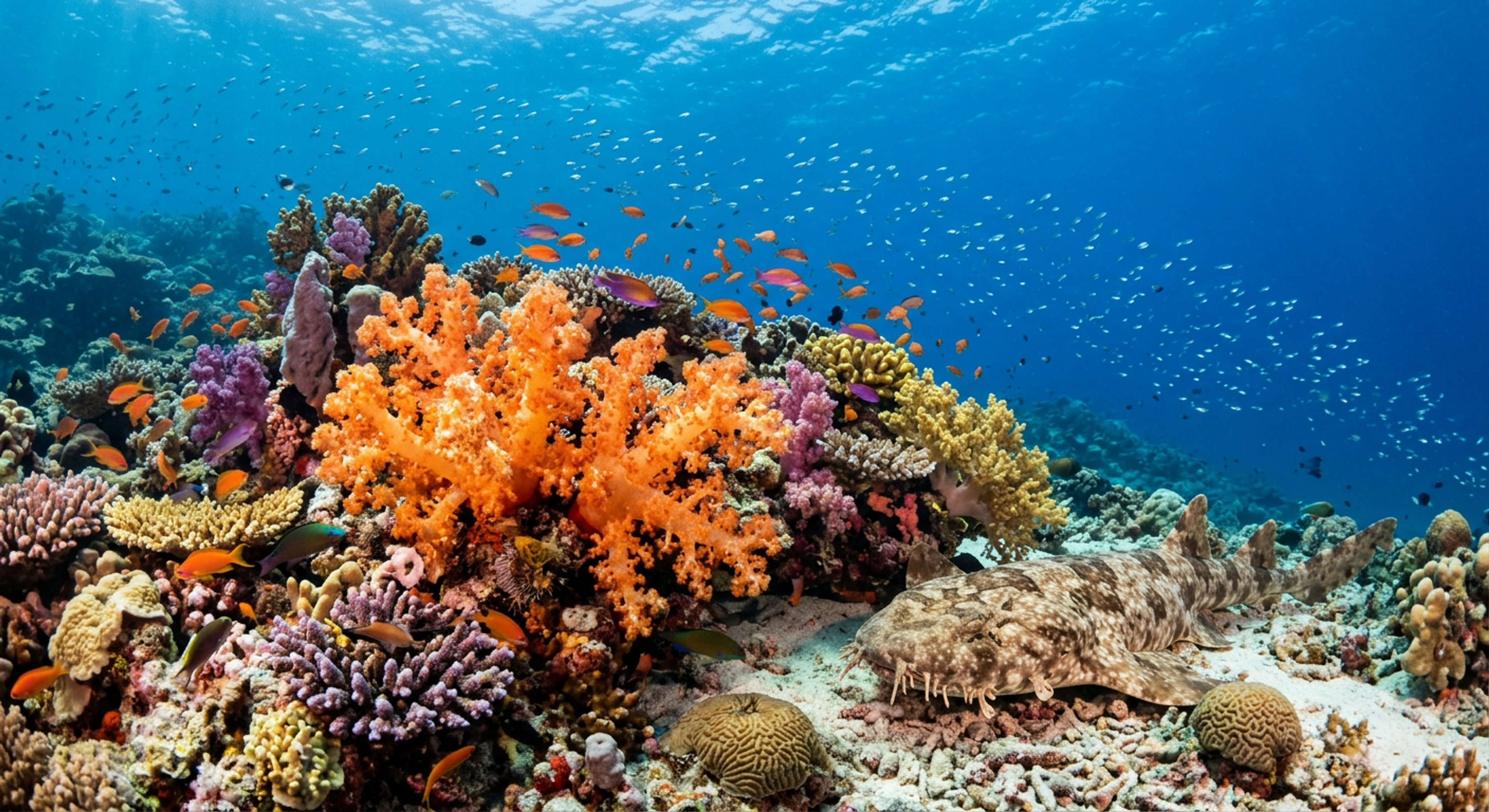
My dive guide was banging his tank with a metal pointer stick. The sharp clanking sound echoed through the water like a faulty car alarm. I ignored him completely.
I had my 105mm macro lens pressed inches away from a purple Muricella gorgonian sea fan. There was a Bargibant's pygmy seahorse hiding right there in the polyps. It was maybe fifteen millimeters of pink bumps and a curly tail. I had my f-stop locked at f/22 for maximum depth of field. My ISO was crushed down to 100. I was waiting for the tiny creature to turn its head toward my focal point. The tank banging got louder. A massive shadow blocked out the ambient sunlight from above. I finally looked up from my viewfinder. A giant black manta ray was hovering right over my head. My strobes were pushed in tight for macro lighting. I could not shoot a manta with a 105mm lens. I just glared at the majestic beast until it glided away.
Welcome to Raja Ampat.
People call this sprawling archipelago the underwater version of the Amazon rainforest. They are not exaggerating. Situated at the very eastern edge of Indonesia in West Papua, Raja Ampat is the absolute epicenter of the Coral Triangle. Scientists have recorded over 1600 species of reef fish here. They also found over 550 species of hard corals. To put that in perspective, the entire Caribbean Sea has maybe 70 coral species on a good day.
For a dedicated muck diver from the Lembeh Strait like me, this place is pure sensory overload. Lembeh is black volcanic sand. It is quiet. It is mostly empty until you spot the weirdest alien creature imaginable hiding in a discarded glass bottle. Raja Ampat is visually loud. Every square inch of the reef is covered in something trying to outgrow something else. Soft corals expand in the aggressive currents like inflated lungs. Anthias swarm the reef walls in thick clouds of orange and purple. It is a biological traffic jam caused by the Indonesian Throughflow. Millions of gallons of water push from the Pacific Ocean into the Indian Ocean right through these islands. This massive water movement brings a non-stop buffet of nutrients.
You drop down to 25 meters at a dive site like Blue Magic and the current immediately tries to rip your mask off. You have to hook into dead rock with a reef hook just to stay put. Your bubbles fly completely sideways. You also have to watch your dive computer like a hawk. When you are fighting a washing machine current at 25 meters, your air consumption spikes and your No-Decompression Limit (NDL) drops rapidly. You do not mess around with decompression limits when you are miles away from the nearest hyperbaric chamber.

The Endemics of the Edge
Let us talk about the locals. Raja Ampat has creatures you will not easily find anywhere else. Most tourists come here for the sweeping wide-angle shots of pristine coral gardens. I come here to hunt for the weird bottom dwellers.
The Tasselled Wobbegong shark (Eucrossorhinus dasypogon) is my absolute favorite predator in these waters. Most sharks are nervous and constantly swimming away from photographers. The wobbegong is profoundly lazy. It sits under table corals and waits for careless fish to swim directly into its mouth. It has a fringe of fleshy branching lobes around its jaw that looks exactly like marine weed. Its skin is a complex mosaic of spots and lines. From a photography standpoint, it is a dream subject. You can get incredibly close without spooking it. You can adjust your strobe power meticulously. You can dial in your shutter speed to 1/125s to expose the deep blue ambient water in the background while keeping the shark perfectly lit in the foreground.
Sometimes you find them resting on top of massive brain corals. They just stare at you with tiny piercing eyes. They look like forgotten bath mats left on the seafloor.

Then there are the mantas. Specifically, the melanistic black mantas of the Dampier Strait. At sites like Manta Sandy, you just kneel in the rubble behind a line of rocks and wait. These giants come in to get cleaned by tiny wrasses. The black morphs are entirely black on their bellies instead of white. Getting a proper photo of a black manta requires serious strobe discipline. If you blast them head-on with light, you just illuminate all the floating particles in the water. We call that backscatter. It ruins photos instantly.
You have to pull your strobe arms far out to the sides and angle the flash heads slightly outward. You light the manta with the inner edge of the beam. Even knowing the technique, I still prefer my macro critters. A black manta takes up too much memory card space.
The Brutal Journey and Empty Wallets
Getting to this remote paradise is a miserable experience. You do not just fly to Raja Ampat directly from Europe or America. You endure a gauntlet of regional airports, questionable luggage scales, and endless waiting.
You usually start in Jakarta or Bali. Then you take a red-eye flight on a domestic carrier to Makassar in Sulawesi. You sit on a hard plastic chair in the transit lounge at 3:00 AM drinking terrible instant coffee. Then you board another early morning flight to Sorong in West Papua. The Sorong airport is chaotic. Porters grab at your bags immediately. The humid heat hits you the second you step off the plane. The air smells strongly of clove cigarettes.
The Sorong harbor smells of diesel fumes, rotting fish, and wet rope. You drag your heavy Pelican cases full of delicate glass dome ports over rickety wooden planks to reach your liveaboard boat. The excess baggage fees for camera gear alone cost as much as a new dive computer. A proper trip to Raja Ampat will empty your bank account faster than a flooded camera housing. Liveaboards charge a massive premium for fuel and isolation. Marine park fees are constantly increasing.
But the moment you jump into the water at Misool in the southern part of the park and see the sheer density of life, you forget about your depleted savings account. Mostly.

The Glass and Aluminum Burden
I need to talk about the physical toll of bringing a proper camera rig here. My aluminum housing, glass ports, dual strobes, and video lights weigh nearly fifteen kilograms on land. In the water, float arms make it neutrally buoyant. Out of the water, it is a nightmare.
I remember one time at Melissa's Garden. It is a famous shallow hard coral plateau in the Fam Islands. The guide told us it was a relaxing dive. Guides always lie. The surge was throwing me back and forth across a massive field of staghorn corals. I had spotted a tiny Costasiella nudibranch. We call them leaf sheep. It is a brilliant green slug that steals chloroplasts from algae. I was holding my breath slightly just to stabilize my buoyancy. This is a terrible habit that PADI instructors absolutely hate. It is dangerous and can lead to lung expansion injuries. But every underwater photographer has done it for the shot. The saltwater was slowly leaking through my regulator mouthpiece. I could taste the bitter brine.
I had my external diopter flipped down over my macro lens. The depth of field was essentially the width of a human hair. Every time the ocean surge pushed me forward, the leaf sheep became a green blur. Every time it pulled me back, I lost it entirely. I spent forty-five minutes fighting the ocean for one sharply focused frame. I drained my tank down to 50 bar. My computer was yelling at me to ascend and start my safety stop. It was miserable. I loved it.
If you get blown off the reef during a dive like this, you have to be prepared. You must shoot your Surface Marker Buoy (SMB) early. If you drift into the blue at Cape Kri without a bright orange sausage marking your position, the skiff driver will never find you. You will just drift toward Halmahera.
Choosing Your Punishment: Seasons and Conditions
You need to time your trip perfectly. The ocean does not care about your vacation schedule or your expensive camera rig. The winds dictate everything in the archipelago.
| Season | Water Temperature | Visibility | Marine Life Focus | Diving Conditions |
|---|---|---|---|---|
| October to April | 27°C to 29°C | 10 to 20 meters | Mantas, Macro, Plankton blooms | Peak season. Nutrients bring large pelagics. |
| May to September | 26°C to 28°C | 15 to 30 meters | Clear water wide-angle, Reef sharks | Rough surface conditions. Manta sightings drop. |
I personally prefer the October to April window. Yes, the visibility drops significantly because the water is thick with plankton. Wide-angle photographers hate this season. They want crystal clear blue water for their reefscapes. I love the plankton. Plankton feeds the tiny things at the bottom of the food chain. The nudibranchs are fat. The skeleton shrimps are everywhere fighting each other on hydroids.
The currents during this peak season are famously aggressive. A site called Cape Kri holds the world record for the most fish species recorded in a single dive. Dr. Gerry Allen famously counted 374 distinct species in one dive there in 2012. I usually spend an entire dive looking at one square foot of yellow tube sponge, but I appreciate his statistical dedication.
Diving during the May to September monsoon brings strong winds to the southern regions. Crossing down to Misool during this time means feeling your stomach drop with every huge wave that hits the boat hull. The smell of damp neoprene inside the dive deck mixes with the smell of seasickness pills. Most boats move to the northern areas like Wayag or just go into dry dock for maintenance.

Diving Raja Ampat forces you to make terrible choices every single morning. Do you put the heavy glass dome port on your housing to capture the schooling barracuda? Or do you mount the 60mm macro lens to hunt for the elusive Pontohi pygmy seahorse hiding in the Halimeda algae?
You cannot change lenses underwater. Once the housing is sealed, your fate is locked for the next hour. I have sat on the wooden dive deck sweating profusely in my 3mm wetsuit, staring at my camera, paralyzed by indecision while the salt dried on my skin. I almost always choose macro. Let the visiting tourists take photos of the big stuff. Give me a ripping current, a tiny crustacean, and an hour of pure stubborn focus. My silicone O-rings are freshly greased. The strobe batteries are fully charged. The skiff engine is running loud in the background. Time to drop down.