

Solo Diving Guide: Risks, Gear & Self-Sufficiency
The buddy system is a crutch that often snaps under pressure. True survival relies on redundancy, psychological steel, and the absolute ability to solve problems alone in the dark.
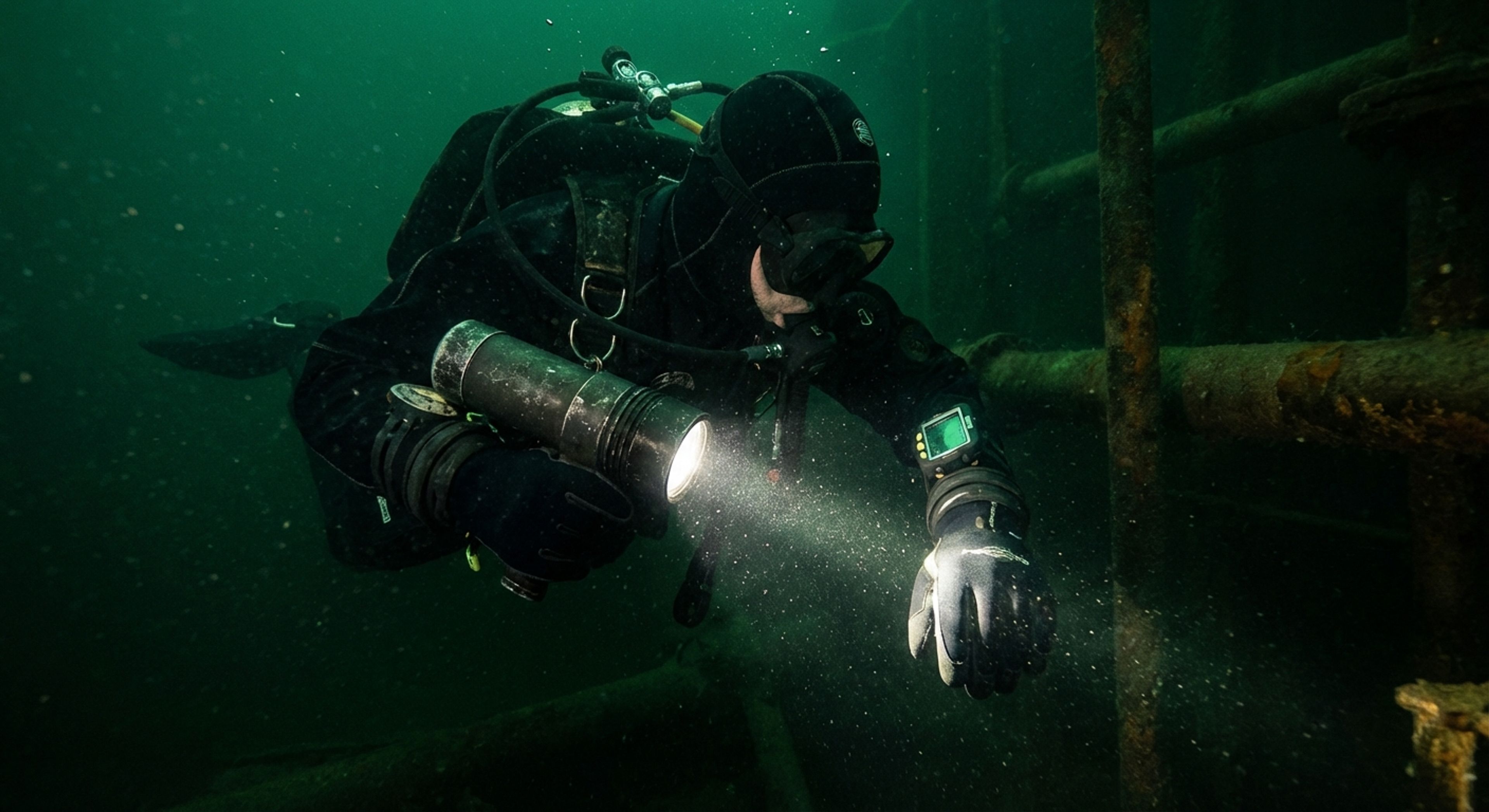
Most recreational divers are trained to hold hands. From the first open water course, you are drilled with the concept of the buddy system. You are told that if your air runs out, your regulator freezes, or you get tangled in a ghost net, your buddy will be your savior.
That is a comforting lie.
In my line of work, 150 meters down in the North Sea, the only person responsible for your life is looking back at you in the mirror. Even in recreational limits, a panicked buddy is often more dangerous than a shark. They don't save you. They climb you like a ladder to get to the surface, blowing their lungs and yours in the process.
Let’s get one thing straight. Solo diving is not just "diving alone." Any idiot can jump off a boat without a partner. That is negligence. Solo diving is the practice of Self-Sufficient Diving. It is the discipline of redundancy. It is the engineering of safety systems so robust that you become your own rescue team.
Agencies like PADI and SDI offer "Self-Reliant" or "Solo Diver" courses for a reason. If you are not ready to handle a catastrophic equipment failure in freezing water with zero visibility while your heart rate remains under 60 beats per minute, stay on the boat.
The Myth of Loneliness vs. The Reality of Self-Sufficiency
The recreational industry scares people away from solo diving because of liability. They paint a picture of a lonely diver drifting into the void.
The reality is colder and harder. Self-sufficiency means you have calculated the gas required to solve a problem at depth, ascend, and complete decompression stops without assistance. It changes your mindset. When you dive with a buddy, you outsource part of your brain. You think, “If I miss that navigation marker, he sees it.” Or, “If my O-ring bursts, I’ll take his octo.”
When you dive solo, that mental crutch is kicked away. Your awareness expands. You hear every bubble. You feel the thermocline shift through your drysuit undergarments. You check your SPG (Submersible Pressure Gauge) twice as often.
This is the only way I dive unless I am on a working team where every member is a clone of myself in terms of capability.
The Risks: What Actually Kills You
In the commercial sector, we analyze failure points. In solo diving, the risks are identical to buddy diving, but the margin for error is razor-thin.
- Entanglement: Ghost nets and monofilament fishing lines are invisible in low light. If you get snagged alone, you cannot signal for help. If you cannot reach the entanglement with a cutting tool, you stay there until your gas runs out.
- Medical Emergencies: A seizure, a heart event, or severe nitrogen narcosis. A buddy might be able to tow an unconscious diver to the surface. Alone, the outcome is fatal.
- Equipment Failure: A blown high-pressure hose or a free-flowing regulator. In a buddy team, this is an inconvenience. Solo, it is a race against time to shut down the valve or switch to a redundant source before your supply empties.
The Iron Logic of Redundancy
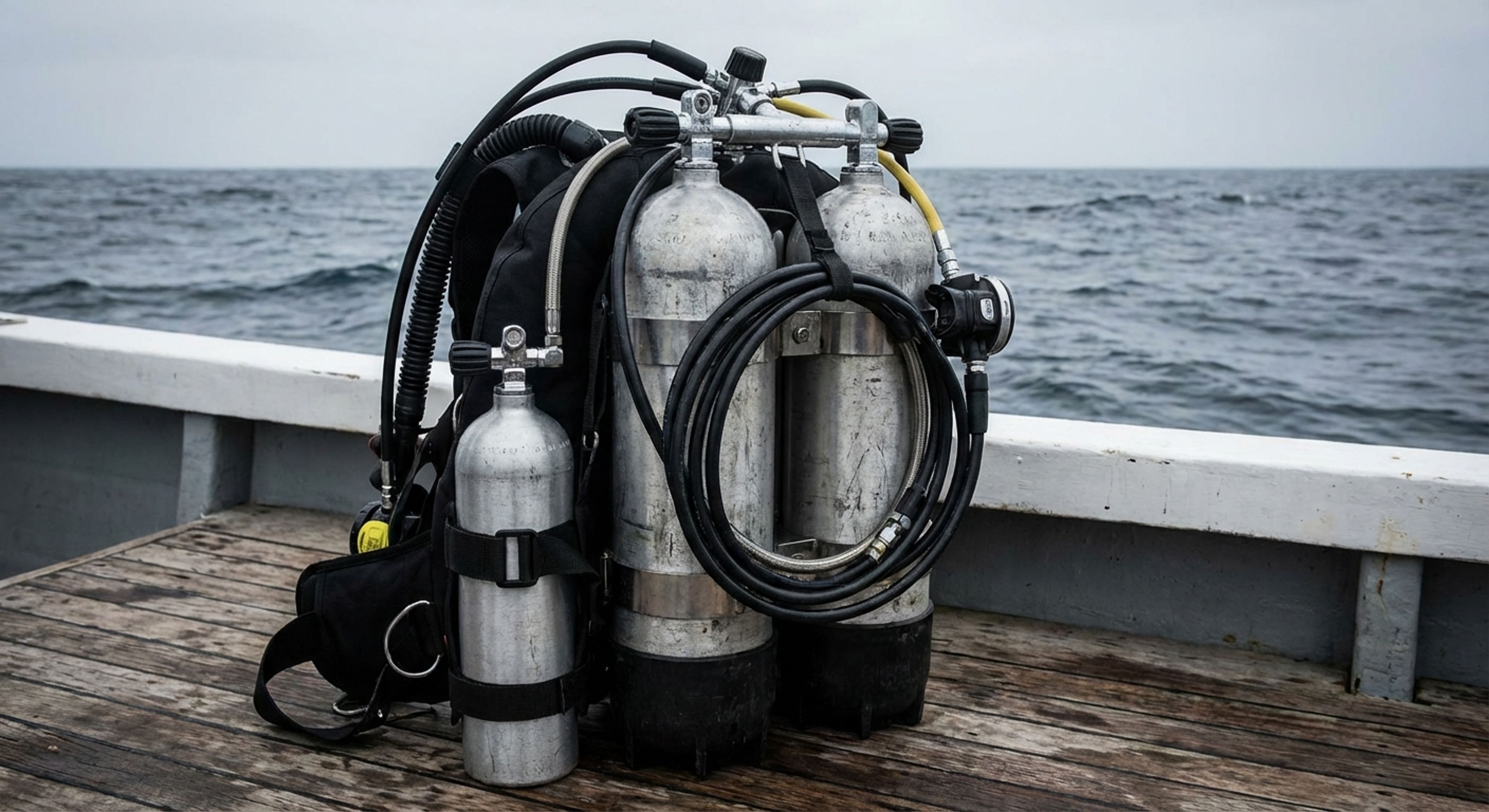
If "two is one, and one is none," then three is a good start. You do not dive solo with standard recreational gear. A single tank with a single first stage is a death wish. If that first stage fails, you have nothing.
Here is the non-negotiable list of equipment for self-sufficiency.
1. Redundant Gas Supply
This is the baseline. You need a completely independent gas source capable of bringing you from your maximum depth to the surface safely, including a safety stop or decompression obligations.
- Pony Bottle: A 19 cu ft or 30 cu ft (3L or 4L) cylinder slung alongside your main tank. It must have its own regulator and SPG. It is not an ornament. It is your "get out of jail" card.
- H-Valve or Y-Valve: Allows two first stages on a single cylinder. If one freezes or blows, you shut down that post and breathe off the other.
- Independent Doubles / Sidemount: My preference. Two completely separate tanks. If one fails catastrophically, you isolate it and still have 50% of your gas.
2. The Regulator Configuration
Do not use cheap plastic regulators. You want balanced, environmentally sealed, cold-water rated metal. I use DIN valves exclusively. Yoke valves are for warm pools; they trap water and burst o-rings when banged against a wreck.
Your redundant source needs a regulator that is prepped and ready. Not tucked away in a pocket. Around your neck on a necklace or clipped to a D-ring where your hand can find it blind.
3. Redundant Instrumentation
Computers fail. Batteries die. Pressure sensors get clogged with salt crystals.
- Primary Computer: Wrist-mounted, air integrated.
- Backup Computer: Wrist-mounted or in a console.
- Analog SPG: Never trust digital 100%. A brass and glass gauge connected via a high-pressure hose is mechanical truth.
- Bottom Timer/Watch: If both computers die, you need to know run-time and depth to cut tables in your head.
4. Cutting Tools
You need to be able to cut yourself free with either hand.
- Primary: Titanium shears or a line cutter on your waist belt or computer strap.
- Secondary: A serrated knife on your leg or inner arm.
- Tertiary: A small line cutter (like an Eezycut) on your BCD shoulder strap.
If you can't reach it, you don't have it.
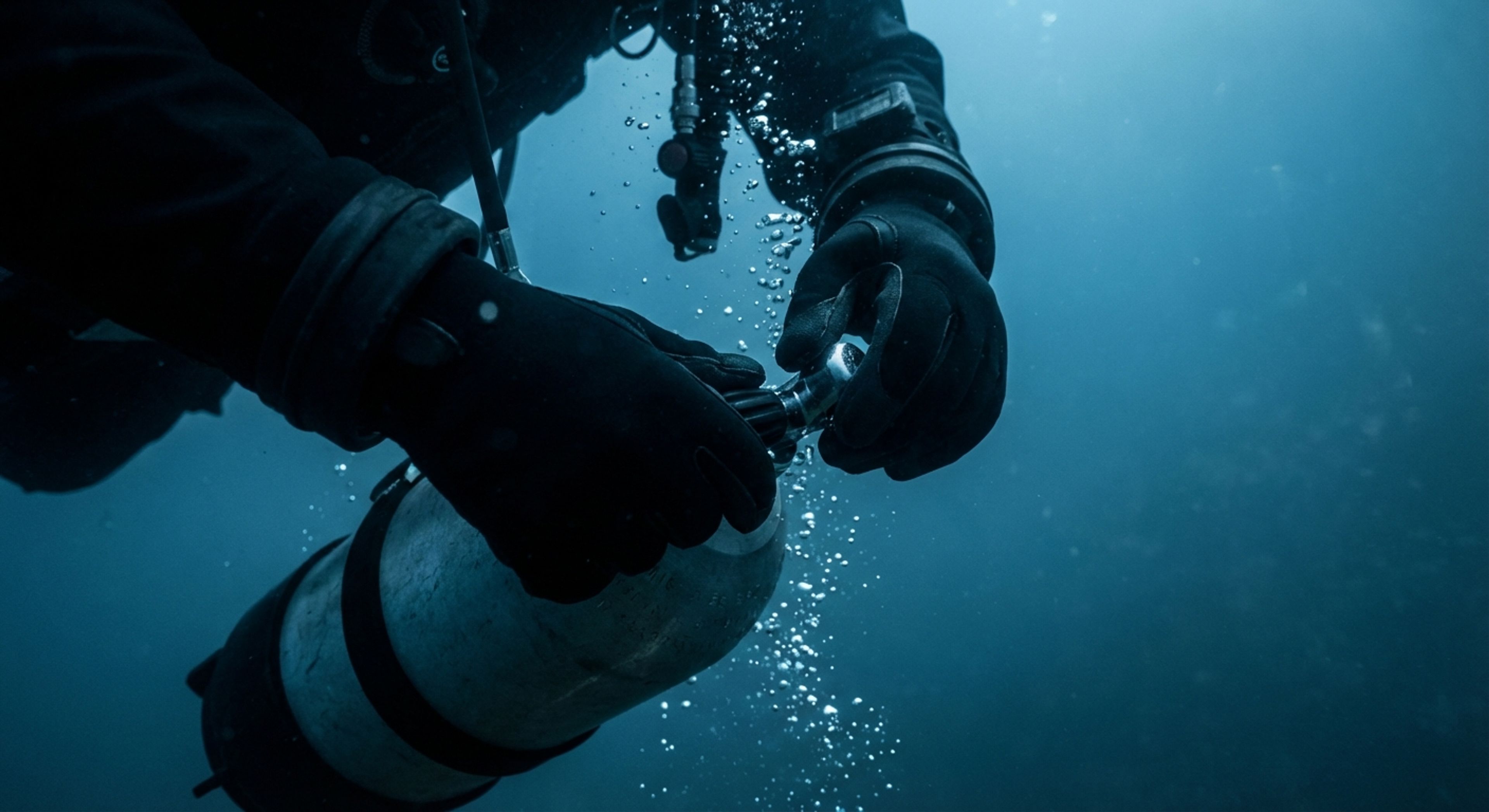
5. The Backup Mask
It sounds trivial until a fin kick from a passing seal or a failure of the silicone strap rips your mask off your face in 4°C water. The shock of the cold hitting your eyes and nose triggers the cold shock response (gasp reflex). You inhale water, you panic, you die.
I carry a low-volume frameless mask in my drysuit thigh pocket. I can switch masks blind, in freezing water, without changing my breathing rhythm. Can you?
Gear Comparison: Tourist vs. Soloist
| Component | Standard Recreational Setup | Self-Sufficient / Solo Setup |
|---|---|---|
| Gas Source | Single Cylinder (Al 80) | Twinset, Sidemount, or Single + Pony Bottle |
| Regulators | 1 First Stage, 2 Second Stages | 2 Completely Independent First & Second Stages |
| Mask | One on face | One on face + Spare in pocket |
| Cutting Device | Maybe a small knife? | Minimum 2 (Shears + Knife/Line Cutter) |
| Surface Marker | Small tube (maybe) | Lift bag or SMB + Finger Spool (Redundant) |
| Mindset | "My buddy has my back." | "I am my own rescue team." |
The Psychology of the Void
The gear is heavy. It costs money. But the hardest part of solo diving is the software running in your skull.
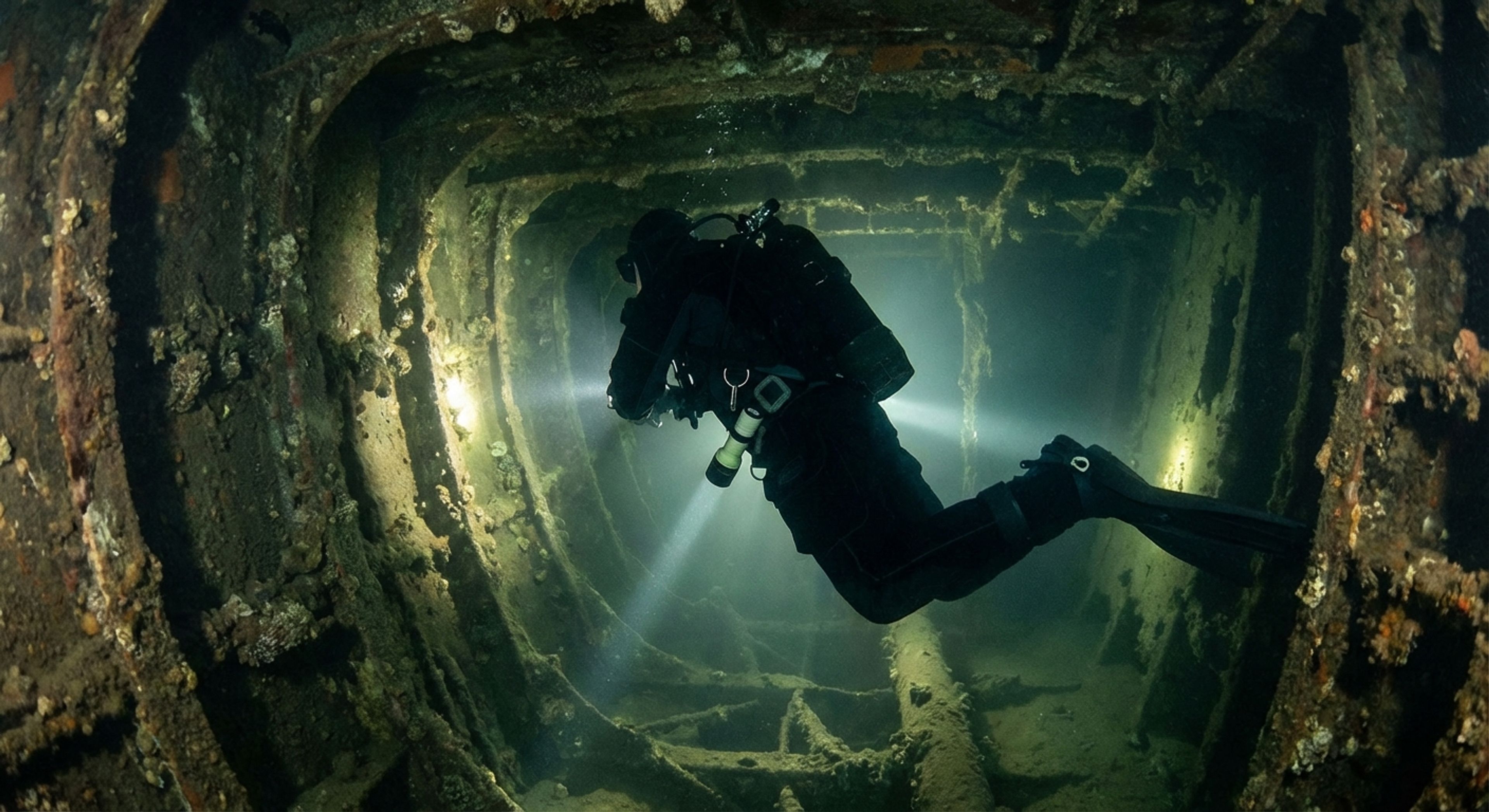
I remember a dive on a wreck off the coast of Narvik. Darkness. Silt. I was penetrating a cargo hold, solo. My primary light flickered and died. Total blackness.
In that second, the instinct is to gasp. To inhale sharply. That is the lizard brain screaming. If you listen to it, you hyperventilate, CO2 builds up, narcosis hits harder, and you lose control.
I stopped. I held the guideline. I didn't move. I counted to three, reached for my backup light on my right shoulder harness, and deployed it. The beam cut through the dark. Problem solved.
To dive solo, you must possess a level of stoicism that borders on coldness. You need the ability to compartmentalize fear. When a high-pressure hose bursts, it sounds like a gunshot underwater. It is deafening. A buddy diver might bolt for the surface. A solo diver checks the gauge, identifies the leak, reaches back, turns the valve off, switches regulators, and assesses gas reserves.
If you are prone to anxiety, if you get claustrophobic, or if you need constant reassurance, do not do this. The ocean has no empathy.
Risk Assessment and Gas Management
We use the "Rule of Thirds" in overhead environments, but for open water solo diving, I prefer Rock Bottom Gas Management (or Minimum Gas).
You calculate the exact amount of gas required to handle a catastrophe at your deepest point, plus one minute to solve the problem, plus the ascent, plus a safety stop. That is your "Rock Bottom." When your gauge hits that number, the dive is over. No arguments. No "just one more look at that crab."
You must also assess the conditions honestly.
- Current: If you drift, there is no one to help you swim back.
- Cold: Hypothermia degrades cognitive function. Solo divers must wear adequate thermal protection. I dive dry, always.
- Entanglement hazards: Kelp forests and wrecks require higher vigilance.
Final Words
Solo diving is the purest form of underwater exploration. It is silent. It is focused. It forces you to understand the physics of your equipment and the physiology of your body.
But do not confuse buying the gear with having the skill. Wearing a pony bottle does not make you a solo diver. Drilling failure scenarios until your hands move automatically makes you a solo diver. Get the proper training from a recognized agency.
Start in the shallows. Practice switching to your backup gas with your eyes closed. Practice removing your mask and putting on your backup while maintaining buoyancy.
If you want to survive the deep alone, you must become a machine. Efficient. Redundant. Unbreakable.
The water is waiting. It doesn't care if you come back up. Make sure you do.