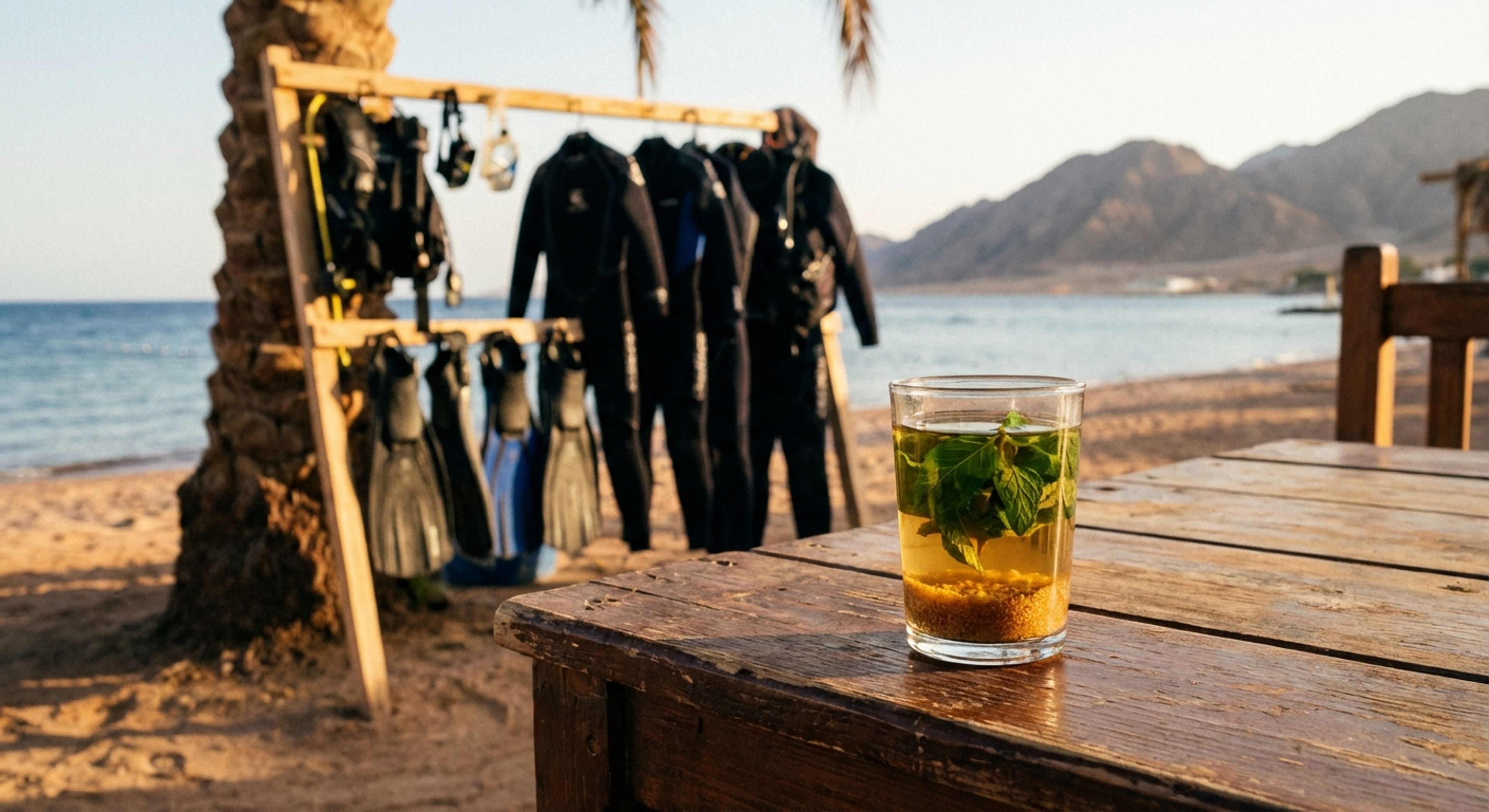

The First Breath: Crossing the Mirror in the Red Sea
There is a moment when your brain screams 'stop' but your lungs say 'yes.' I take you through the exact sensory experience of taking that first breath underwater in Dahab, from the taste of rubber to the silence of the blue.

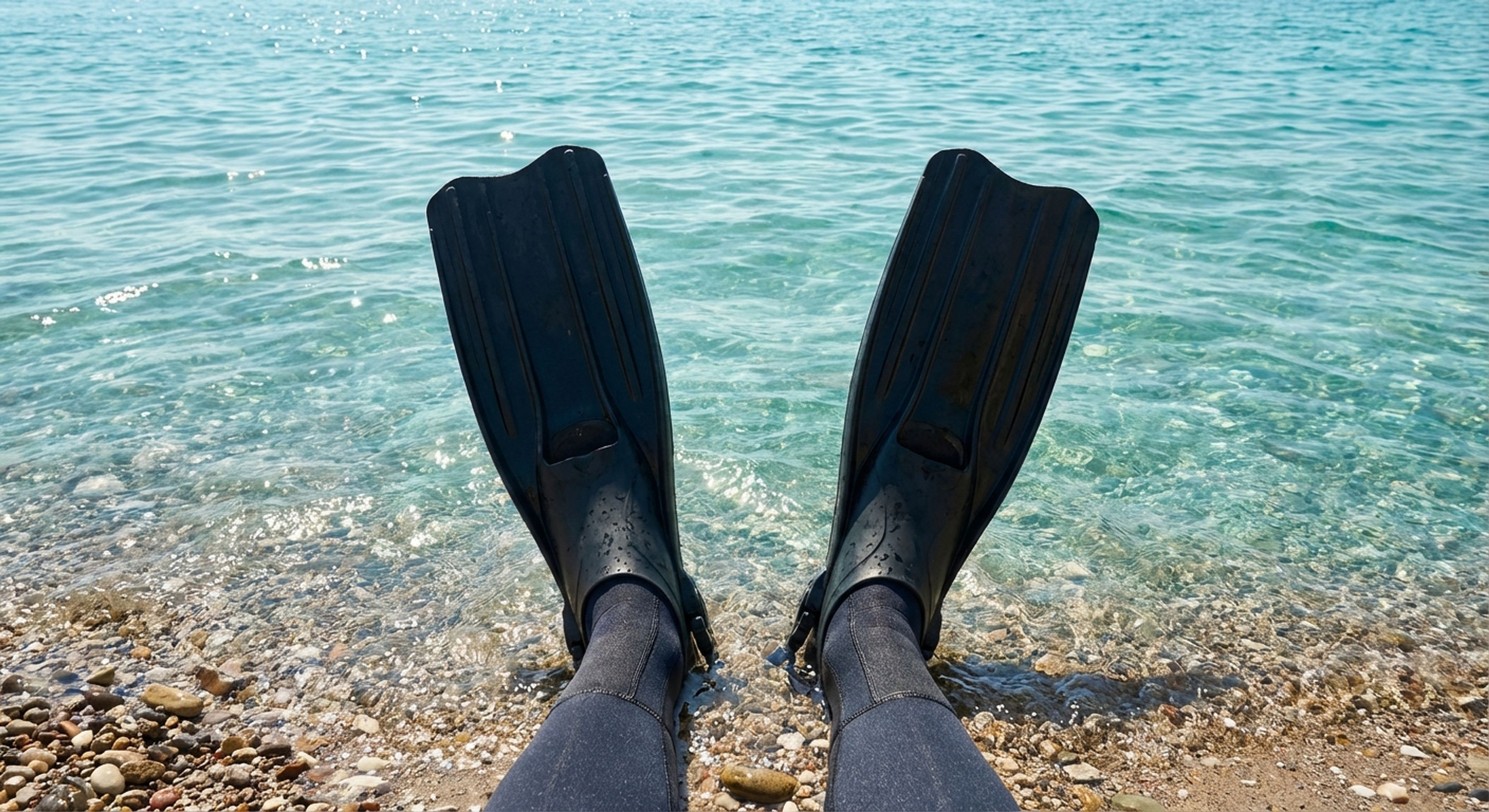
My friend, welcome. Sit. The tea is hot and the sugar is plentiful, just how we like it here in Dahab. You look at the water and you see a flat blue sheet. I look at it and I see a ceiling. A ceiling to a house where I spend half my life.
You asked me a question that made me smile. You want to know what it feels like. Not the technical part. Not the PADI manual definition of "regulator function." You want to know what happens inside the head and the heart when you put your face in the water and decide not to die.
Yalla, let me tell you. I have seen a thousand faces make this change. I remember my own. It is not just breathing. It is passing through a mirror.
The Resistance of the Mind
Before the water, there is the heat. Here in South Sinai, the sun is a heavy hand on your shoulder. The wetsuit is tight. It smells of neoprene and old salt. You are sweating. The tank on your back weighs twelve kilos and the lead belt digs into your hips. You feel clumsy. Like a duck trying to walk on rocks.
Your brain is smart. It has kept your ancestors alive for thousands of years by following one simple rule: Do not inhale water.
So when we stand chest-deep in the Lighthouse reef and I tell you, "Okay habibi, kneel down," every alarm in your head starts ringing.
You put the regulator in your mouth. The mouthpiece is silicone. It feels foreign. The taste is plastic and perhaps a faint hint of the sea if we washed it in the ocean. You clamp your teeth on the tabs. You are breathing air from the tank now, but your face is still dry. The air is cold. It is dry air, filtered and compressed to remove moisture so the tank does not rust. It hits the back of your throat with a chill, dry as a desert bone. It makes you thirsty immediately.
Then I give the signal. Down.
The Plunge: Chaos and Noise
You dip your head. The water rushes over your forehead, your eyes, your ears.
The first thing you notice is not the sight. It is the sound.
On land, the world is full of background noise. Wind. Cars. Birds. Talking. Underwater, the first second is a shock of silence, followed immediately by the loudest noise you have ever made.
HSSSHHHHHHHHHH.
That is the sound of you inhaling. It sounds like a storm inside your skull. The regulator delivers air at the ambient pressure of the water, so it rushes in with force.
Then you exhale.
GLUG-GLUG-GLUB-ROAR.
The bubbles are chaotic. They brush past your ears and tickle your cheeks. They rise to the surface, wobbling and shaking. For a moment, you are blind because of the bubbles. You feel the cold water pressing against your cheeks, the only part of your face exposed.
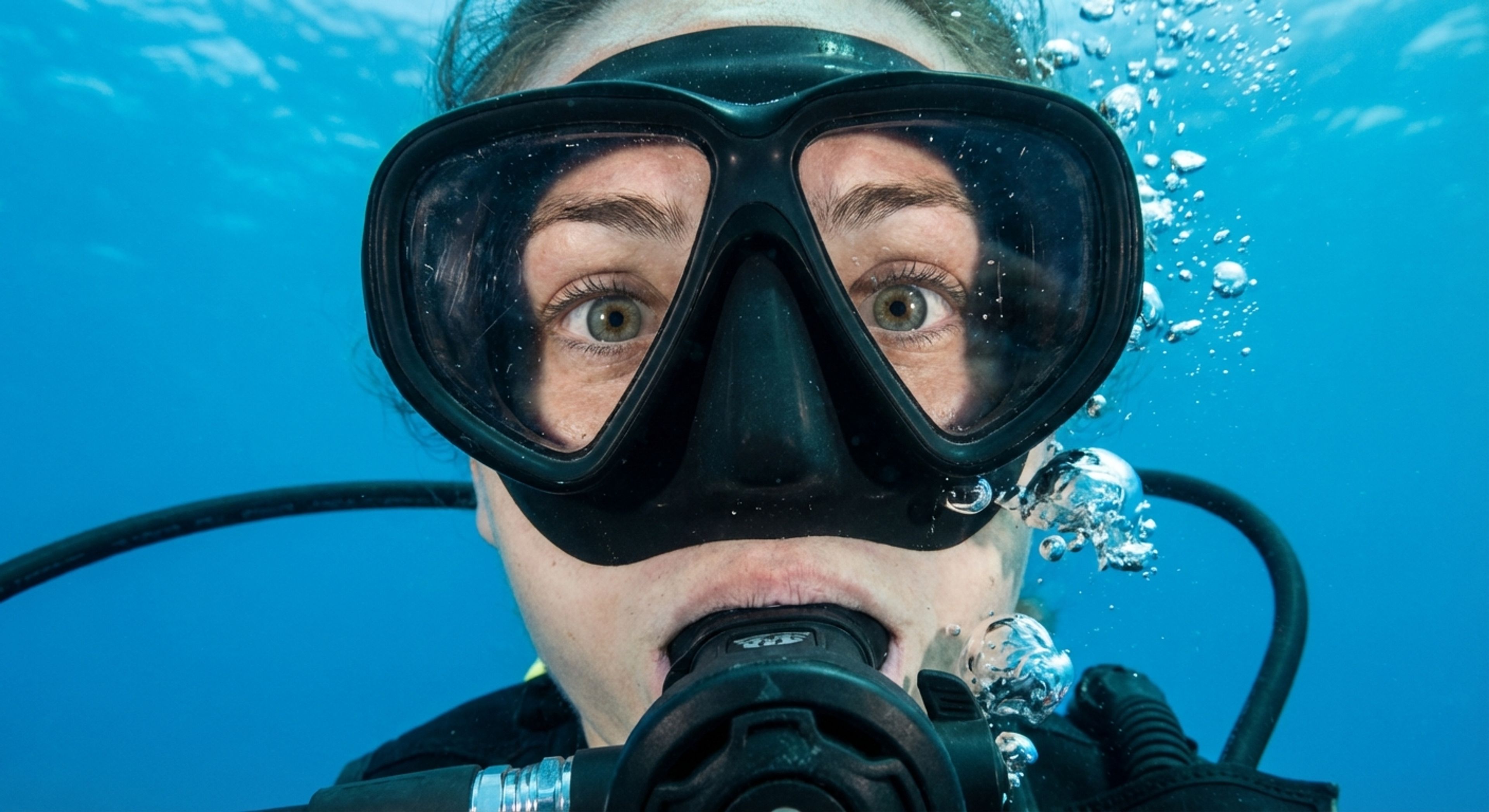
Your heart is beating fast. I can see it. I see it in the eyes of every student. The eyes go wide behind the mask. The breathing is short. Shallow.
Sip. Sip. Sip.
You are stealing air, afraid to take a full meal. Your brain is shouting: "We are underwater! Hold your breath!" But you must not. Never hold your breath. You force yourself to draw in that dry, cold air again. The mechanism works. It delivers.
The Shift: When the World Slows Down
This is the magic moment. It usually happens after thirty seconds.
You realize you are not dead.
The panic, it is like a fist that slowly opens. You take a long breath. You fill your lungs. Because the air is compressed, a full lungful of air underwater contains more oxygen molecules than on the surface. It is rich. It wakes you up.
You stop fighting the gear. You settle onto the sand.
Now, you look.
The Red Sea is not like the Atlantic. We do not have dark, murky water. We have liquid light. The sun rays cut through the surface like swords, dancing on the white sand bottom. We call these "caustics." It looks like a net of gold light moving back and forth.
The books say everything looks 33% larger and 25% closer due to refraction. But to you, it just feels intimate. The coral block that seemed far away is suddenly right there. The orange Anthias fish are exploding like fireworks around your head.
You feel the weight vanish. The heavy tank? Gone. The tight belt? Gone. You are no longer a clumsy duck. You are something else. You are flying.
The Sensory Archive
Let me break it down for you, the way a chef breaks down a recipe. The feeling is a mix of contradictions.
| Sensation | On Land | Underwater |
|---|---|---|
| Gravity | A constant downward pull. Heavy feet. | Zero. You hover. You are an astronaut. |
| Sound | Constant, directional, layered. | Rhythmic. Only your breath and the click of shrimp. |
| Air Quality | Humid, warm, natural. | Bone dry, cold, mechanical. |
| Vision | Wide peripheral, consistent colors. | Tunnel vision (mask), colors disappear with depth (reds first), objects magnified. |
| Mental State | Multi-tasking, distracted. | Singular focus. Zen. Only the now exists. |
The Inner Monologue of "Thomas"
I remember a guest last month. Thomas. Big guy, from Germany. Strong, tattoos, looked like he could lift a camel. But in the water? He was a leaf in the wind.
I held his vest as we went down. I watched his eyes.
First ten seconds: Pure terror. I saw him checking the gauge, checking me, checking the surface. His hands were gripping his inflator hose so hard his knuckles were white. He was thinking, "This is unnatural. I am a mammal. I belong on the dirt."
Twenty seconds: He forces a long exhale. He watches the bubbles go up. He realizes the water is not entering his nose. The seal is good.
Forty seconds: He looks at a Lionfish hovering near a rock. The Lionfish is calm. It spreads its spines, confident, keeping its distance. It does not care about Thomas. Thomas sees this. If the fish is calm, why is Thomas panic?
Sixty seconds: The grip on his hose loosens. His legs stop kicking the sand. He hangs there. Suspended.
This is the moment I wait for. The moment the "Land Brain" shuts off and the "Water Brain" turns on. The mental chatter stops. You cannot worry about your email, your rent, or your girlfriend when you are submerged. The ocean demands your full attention. It is the ultimate meditation.
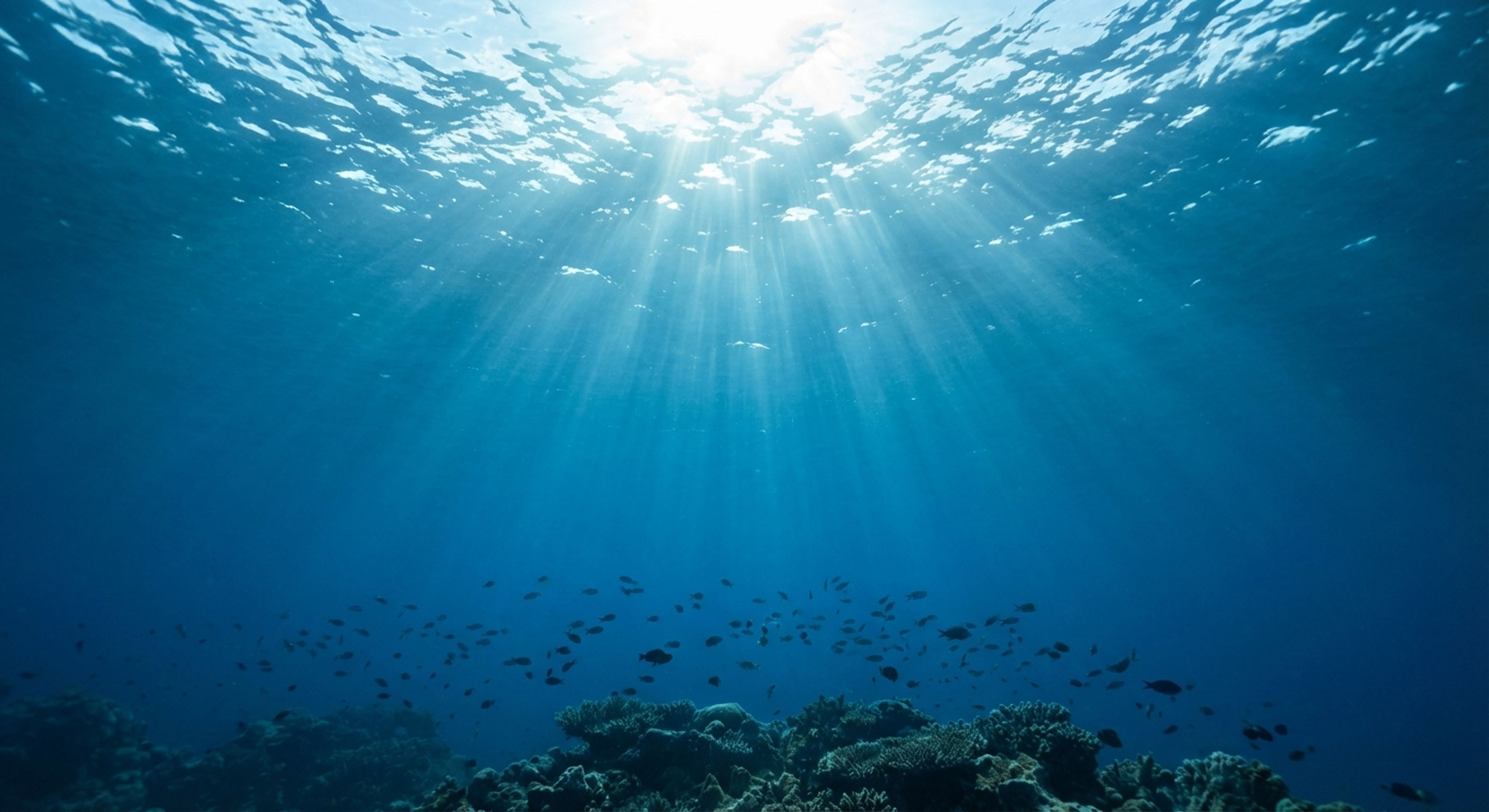 penetrating the deep blue water. A silhouette of a diver hovering in the distance. Serene and majestic atmosphere.)
The Ghost in the Machine
It is not all perfect, my friend. We must have respect.
Breathing underwater feels... borrowed.
You are acutely aware of your time. You have a gauge. It counts down. 200 bar. 150 bar. 100 bar. You are carrying your life on your back. This creates a very specific emotion: Preciousness.
Every breath costs something. So you learn to cherish them. You do not pant like a dog. You breathe slow. Deep. You become a miser with your air. This connects you to your body in a way you never feel on land. You feel your diaphragm expand. You feel the carbon dioxide build up if you skip a breath. You are a machine and a soul working together.
In the Blue Hole, where I guide the advanced divers, this feeling is stronger. The deep blue calls you. It is easy to feel too comfortable. That is why we say the sea has ghosts. The nitrogen at depth can make you feel drunk, nitrogen narcosis. We call it the "Martini effect." You feel happy. Too happy. You forget you are human.
That is why I am there. To tap you on the shoulder and say, "Habibi, check your air."
Returning to Gravity
When the dive ends, and we break the surface, the feeling is heavy.
Gravity grabs you immediately. The tank is heavy again. The water drains from your ears. You spit out the regulator and the air tastes humid and thick. It tastes like salt and gasoline and sunscreen.
But you are smiling.
Everyone smiles. It is involuntary. You have traveled to another planet and returned.
You ask what it feels like?
It feels like you have a secret. You look at the tourists walking on the boardwalk, eating their ice cream, looking at the top of the water. They see the surface. But you? You know what is underneath. You have breathed the forbidden air.
Come. Finish your tea. The wind is dying down. Tomorrow, I will not just tell you. We will go. You will hear the bubbles yourself.