

Stop Being a Sheep: How to Find Your Way Underwater Without Holding My Hand
You follow the dive master like a lost puppy. Hay naku, it is time to grow up. Learn to read the reef, the sun, and that compass you forgot you have on your wrist.
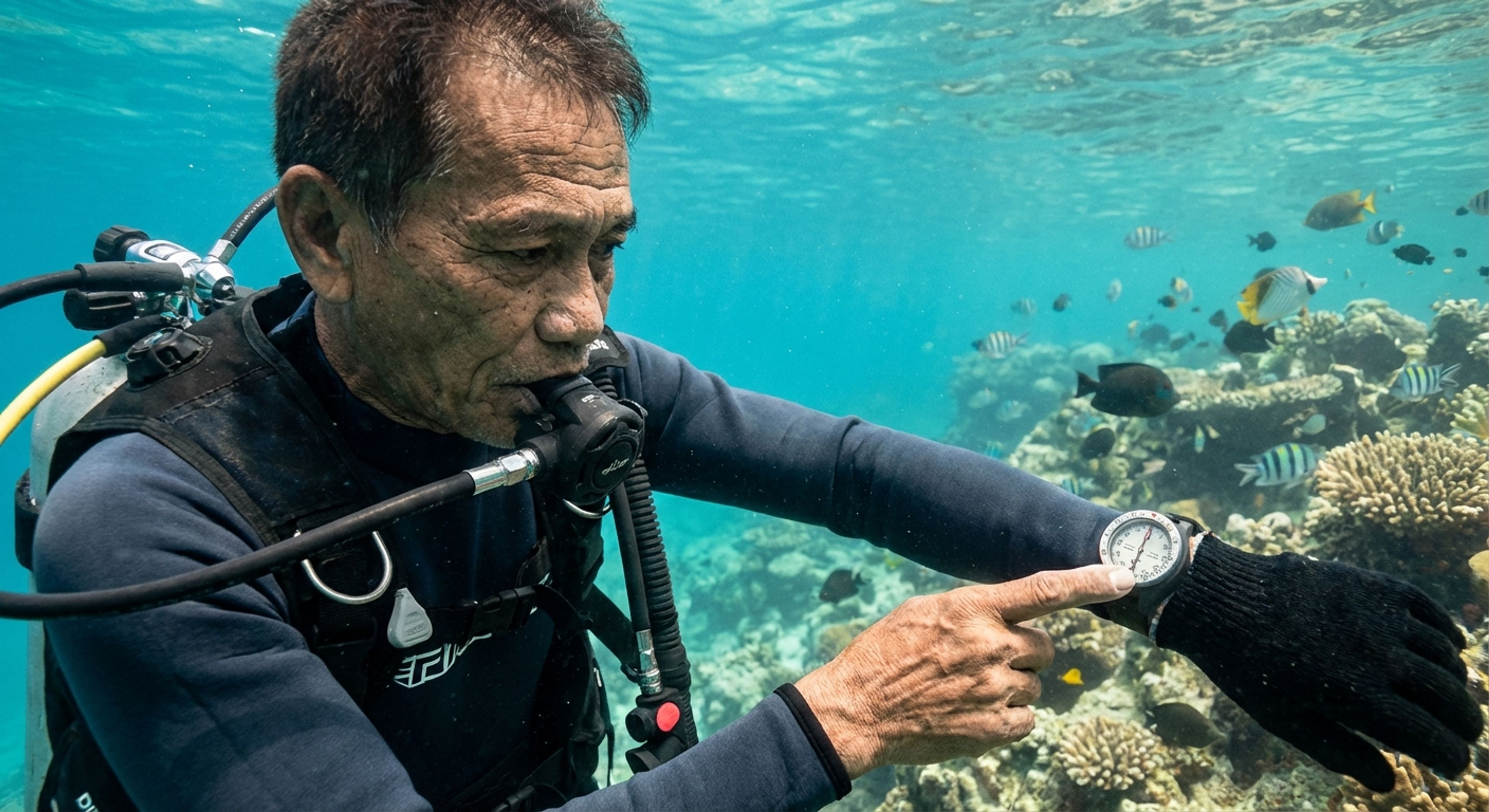
Hay naku. Every day is the same story.
I jump in the water at Cathedral Rock. I look back. Five, six divers. All staring at my yellow fins. If I turn left, you turn left. If I swim in circles, you swim in circles. If I swim into a cave and stay there, I think maybe you follow me and we act like canned tuna together.
You look like a school of sardines. But sardines are smart. They know where they are going. You? You are just "following the leader."
Listen to Tatay Santiago. This is dangerous. What if the current separates us? What if my mask strap breaks and I have to surface? What if, sus maryosep, you get distracted by a turtle and forget to look up?
Suddenly, the yellow fins are gone. You are alone in the blue. The panic comes. You suck your tank dry in ten minutes.
It is time to stop being a baby diver. It is time to learn how to find your way home. You have a brain. Use it. You have eyes. Open them. You have a compass. Maybe wipe the dust off it.
The Ocean Is Talking to You (Natural Navigation)
Before you touch that plastic compass, you look at the world. The ocean tells you everything, but you are too busy looking at your fancy dive computer with the color screen to notice.
Natural navigation is how we did it in the 70s. We didn't have digital maps. We had instinct. We had eyes.
The Sun is Your Light Bulb
When you jump in, look up. Where is the sun?
If the dive plan is "reef on left shoulder" and it is morning, maybe the sun is shining on your right side. So, to go home, you turn around. Now the sun should be on your left side. Simple geometry.
Even if it is cloudy, the water is brighter in one direction. Shadows on the sand tell the truth. If the shadows of the coral heads are pointing to the deep water when you start, they must point to the shallow water when you return. Unless the sun moves very fast, which only happens if you stay down too long and get narcosis.
Sand Ripples Do Not Lie
Look at the sand. You see the lines? The ripples?

Waves make these ripples. Waves usually come from the open ocean and hit the shore. So, the ripples usually run parallel to the shore.
If you swim across the ripples (perpendicular), you are swimming away from shore or towards it. If you swim with the ripples (parallel), you are swimming along the coast.
If you get lost, look at the sand. Swim perpendicular to the ripples into the shallower water. You will hit the beach. Maybe not the right beach, but land is land. Better than drifting to China.
The Current
The current is not just annoying water pushing you. It is a direction.
When we start a dive, I always check the current. Maybe it hits my left cheek. It feels cold. It is strong. Throughout the dive, I feel that water. If I turn around to go back, the current should now hit my right cheek. Or maybe it pushes me from behind.
If the current suddenly stops, you are behind a rock, or the tide changed. Pay attention. Feel the water on your face. Don't just fight it.
Depth and Landmarks
This is common sense, but common sense is not so common. If you go deeper, you are usually going away from the island. If you go shallower, you are going towards the island (unless you are on a pinnacle, then shallow is just "up").
Pick landmarks. "The big brain coral shaped like a butt." "The rock that looks like a sleeping turtle." Remember them. Turn around and look at them from the back, because rocks look different when you return.
The Compass: Your Best Friend (If You Don't Act Stupid)
Natural signs are good. But sometimes, visibility is bad. Sometimes, it is night. Sometimes, you are in the blue water with no bottom.
Then, you need the tool.
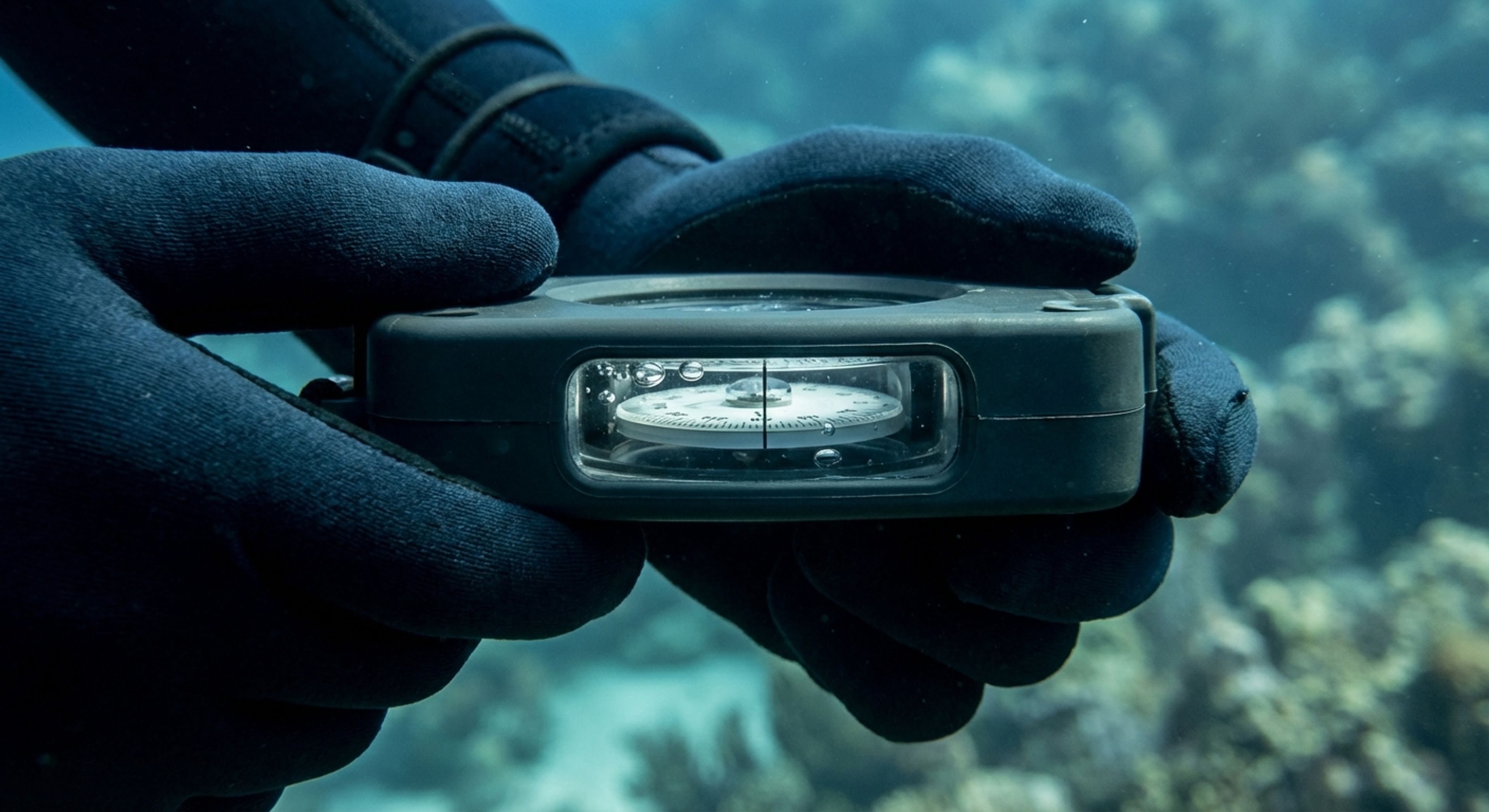
I hate the digital compasses inside your dive computers. They need batteries. They need calibration. You have to press buttons. Too much work. Give me a good, oil-filled analog compass on a slate or wrist strap. Sturdy. Reliable. Like me.
How to Hold It
This is where you fail. I see divers holding the compass tilted, sideways, upside down. The needle floats in oil. If you tilt the compass, the needle drags against the glass. It gets stuck. It cannot spin.
- Keep it Flat: Imagine you are carrying a full plate of Lechon and you don't want to spill the sauce.
- Lubber Line: The red line down the middle must point where your body is going. Not where your head is looking. Where your belly button is going.
- Arms Locked: Hold it with two hands. Lock your elbows into your ribs. You turn your whole body, not just your wrist. You are a tank, not a ballerina.
The Bezel (Put the Dog in the House)
You have a spinning ring on top. That is the bezel. It has two index marks. We call them the "House." The North needle is the "Dog."
You point your body where you want to go. You look at the compass. You spin the bezel until the markers bracket the North needle. The Dog is in the House.
Now swim. If the Dog goes out of the House, you are turning. Turn your body until the Dog goes back in the House. Simple. Even a split-fin diver can do this.
Comparing Navigation Methods
Here. I made a table. Because you young people like data.
| Feature | Natural Navigation | Compass Navigation |
|---|---|---|
| Reliability | Good, but depends on visibility | 100% if you are not stupid |
| Battery Life | Forever | Forever (for analog) |
| Difficulty | Requires experience | Requires technique |
| Best For | Reef dives, clear water | Night, muck, blue water |
| Cost | Free | Cheap |
Drills: Practice or You Will Get Lost
You want to be a good diver? You practice. You don't just dive for photos. You dive to work.
Go to a sandy patch. Somewhere shallow, maybe 5 to 6 meters. Tell your buddy: "I am going to practice. Don't help me unless I swim into a boat."
1. The Reciprocal Course (Out and Back)
This is the "I left my lunch on the boat" drill.
- Point straight away from the shore. Center your lubber line.
- Set your bezel so the Dog (North) is in the House.
- Count your kick cycles. One cycle is Left-Right-Glide. Count to 20 cycles.
- Stop.
- The Turn: Turn your body 180 degrees. Do not change the bezel. Turn until the North needle is pointing at you (the 6 o'clock position), exactly opposite the House. Or, if your compass has a white tail, put the tail in the House.
- Swim 20 kick cycles back.
- Did you arrive at the start? Or are you 10 meters away? If you are far away, you drifted, or your kicks are sloppy.
2. The Square Pattern
This is harder. You make a box.
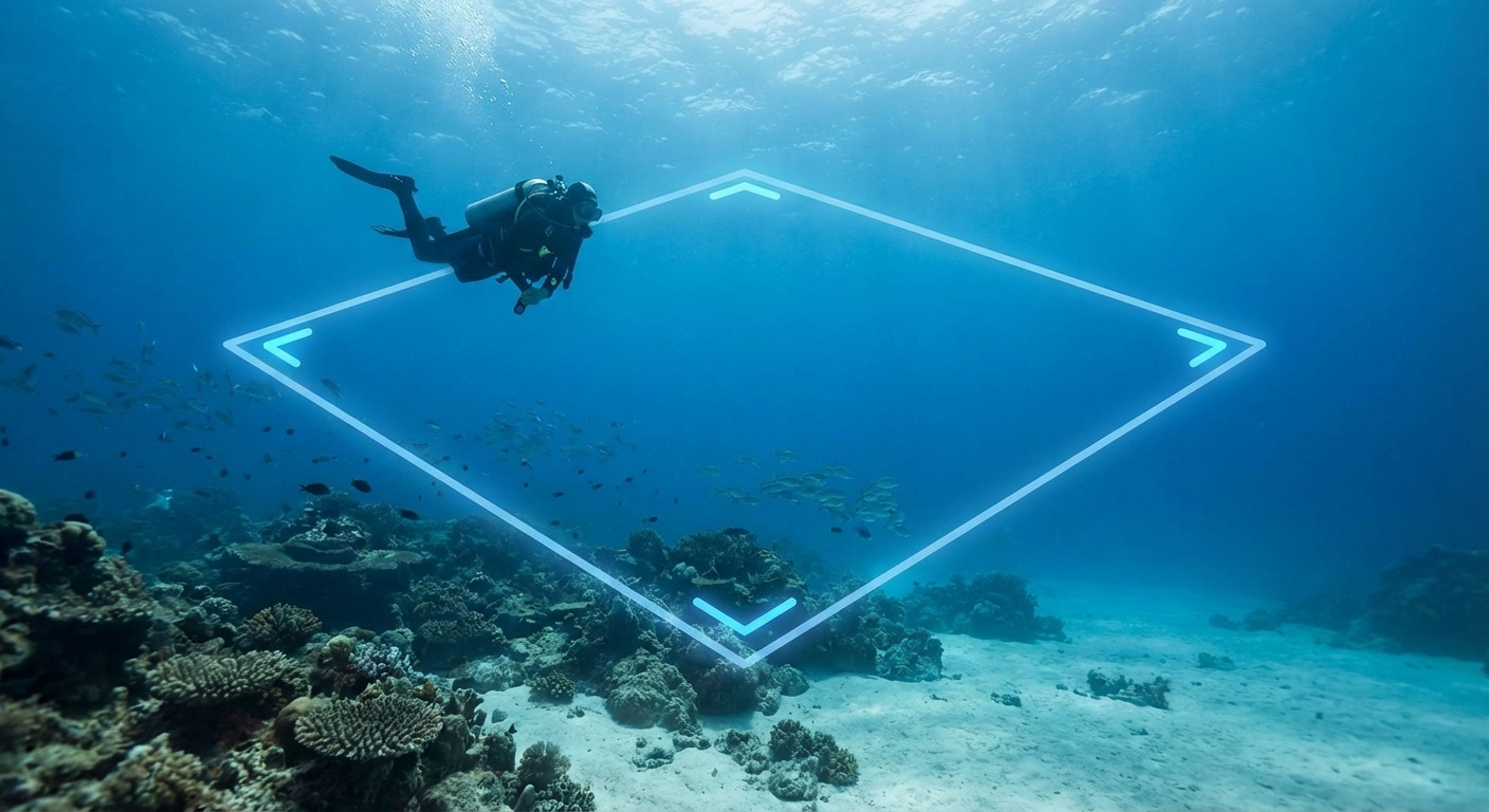
- Pick a heading (say, North). Set bezel. Swim 20 kicks.
- Turn 1: Turn 90 degrees to your Right. Put the North needle on the "West" mark (left side) of your bezel ring (or just reset the bezel for East). Swim 20 kicks.
- Turn 2: Turn 90 degrees Right again (Facing South). Swim 20 kicks.
- Turn 3: Turn 90 degrees Right again (Facing West). Swim 20 kicks.
- You should be back at the start.
Why do we do this? Because sometimes you need to go around a reef, or search for a weight belt you dropped.
The Secret: Kick Cycles
Time is garbage underwater. "Swim for 5 minutes." How fast? Is there current? Are you tired?
Counting kicks is better. It measures distance. I know that 50 of my kicks is about 40 meters in calm water. I know this because I measured it in 1985 and my legs are still strong from hiking Taal Volcano.
Go to a pool or a measured line in open water. Count your kicks for 30 meters. Do it three times. Take the average. Now you have a ruler attached to your hips.
It Is About Confidence
I remember a dive in Batangas, years ago. I had a guest, an American guy. Big shot. Had all the gear. Titanium regulator, computer with air integration, camera bigger than his head.
We were at a site with a lot of silt. Suddenly, the tide turned and visibility dropped to zero. Milk. I couldn't see my hand. He panicked. I felt him grab my tank valve. He was shaking.
I didn't panic. I looked at my compass. I knew the wall was to the East. I knew the boat was to the North. I took his hand. I checked the depth. We swam slow. I felt the current change. I knew we were near the point.
We surfaced right at the ladder of the bangka.
He looked at me like I was a magician. "How did you do that, Santiago?"
I didn't do magic. I paid attention.
 , water dripping off masks, sunny day, ocean surface view)
Summary
When you navigate, you stop being a passenger. You become a driver.
It changes the dive. You are not just looking at fish. You are building a map in your head. You know where you are. You feel the shape of the reef.
It makes you calm. Because you know that no matter what happens, you can find the way back.
So next time you dive with me, don't just stare at my yellow fins. Look around. Check your compass. Maybe, just maybe, I will let you lead.
But don't get us lost, or you buy the beer.
Hay naku, go practice now.