

Capture True Blue: Underwater Photography Lighting Guide
The sea steals color the deeper you go. Here is how we steal it back using the sun, our fins, and the laws of physics to get that perfect blue shot.

Salam, my friend. Welcome. Sit. Let me pour you some tea. It is Bedouin tea, with plenty of sugar and a leaf of habak grown right here in the Sinai dust.
You know, people come to Dahab for many reasons. Some come to hide from the world. Some come to test themselves in the deep canyons (always with respect, never with ego). But many, like you, come with these big cameras. Huge housings, arms like a spider, glass domes that cost more than my jeep.
You dive in. You see a beautiful Spanish Dancer nudibranch. It is bright red, dancing like a flame in the dark. You take the picture. You are so happy.
Then you get back to the surface. You look at the screen.
Blue. Everything is blue. The red is gone. The dancer looks like a grey smudge. You look at the water, then at your camera, and you feel cheated.
Listen to me. The ocean is beautiful, but she is a thief. She steals light. She steals color. To take a good photo, you have to be smarter than the water. You have to understand how she thinks.
The Death of Red
Here in the desert, the sun is harsh. It reveals everything. But underwater, the water acts like a giant filter.
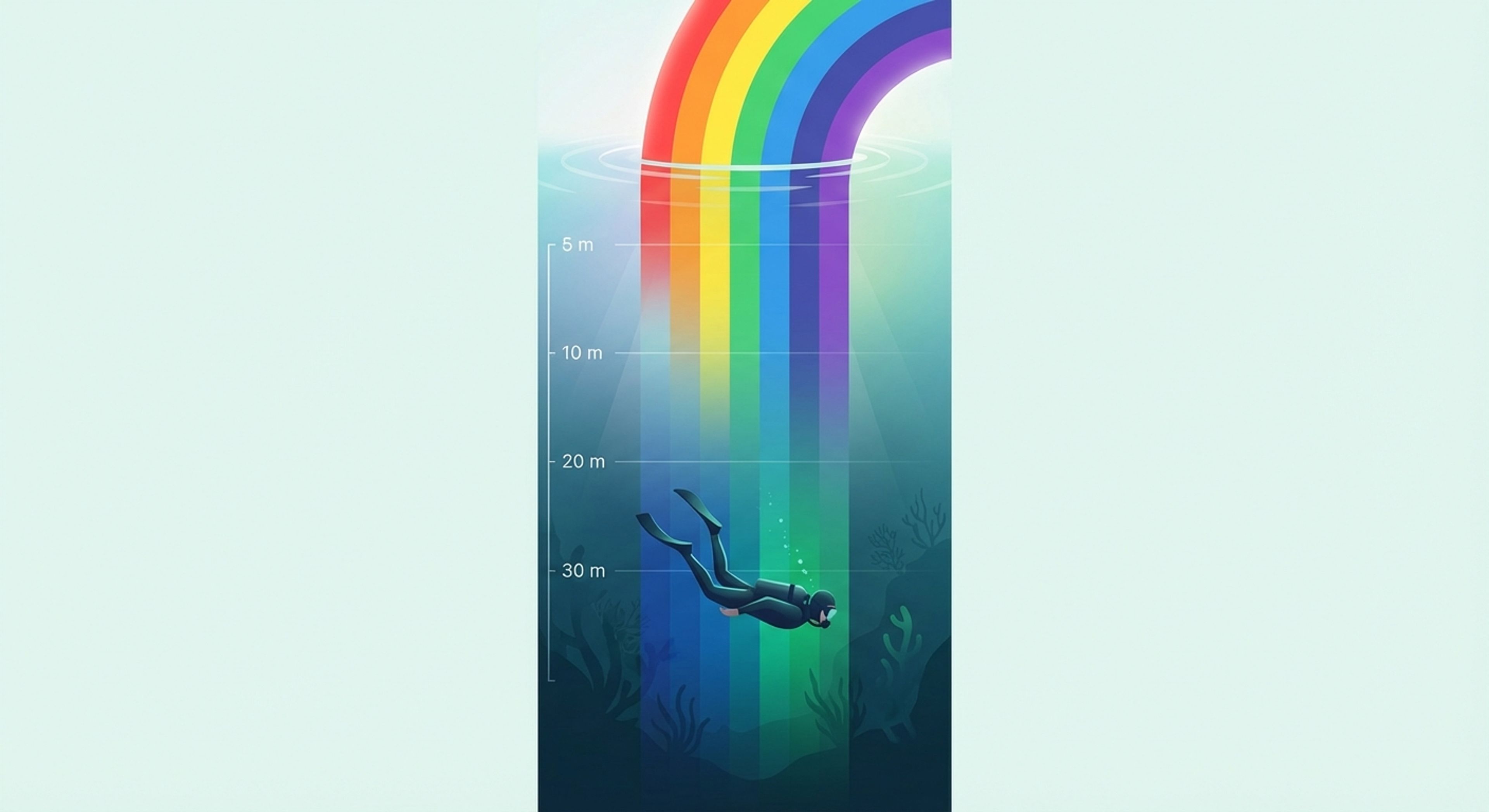
Imagine light is made of many distinct runners. Red, Orange, Yellow, Green, Blue. They all jump into the water together when the sun hits the surface.
Red is a lazy runner. Very lazy. After 5 meters (15 feet), Red gets tired and stops. He effectively dies. If you cut your finger at 15 meters, the blood looks green or black. It is spooky.
Orange makes it a bit further, maybe 10 meters. Yellow gives up around 20 meters.
But Blue? Blue is a marathon runner. Blue goes deep. That is why the ocean is blue. It is the only color that survives the journey.
So when you take a photo at 10 meters without a strobe or flash, your camera is not broken. It is just recording the truth. There is no red light down there to record. You cannot boost the saturation in editing to fix this because the data simply isn't there. It is like trying to record a whisper in a sandstorm.
To fix this, we have two choices: we bring our own sun (strobes), or we learn to dance with the real sun. Today, we talk about the sun.
The Golden Rule: Get Close, Then Get Closer
I have seen photographers with lenses as long as my arm. They try to shoot a shark from 10 meters away.
This does not work.
Water is 800 times denser than air. Even here in Dahab, where the visibility is like gin, the water is full of things. Tiny plankton. Salt. Sand. Microscopic creatures whose names I cannot pronounce.
When you are far away, your camera has to look through all that water to see the subject. It is like trying to take a portrait through a thick fog. The photo will be soft. It will be blue. It will be boring.
You must eliminate the water column.
This is the rule I tell everyone who dives with me: Zoom with your fins, not your lens.
If you think you are close enough, you are not. Get closer. Fill the frame. When you are half a meter away, the amount of water between your lens and the fish is small. The colors will be sharper. The contrast will be higher. The "fog" disappears.
But please. Do not crush the coral. I saw a man once crushing a 200-year-old table coral just to get a macro shot of a shrimp. I did not give him tea afterwards. Respect the reef first. Photo second.
Shooting With the Sun (Front Lighting)
When we walk in the desert, we keep the sun on our faces to stay warm. When you shoot underwater to get color without strobes, you keep the sun on your back.
Think of the sun as your wingman.
If you are shallow, let's say 5 to 10 meters, and the sun is high and bright (like it always is in Egypt), you can still capture natural colors.
Position yourself so the sun is behind you, shining over your shoulder onto the reef. The sunlight hits the coral and bounces back into your lens.
This is the best way to get that "holiday brochure" look. Bright blue water, colorful reef. It works best in the middle of the day, between 10 AM and 2 PM, when the sun penetrates deep into the water.
If you shoot into the sun, the fish becomes a shadow. A silhouette. That is a different style. But for color? Keep the sun behind you.
The Magic of the Sunburst (Shooting Up)
Now, maybe you want drama. You want to show the world how it feels to be small in the big blue.
You look up.
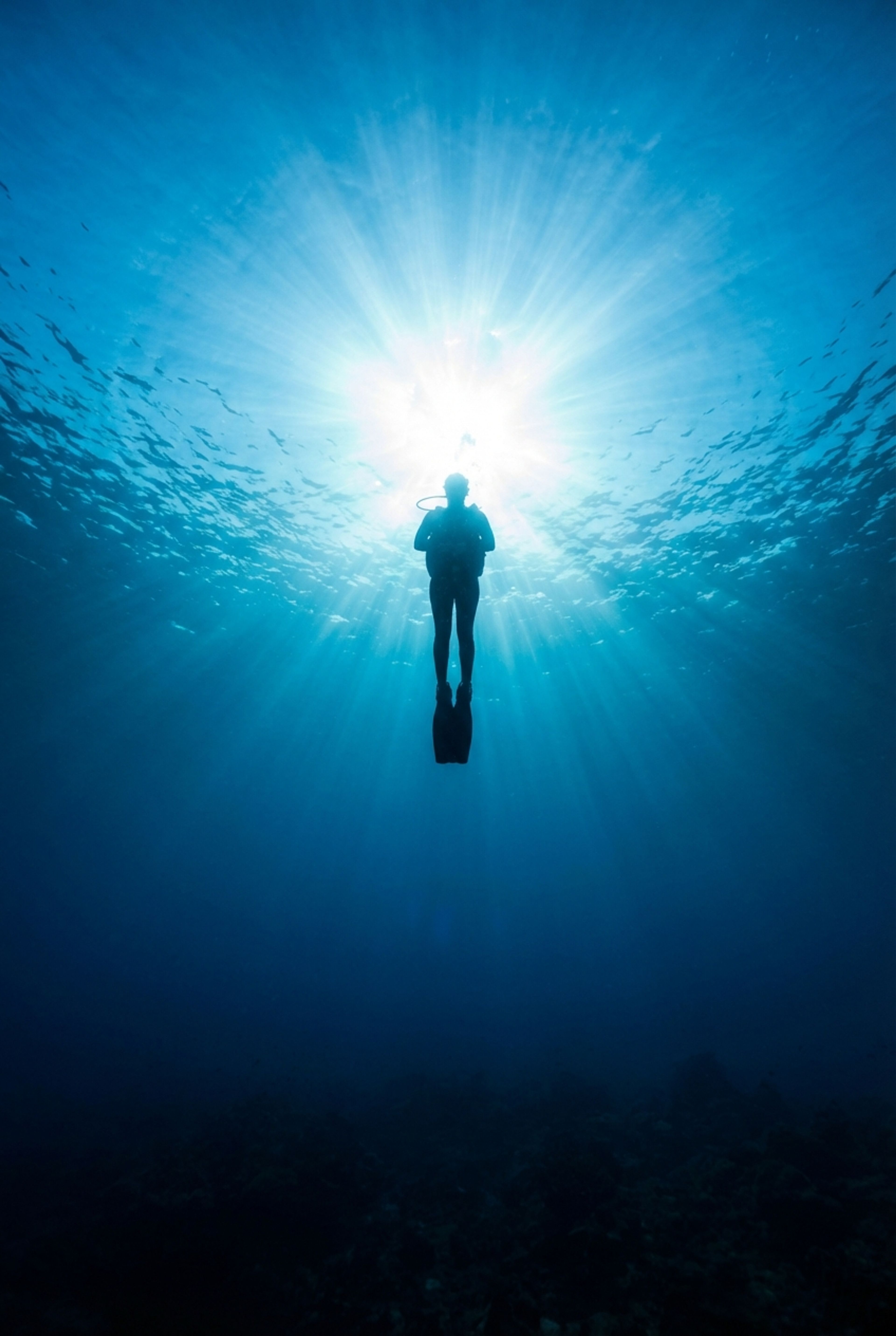
Shooting upwards is my favorite technique. We call it the "Sunburst." It is when you capture the ball of the sun cracking through the surface of the water, with rays of light dancing down like curtains in a mosque.
But this is tricky. If you just point and click, the sun will look like a big ugly white blob that exploded, and the rest of the photo will be black.
Here is the trick, the secret sauce:
- Fast Shutter Speed: You need to be fast. 1/200th of a second or faster. This freezes the light rays so they look distinct.
- Small Aperture (High F-stop): Set your camera to f/11, f/16, or even f/22. When you close the aperture (the hole in the lens), the light rays become sharp and defined. If the hole is wide open, the sun is just a mushy glow.
- The Angle: Get low. Get under the subject. Maybe it is a turtle, or your buddy, or a nice fan coral. Put them between you and the sun.
When you do this, the subject becomes a silhouette. A black shape against the blue fire of the surface. It is very artistic. It tells a story of depth.
A Table for Your Pocket
I am not a man of spreadsheets, I am a man of the sea. But sometimes, it helps to see things side-by-side.
| Shooting Angle | Lighting Source | What it looks like | Best for... |
|---|---|---|---|
| Looking Down | Ambient light fades | Usually dark, muddy background. Poor contrast. | Identification shots only. Avoid if possible. |
| Eye Level | Front Light (Sun behind you) | Blue water background. Good color on subject. | Fish portraits, reef scenes. |
| Looking Up | Back Light (Shooting into sun) | Dramatic silhouettes. Sunbeams. | Wide angle, atmosphere, showing depth. |
The Water Acts as a Lens
There is one more thing you must remember.
When you wear your mask, things look bigger, yes? The physics of refraction mean objects appear 33% larger and 25% closer underwater.
This messes with your head. You reach out to touch the anchor line, and your hand grabs empty water.
For photography, this matters. You think you are close to that clownfish. Your eyes tell you, "Malik, stop, you are going to kiss the fish." But your camera sensor knows the truth. You are still too far away.
Trust the camera, not your eyes. Check your dome port. If you aren't scaring yourself with how close you are, you aren't close enough.
Respecting the Ghosts
I took a diver to the Canyon dive site last week. He was so obsessed with getting the perfect light on a glassfish that he drifted down past 40 meters without checking his air or his computer.
I had to swim down, grab his fin, and signal him to stop. We made a slow, safe ascent together.
He was angry at the surface. He said, "I almost had the shot!"
I told him, "My friend, you can take photos of the fish, but do not become food for them."
Photography is wonderful. It lets you take a piece of the Red Sea home to your living room. But do not let the viewfinder blind you. Look around. Feel the water. Watch your buoyancy and your depth. No photo is worth a trip to the chamber.
The best lighting is the light in your own memory. The camera is just a tool to help you trigger it.
So, pack your gear. Come to Dahab. We will dive the Lighthouse reef at sunset. The light then is soft, gold and blue mixing together. It is the hardest light to shoot, but the most beautiful to feel.
And afterwards? More tea. Always more tea.