

Tech Diving 101: Your Ticket into the Underworld
Recreational diving ends where the light fades. Technical diving begins when the surface is no longer an option. Here is the cost of entry into Xibalba.
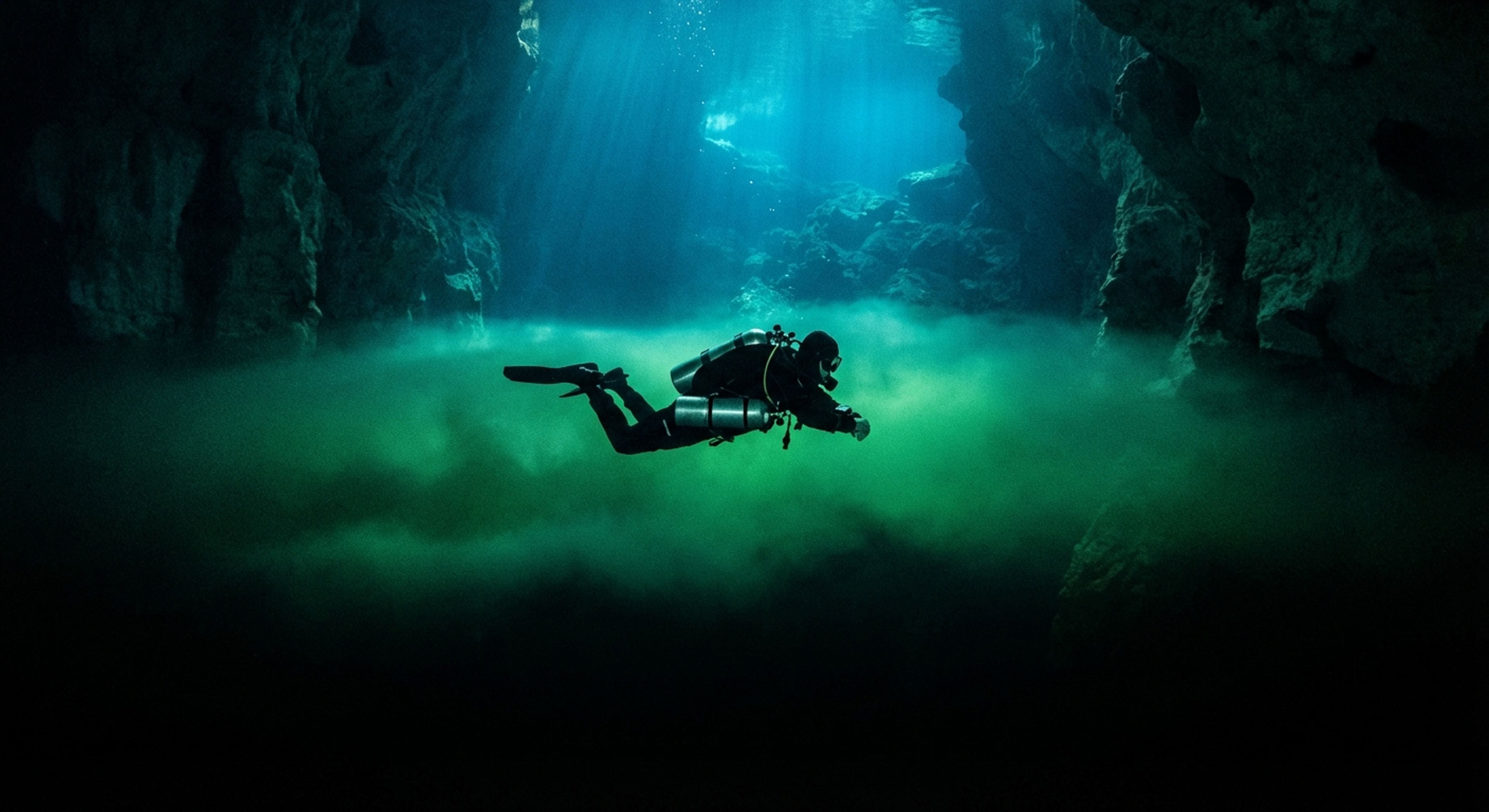
I remember the first time the surface disappeared not because of distance, but because of rock.
I was in the Yucatán, my home. The water was 24 degrees Celsius, clearer than air. I had just crossed the halocline, that blurry, oily boundary where fresh water meets the salt water sitting heavy at the bottom. The light from the jungle opening above was just a pale green smudge. It looked like a dying star.
I turned my back on it. I kicked my fins and glided into the throat of the cave.
This is where the holiday ends. This is where the sport stops being a hobby and starts being a discipline.
People ask me often. Sofia, why do you carry so many tanks? Why do you need three computers? Why do you go where the sun cannot reach? They want to know what Technical Diving is.
Simple. Technical diving is the art of surviving in places where you are not supposed to be.
The Glass Ceiling
In the PADI Open Water manuals, they tell you the limit is 18 meters. Then maybe 30. Then 40. That 40-meter line is the sand in the hourglass.
Technical diving is generally defined by three things. If you hit any of these, you are no longer a tourist. You are a tech diver.
- Depth: You go deeper than 40 meters (130 feet).
- Decompression: You stay down so long that your tissues soak up too much nitrogen. You cannot go directly to the surface. If you do, the nitrogen bubbles in your body will expand violently, like opening a shaken soda. You have a "glass ceiling" above you. You must stop and wait at specific depths to off-gas.
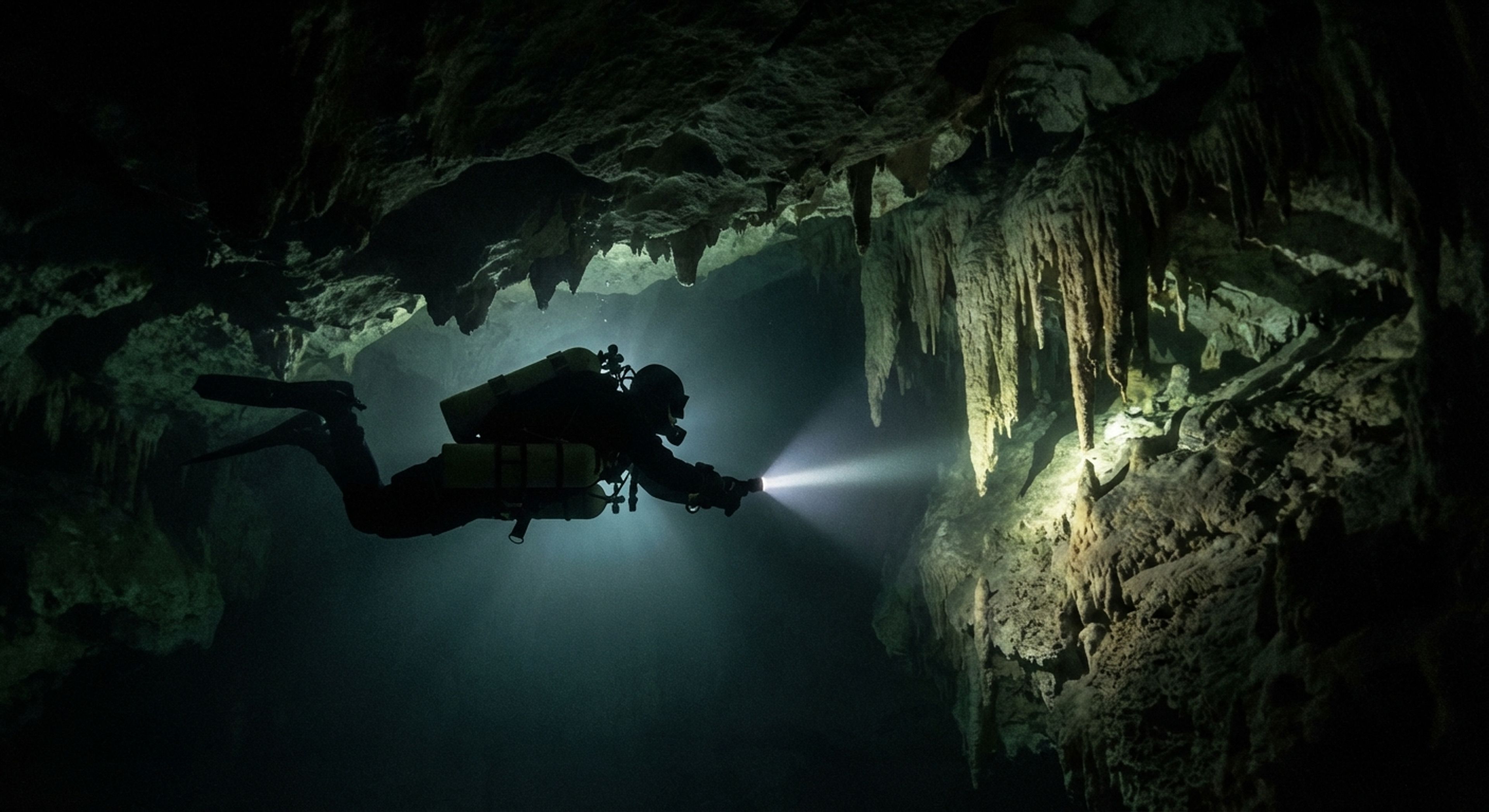
- Overhead: You are physically blocked from the surface. A cave. A shipwreck. Ice. There is no swimming up for air. You have to swim out before you can swim up.
In the cenotes, we call the underworld Xibalba. The Mayans believed it was a place of fear and awe. When I enter a cave system, I am entering their house. I cannot just leave if I feel panic. I cannot just hit the inflate button and rocket to the sun.
If something goes wrong in tech diving, you have to solve it underwater. If you bolt, you die. That is the contract you sign.
The Iron Lung: Doubles and Redundancy
Look at a recreational diver. Single tank. Single regulator. Maybe a spare hanging yellow octopus hose dragging in the coral.
Now look at me.
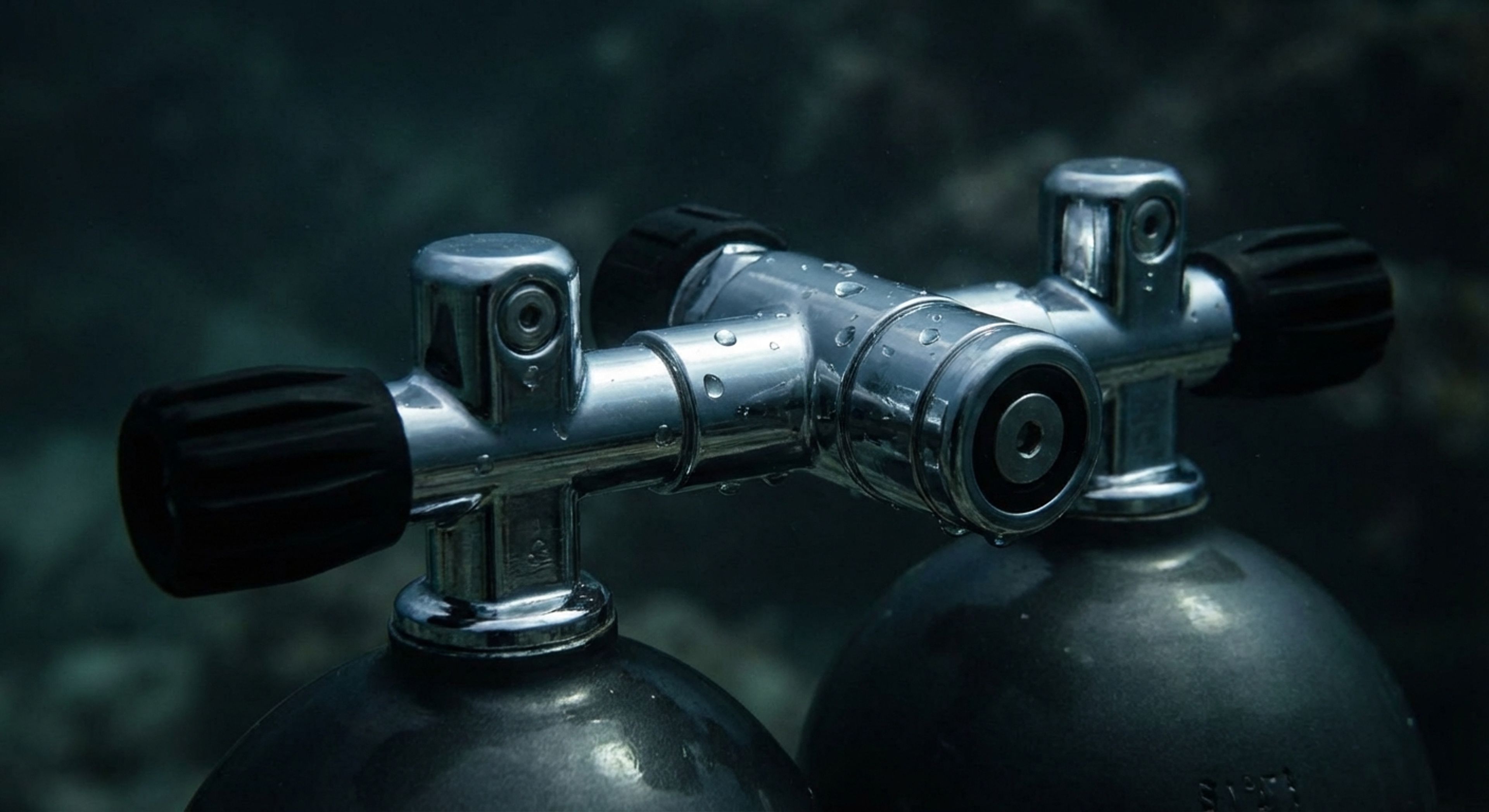
I dive with "Doubles" or Twinsets. Two large steel tanks bolted together on my back with a heavy steel manifold. Or sometimes Sidemount, with a tank clipped under each armpit like wings.
Why the weight? Why the back pain?
Redundancy.
In the dark, one is none. Two is one.
If a valve fails, I can shut it down and use the other. If a regulator freezes and starts screaming bubbles, I switch to the backup. I carry enough gas to get myself and a teammate out of the deepest point of the dive, even if one of our tanks explodes.
This gear is heavy on land. It bites into your shoulders. It makes you sweat in the Mexican humidity. But the moment you slip into the water, the weight vanishes. You become a spaceship. You have to be perfectly trimmed, flat in the water. If you kick up silt in a cave because your feet are dragging, you blind everyone. Zero visibility.
We don't wear this gear to look cool. We wear it because the environment is trying to kill us, and this steel is our armor.
The Alchemy of Air: Trimix
Air is for tires. That is what my instructor told me years ago.
Okay, air is fine for looking at clownfish at 15 meters. But deep down? Air becomes problematic.
At 30 or 40 meters, the nitrogen in regular air acts like a drug. We call it Nitrogen Narcosis. The "Martini Effect." You feel drunk. Your reaction time slows down. You might look at your pressure gauge, see you are low on gas, and just laugh. In a cave, laughter is fatal.
Go even deeper, past 56 meters, and the oxygen itself becomes toxic (reaching a partial pressure of 1.4 ATA or higher). It can cause a grand mal seizure underwater. You convulse, spit out your regulator, and drown.
To go deep, we become alchemists. We mix gases. We replace some of the nitrogen and oxygen with Helium.
This is Trimix. Oxygen, Helium, Nitrogen.
Helium is a beautiful, expensive gas. It is light. It flows through the regulators like silk, reducing the work of breathing. Most importantly, it is not narcotic. You can be at 80 meters, surrounded by crushing pressure, but your head is as clear as if you were sitting on your couch reading a book.
Breathing Trimix is cold, though. Helium steals your body heat fast. You feel the chill in your lungs. It is the price of clarity.
| Feature | Recreational Diving | Technical Diving |
|---|---|---|
| Limit | 40 meters (usually 30m) | No hard limit (human physiology is the limit) |
| Ascent | Direct to surface at any time | Mandatory decompression stops |
| Gas | Air or Nitrox (max 40% O2) | Trimix, 50% O2, 100% O2 for deco |
| Gear | Single tank, minimal redundancy | Twinset/Sidemount, multiple backups |
| Mindset | Fun, observation, relaxation | Task-oriented, disciplined, survival |
The Mindset: Plan the Dive, Dive the Plan
This is the hardest part. It is not the heavy tanks. It is not the cold helium. It is the discipline.
In tech diving, we have a saying: Plan the dive. Dive the plan.
Before we get wet, we spend hours on software. We calculate exactly how many minutes we can stay at bottom. We calculate how much gas we need for the descent, the bottom time, and the ascent. Then we add a safety margin (usually following the Rule of Thirds). Then we calculate "What if?"
- What if I lose a tank?
- What if my buddy gets tangled?
- What if the current is stronger than expected?
We write these numbers on a slate or duct tape stuck to our arms.
Once we are in the water, we are robots. If the plan says we turn around at 25 minutes, we turn around at 25 minutes. Even if we see a majestic shipwreck just five meters further away. Even if the cave opens up into a massive, beautiful cathedral of crystal just ahead.
You turn. You obey the math.
I remember a dive in a deep sinkhole near Tulum. We were at 65 meters. My computer showed I had 45 minutes of decompression obligations. That meant I had to hang in the water for nearly an hour before I could touch the air.
I saw a faint light below me. A tunnel I had never explored. The explorer in my heart screamed to go down. Just for a look. Just for a minute.
But my slate said Turn.
I checked my gas. I checked my team. I signaled with my light: Turn.
We spun around and began the long, slow ascent. We spent an hour staring at the blue water, watching the bubbles rise, doing nothing but waiting for the nitrogen to leave our blood. It was boring. It was cold.
And it was perfect. Because we survived to dive it again.
Why We Do It
It sounds terrible, doesn't it? Expensive, heavy, dangerous, cold.
So why do I spend my life in the dark?
Because of the silence.
When you are deep inside the earth, floating in a place that has not seen the sun for a million years, you feel a connection to the planet that you cannot get on a beach. The rock formations in the cenotes are frozen in time. The water is so still it feels like flying in a vacuum.
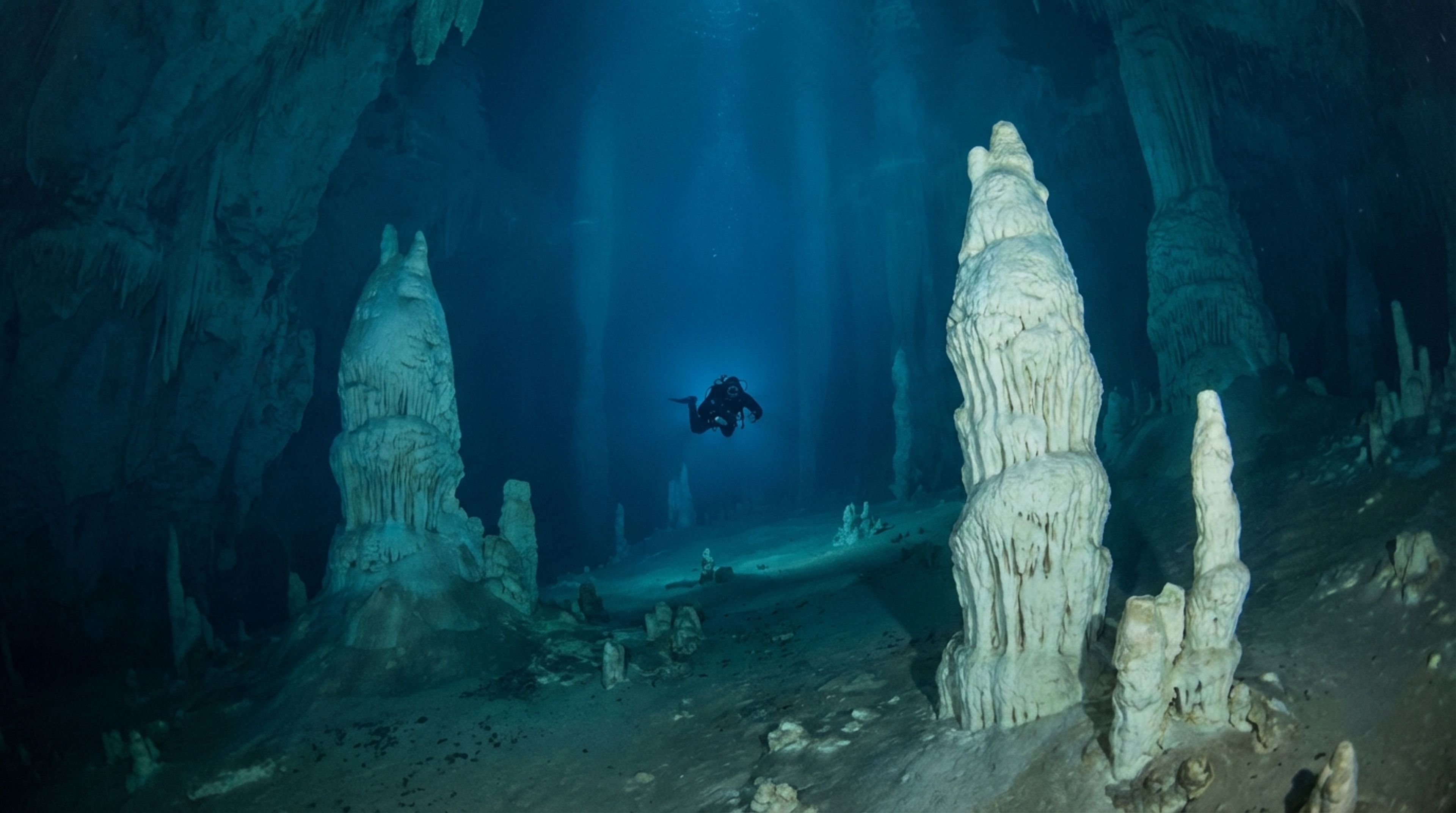
Technical diving strips away your ego. The ocean does not care how rich you are. The cave does not care how many Instagram followers you have. If you make a mistake, they will keep you.
This discipline forces you to be humble. It forces you to be precise. It forces you to trust your team and yourself completely.
When I surface after a three-hour dive, smelling of neoprene and old limestone, peeling off the heavy gear, I feel lighter than anyone else on earth. I have visited the underworld and I have been allowed to return.
That is the ticket. That is why we pay the price.
If you are ready to trade the sunlight for the flashlight, and the easy swim for the hard math, then welcome. The dark is waiting.