

Why You Look Like a Seahorse: Fix Your Trim or Get Out of My Water
You look like you are climbing stairs underwater. It is ugly, it destroys the reef, and it wastes your air. Let Tatay Santiago teach you how to be flat like a shark, not vertical like a beer bottle.
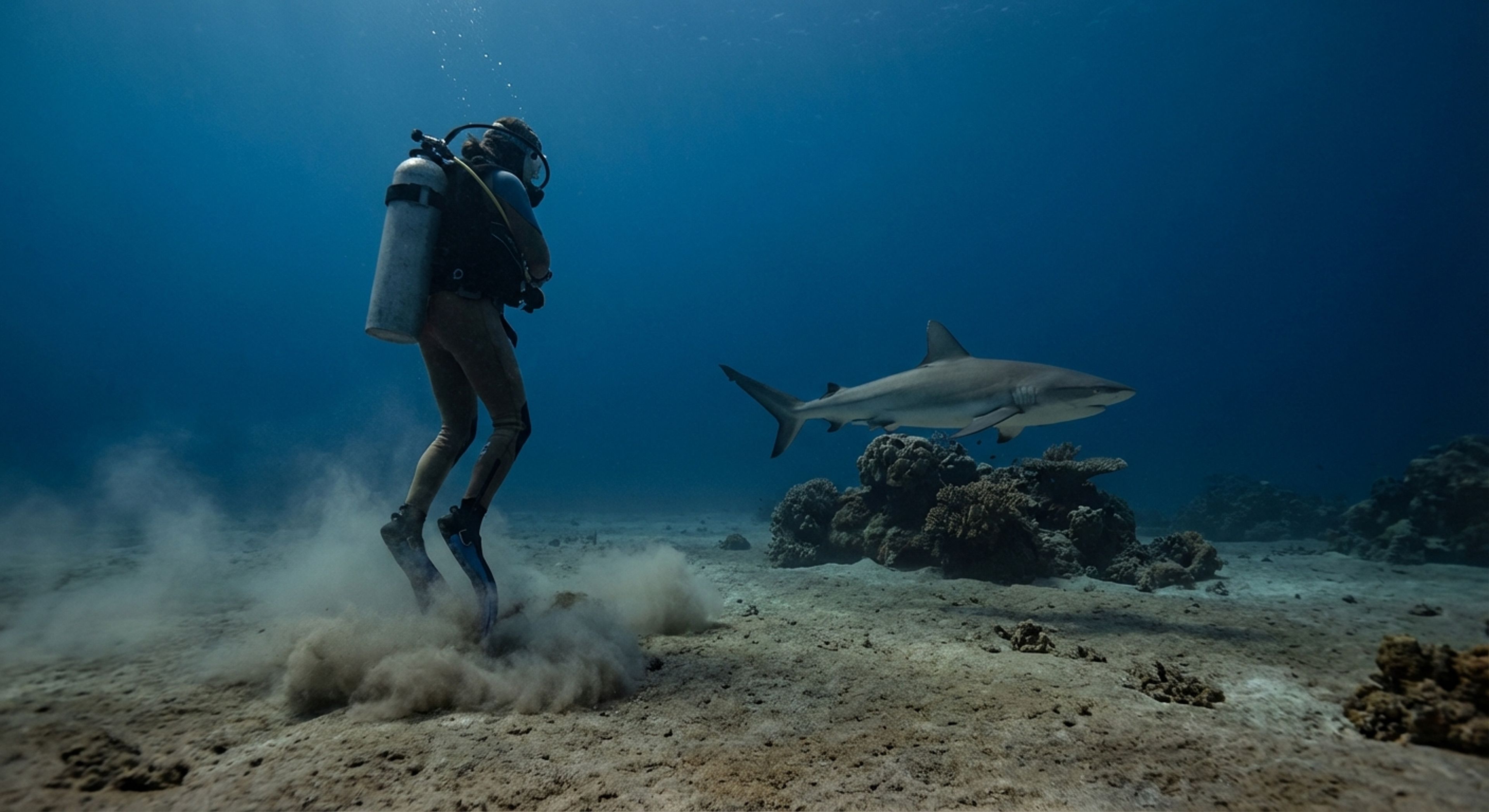
Hay naku. Yesterday I took a group to the Cathedral Rock. Good visibility. Maybe 20 meters. But I could not see the fish because of the dust storm caused by the divers.
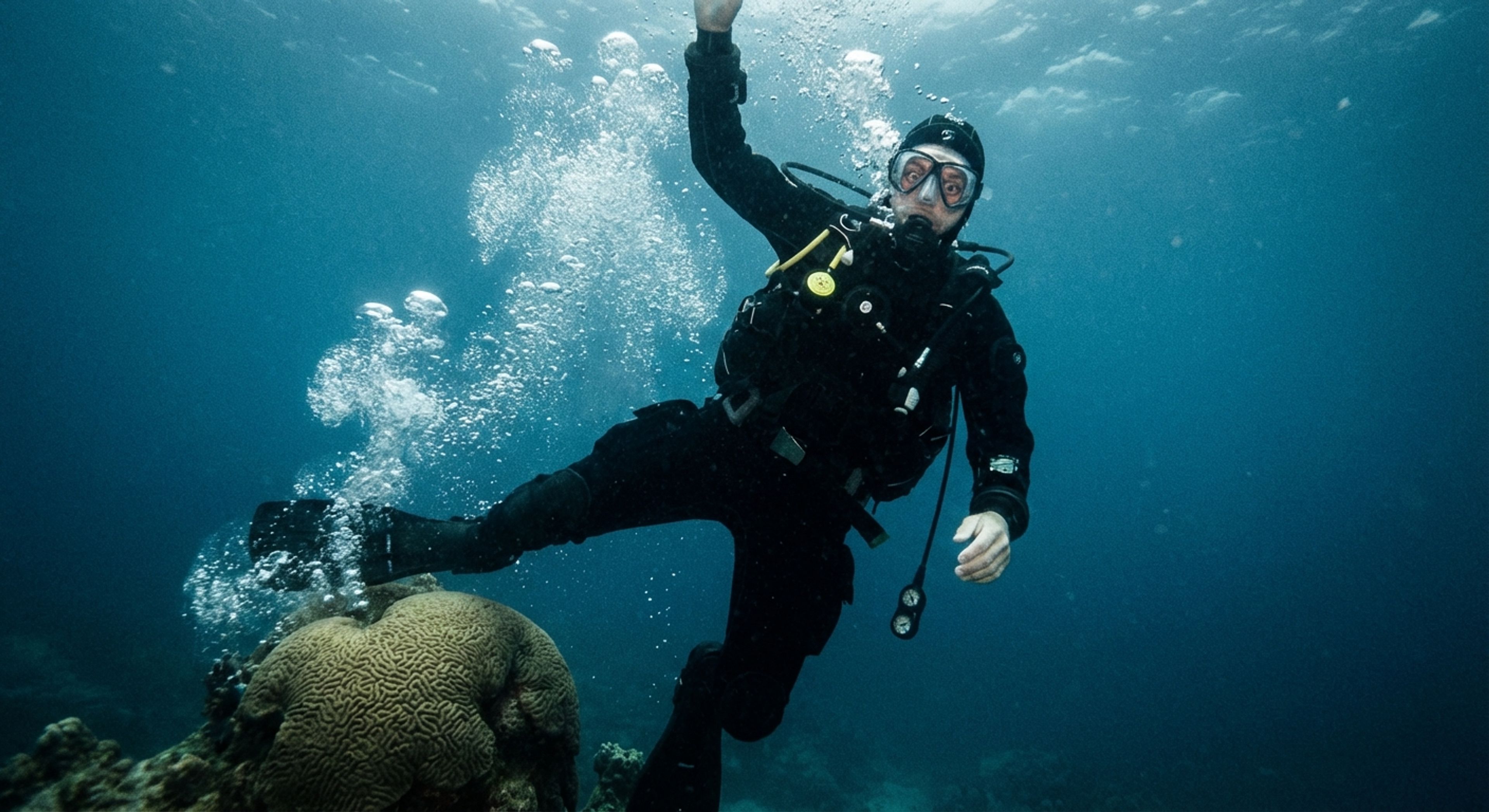
I look back and what do I see? Five "seahorses." You know what I mean. Divers who are vertical. Heads up, fins down, kicking the water like they are trying to climb a ladder. They are not swimming. They are fighting the ocean. And when you fight the ocean, the ocean always wins.
You ask me, "Tatay Santiago, why am I always standing in the water? Why can I not lie flat like you?"
Sit down. Put away your fancy split fins and your shiny titanium dive computer. Listen to me. The problem is not your gear. The problem is you do not understand physics, and you are lazy.
The Physics of Being Lazy (Streamlining)
You want to know why your air gauge is red after 30 minutes while I still have 150 bar? It is because of drag.
Water is heavy. It is 800 times denser than air. When you walk on the street, air moves out of your way easy. When you move underwater, you have to push the water aside.
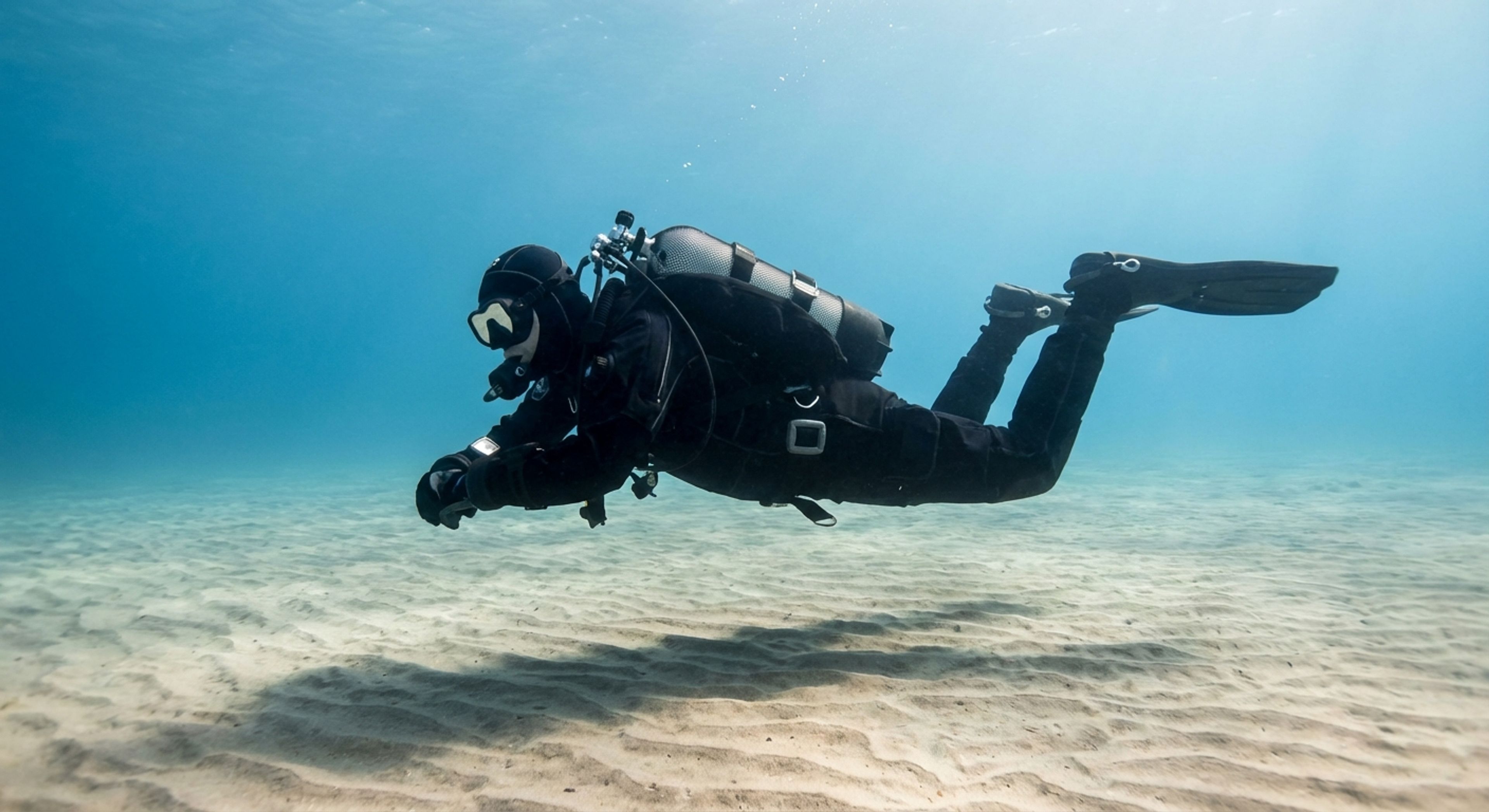
Imagine a knife. If you cut the water with the sharp edge, it is easy. That is good trim. You are flat. Horizontal. You cut the water with your head and shoulders.
Now imagine turning the knife sideways and trying to push it through the meat. It gets stuck. That is you when you "stand" in the water. You are pushing the water with your whole chest, your belly, your legs. You are a wall.
The Cost of Being a Wall
When you are vertical, your surface area hitting the water is huge.
- Drag increases. You need more energy to move one meter.
- Effort increases. Your legs work harder.
- Oxygen demand increases. Your muscles scream for oxygen. You breathe heavy. You suck the tank dry.
- CO2 builds up. You get a headache. You panic.
I see divers pumping their legs like they are running a marathon. Sus! Just lie down. If you are flat, one small kick sends you forward three meters. If you are standing, you kick ten times to go one meter.
Why Your Legs Are Heavy: The Center of Gravity
"But Santiago," you say, "I try to lie flat but my legs sink!"
This is simple mechanics. It is like a see-saw (teeter-totter).
Your body has two centers:
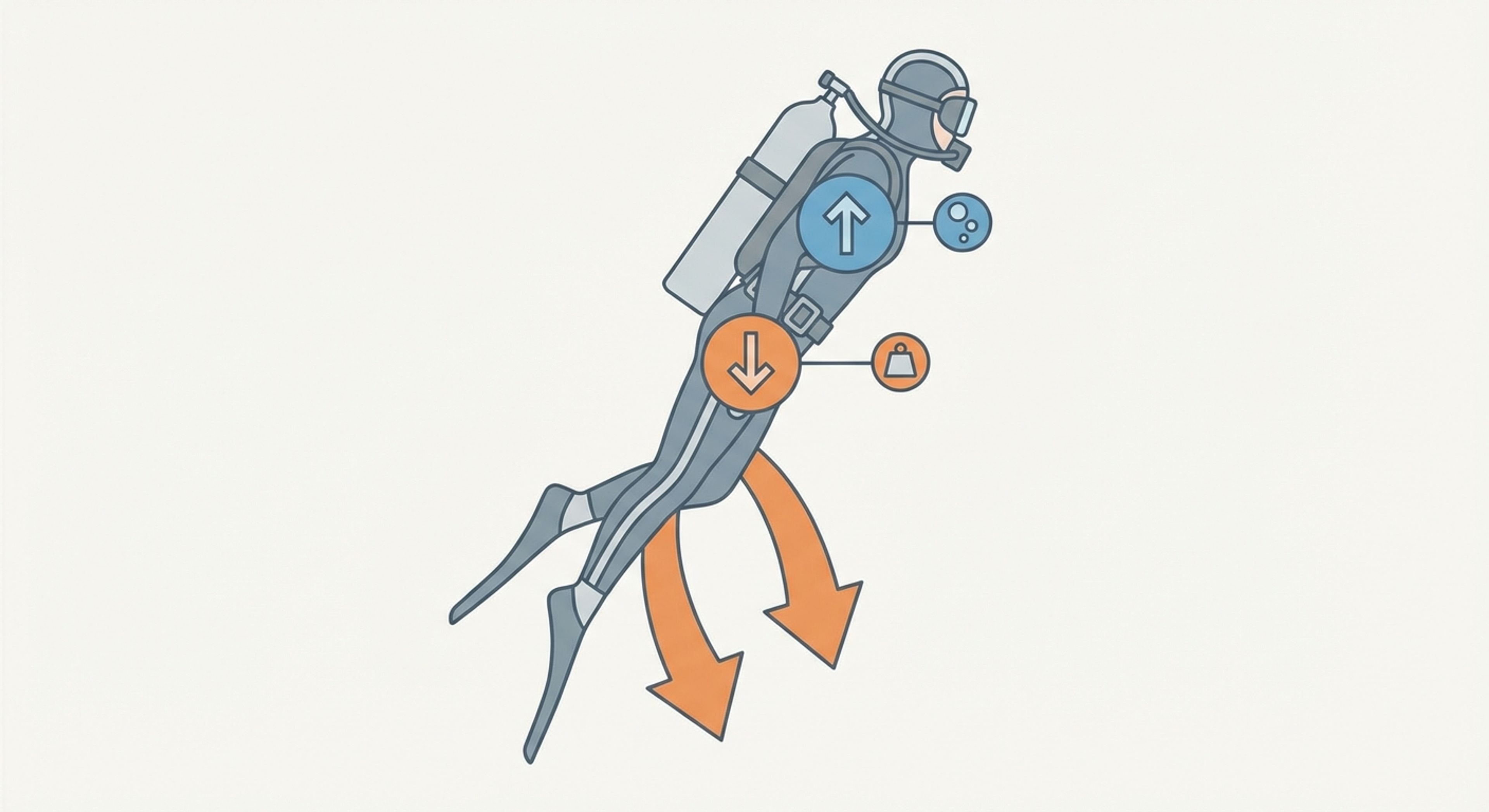
- Center of Buoyancy: This is your chest, where your BCD is and where your lungs are. This pulls you UP.
- Center of Gravity: This is where your weight is. For most of you, it is your hips (weights) and your heavy rubber fins. This pulls you DOWN.
If your Center of Buoyancy is at your chest, and your Center of Gravity is at your waist, what happens? Your chest floats up, your butt sinks down. You become vertical. You become the seahorse.
You need to bring these two centers closer together, or balance them out.
The Weight System Wars
Back in my day, we had a belt. That's it. Blocks of lead on a webbing strap. Now you have pockets, clips, trim weights. But you use them wrong.
Let's look at where you put your lead.
| Weight Location | Effect on Trim | Santiago's Verdict |
|---|---|---|
| Waist Belt | Pulls the lower body down. Good if you have a floaty wetsuit on your legs, bad if you already have heavy legs. | Old school. Works if you know how to position it. |
| Integrated Pockets (Waist) | Same as belt, but bulkier. Often sits too low on the hips. | Convenient, but often makes you roll side to side like a drunk boat. |
| Trim Pockets (Tank Strap) | Puts weight high up on the shoulders/back. Helps push the chest down and lift the legs. | This is the secret. If your legs sink, put 1-2kg here. |
| Ankle Weights | Pulls feet down. | GARBAGE. Throw them away. Why make your feet heavier? |
If your legs are always sinking, you have too much weight on your waist. Move some lead to the upper cam band of your tank (trim pockets). It acts like a counterweight. It pushes your shoulders down and, like the see-saw, your legs go up.
Also, look at your tank. If you use a steel tank, it is heavy. If you use aluminum (like most rental gear in the Philippines), the tank becomes positively buoyant as you use the air. The bottom of the tank floats up.
- Legs dropping? Move the tank higher up your back. This moves the weight higher. Move weights to trim pockets on the upper band.
- Head dropping? Move the tank lower. Keep weights on the waist.
A Story from Batangas
Two years ago, a young man came to dive with me. He had everything. Shiny new BCD, computer with a transmitter, GoPro on a stick. He looked like a Christmas tree.
We went to a drift dive. The current was medium. Not strong, but moving.
He jumped in and immediately went vertical to fiddle with his camera. The current hit his chest like a truck. He started kicking hard to stay in place. He was bicycle kicking. Dust everywhere. The coral polyps were screaming.
I signaled him: "Get flat." He didn't look. He was looking at his computer.
Fifteen minutes into the dive, he runs to me. Eyes wide. Slash across the throat signal. Out of air.
Fifteen minutes! I still had 180 bar.
I gave him my octopus regulator immediately. I grabbed his tank valve to stabilize him. I tipped him forward into a horizontal position. Suddenly, he stopped struggling. The water flowed over us. We drifted like leaves. He calmed down.
When we got on the boat, he said, "Tatay, the current was so strong!"
I said, "No, anak. The current was fine. You were just trying to stand up in a hurricane."
How to Practice (Stop Being Lazy)
You want to fix this? You have to work. You have to practice when there is no whale shark to look at. Do this on your next dive.
1. The Visualization: The Skydiver
Imagine you are jumping out of a plane. You arch your back slightly. You push your hips forward. Your knees are bent 90 degrees. Your fins are parallel to the floor.
This is the only position. Do not be a stick. Be a table.
2. The Look Forward Rule
The body follows the head. If you look at your feet, you will curl into a ball and roll. If you look at the bottom directly under you, you will go vertical.
Look forward. Look at the reef ahead. Look at the horizon. By lifting your chin, you naturally arch your back and bring your legs up.
3. The "Dead Man" Hover
Go to a sandy patch. 5 meters depth (safety stop depth). Add a little air to your BCD until you are neutral. Then stop kicking.
Do not move your hands. Do not move your fins. Just breathe.
- If you sink, add a puff of air.
- If you float, dump a little air.
- If your feet drop and you stand up: You need to move your weights.
Do not fight it with your fins. Let your body show you where the balance is wrong. If your feet hit the sand first, move 1kg from your belt to your tank strap. Try again.
4. Learn the Frog Kick
The flutter kick (up and down) makes you wobble. It pushes water down, which pushes you up. It is for snorkelers.
Learn the frog kick. You kick back, not down. It keeps your fins horizontal. It stops you from silting up the bottom. It gives you power without effort.
The Final Word
Diving is not about fighting the water. It is about surrender.
If you are fighting to stay horizontal, your equipment is set up wrong. Fix your weights. Move them up.
If you are fighting to move forward, your posture is wrong. Get flat.
Do not be the diver who scares the turtles because you look like a flailing octopus. Be the diver the fish ignore. Be part of the water.
Now, go rinse your gear. And wash the inside of your booties, they smell terrible.
Hay naku.