

Wreck Diving Protocols: History, Ecology, and Survival
Descending onto a shipwreck is an act of time travel. Here, we examine the strict protocols between external surveys and internal penetration, the ecological taxonomy of artificial reefs, and the ghosts of maritime history.
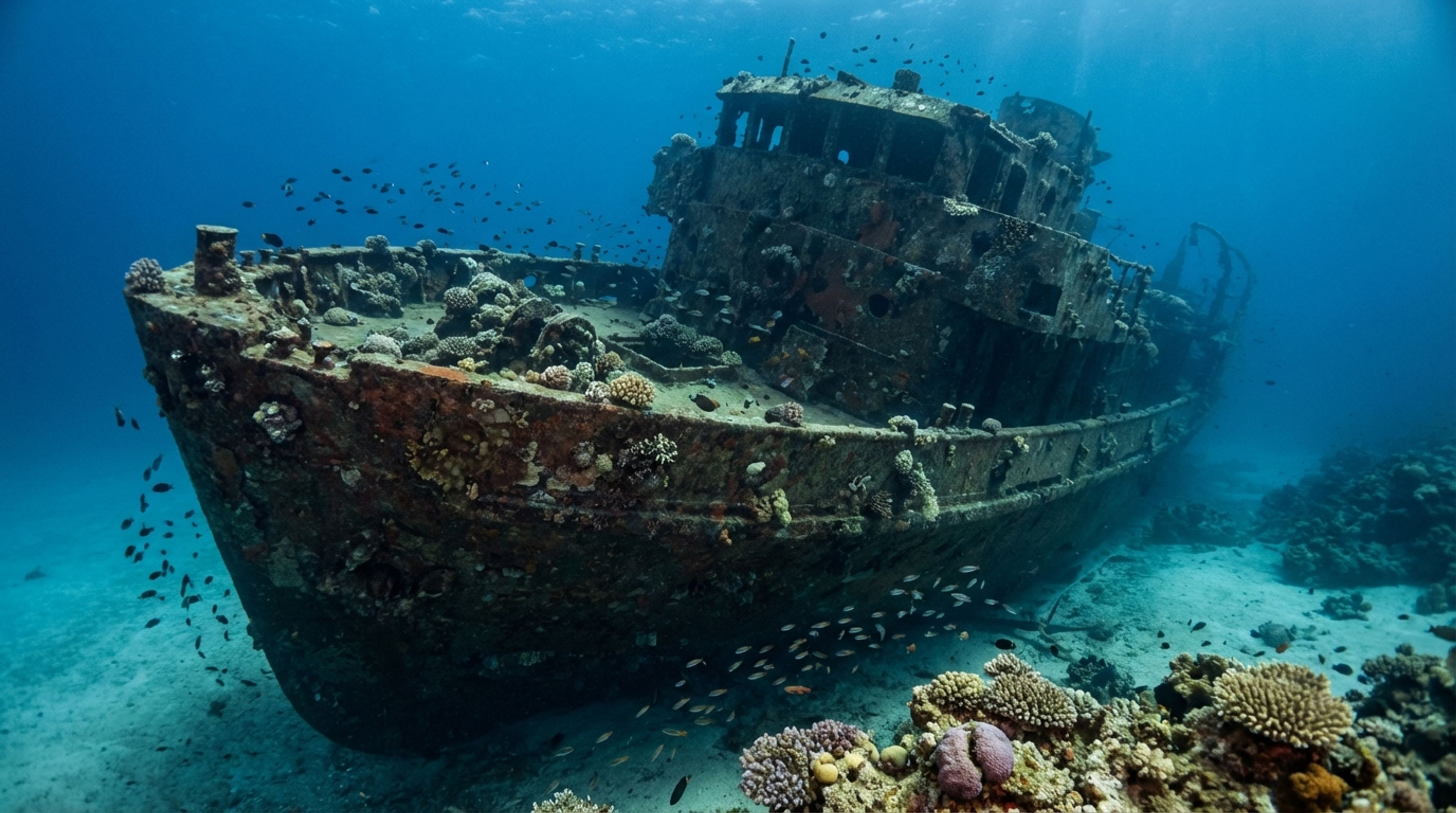
Rust never sleeps. That is the first principle you must internalize when you descend past the twenty-meter mark. The ocean is a solvent. It is patient, relentless, and chemically aggressive. It consumes steel, iron, and wood with a slow, terrifying persistence known as oxidation. When we enter the water to visit a shipwreck, we are essentially visiting a corpse in the active process of decomposition.
I often tell my students at the institute that diving a wreck is the closest a human can come to genuine time travel. You are not merely looking at an object; you are suspending yourself in a specific, frozen moment of history where violence, tragedy, or mere obsolescence sent a vessel to the seabed. It is solemn. It is quiet. It demands a level of respect that I find severely lacking in the average recreational diver who treats these hallowed sites like underwater amusement parks.
Let us establish the parameters for this discourse. We are discussing the submerged heritage of humanity and the biological colonies that claim them. We will categorize the levels of engagement, distinguishing the tourist from the explorer, the specific marine life forms that inhabit these structures, and the absolute laws of physics that will kill you if you ignore them.
The Taxonomy of Engagement: Survey vs. Penetration
There is a disturbing trend in modern certification agencies to rush students into overhead environments with insufficient buoyancy skills. This is folly. We must distinguish clearly between a Wreck Survey and Wreck Penetration. They are as different as walking past a haunted house and locking yourself in its basement.
Level 1: The Wreck Survey (Non-Penetration)
This is the domain of the recreational diver and the prudent marine archaeologist during initial assessments. Here, we observe the "external anatomy" of the vessel. We are documenting the hull integrity, the orientation on the seabed (upright, listed, or turtled), and the distribution of debris fields.
In a survey dive, you never lose sight of the surface light. This is the definition of the "Daylight Zone." You do not swim under overhangs that block your direct vertical ascent to the surface. You are an observer, a historian circling a monument. This requires perfect buoyancy control. If you crash into the deck, you are not just a poor diver; you are a vandal destroying history and the habitat of the Tubastraea (sun coral) and Dendronephthya (soft coral) that likely covers the gunwales.
The hazards here are external. Sharp metal edges (tetanus is a real threat, ensure your immunizations are current), entanglement in abandoned fishing nets, "ghost nets", that drape over wrecks like shrouds, and strong currents that accelerate as they move over the structure.
Level 2: Penetration (The Danger Zone)
Penetration is technical. It is the act of entering the enclosed spaces of the ship: the bridge, the cargo holds, the engine room.
Once you pass the threshold of a hatch or a torpedo hole, you are in an overhead environment. You cannot ascend if your air supply fails. You must swim out the way you came in. The darkness inside a ship is absolute. It is thicker than night; it is a heavy, pressurized blackness that consumes torchlight.
The primary risk here is not just running out of gas, but the "silt-out." Inside a wreck, decades of rust, fine mud, and organic decomposition settle on the floor. If you kick your fins improperly, using a standard flutter kick instead of a modified frog kick, you stir up this sediment. Visibility drops from ten meters to zero in seconds. You are then blind, inside a maze of sharp metal, with a limited gas supply. This is why I insist my students master their propulsion techniques in open water before they even look at a wreck.
Here is a comparative data set regarding the operational limits of these two disciplines:
| Parameter | Wreck Survey (Recreational) | Full Penetration (Technical) |
|---|---|---|
| Zone Limit | Daylight Zone (External) | Overhead Zone (Internal) |
| Gas Management | Standard Reserve (50 bar) | Rule of Thirds (1/3 in, 1/3 out, 1/3 reserve) |
| Equipment | Single Tank, Standard regulator | Twinset/Sidemount, Redundant regulators, Reels |
| Propulsion | Standard finning allowed (careful) | Frog Kick / Helicopter Turn mandatory |
| Risk Factors | Currents, Entanglement, Depth | Silt-out, Collapse, Entrapment, Disorientation |
| Primary Goal | Observation & Photography | Exploration & Surveying internal structure |
The Ecology of Iron: Ships as Artificial Reefs
Nature abhors a vacuum, and the ocean abhors bare metal. The moment a ship sinks, the process of colonization begins. This is of particular interest to me as it blends archaeology with marine biology. A shipwreck acts as a hard substrate in a soft-bottom environment. In the vast sand flats of the ocean floor, a steel hull is an oasis.
The Succession of Species
The biological takeover follows a predictable timeline. The first settlers are usually algae and bacterial mats, creating a biofilm. This attracts the larvae of hydroids and sponges (Porifera). Within a few years, the wreck becomes a thriving metropolis.
The vertical structures of the ship, masts, kingposts, and the bridge, allow filter feeders to access currents higher up in the water column. You will often find massive Gorgonian sea fans (Gorgoniidae) extending from the railings, orienting themselves perpendicular to the current to catch plankton.
The Predator-Prey Dynamic
The interior spaces provide shelter for cryptic species. I have spent hours hovering motionless near the hull of the SS Thistlegorm in the Red Sea, observing the behavior of Pterois volitans (Red Lionfish). They use the shadows of the twisted metal to ambush prey. The wreck creates a "halo effect" where the surrounding sand is grazed bare by fish venturing out from the safety of the hull.
Large pelagic species also congregate here. The wreck alters the current, creating pressure waves that fish like Sphyraena barracuda (Great Barracuda) and Caranx ignobilis (Giant Trevally) find energetically favorable. They patrol the perimeter like sentries. It is a functional ecosystem built upon the bones of human industry.
A Personal Log: The Ghosts of the Inket
I recall a dive I conducted in 2018 off the Andaman Islands. We were investigating the Inket, a Japanese vessel that met its end during the Second World War. It lies in roughly 20 meters of water, partially broken, a testament to the kinetic energy of conflict.
I was there to photograph the boiler room for a university paper. The water was turbid that day; the monsoon currents were churning up the bottom, reducing visibility to perhaps five meters. As I descended, the shape of the bow loomed out of the green gloom like a phantom limb.
There is a specific smell to the air inside your regulator when you are deep, dry, metallic, and compressed. I approached the port side, careful not to disturb the delicate Acropora table corals growing on the deck. I peered into a dark opening near the stern, checking my primary light.
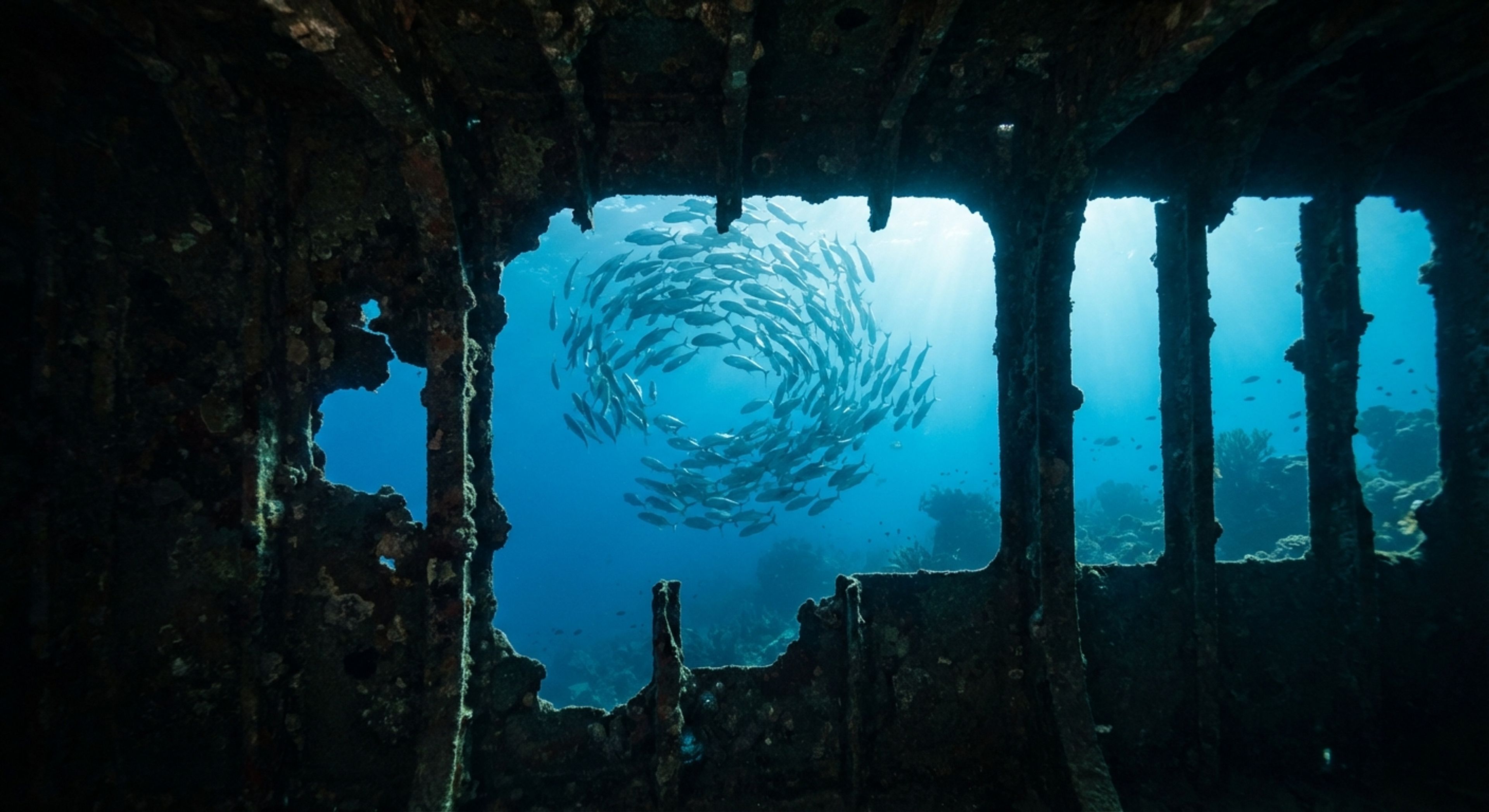
My beam cut through the particulate matter. Inside, residing in what was once a crew compartment, was a massive Epinephelus tukula (Potato Grouper). It must have weighed nearly 100 kilograms. It hovered amidst the wreckage, staring at me with a sour, grumpy expression, claiming the captain's cabin as its own.
At that moment, the duality of the wreck became clear. It is a grave for the sailors who may have perished, yes. But it is also a womb for the ocean. The death of the machine gave life to the reef. I backed away slowly, offering a small nod to the Grouper. He was the captain now. I was just a visitor.
Safety Protocols and The Art of Non-Interference
The ocean does not care about your certification card. It respects only physics and preparation. If you wish to dive wrecks and return to the surface to drink tea and discuss your findings, you must adhere to rigid safety standards.
1. The Guideline (Ariadne’s Thread)
In penetration diving, we use a continuous guideline. A primary reel is deployed outside the wreck, and the line is laid as you enter, wrapped around stable points (tie-offs). This is your lifeline. If visibility hits zero, tactile contact with this line is the only thing that guides you to the exit. I have seen divers panic, lose the line, and become disoriented in a room no larger than a closet. It rarely ends well.
2. The Rule of Thirds
Gas management is non-negotiable. The recreational "return with 50 bar" rule is insufficient for overhead environments. We use the Rule of Thirds:
- 1/3 of gas for the penetration (entry).
- 1/3 of gas for the return (exit).
- 1/3 of gas strictly for emergencies (e.g., sharing air with a buddy). If you hit your turn pressure, the dive is over. No arguments. No "just one more look at the engine."
3. Redundancy
Two lights. Two cutting tools (for fishing nets). Two regulators (DIN valves preferred). If you have only one of something, you have none of it when it breaks. Murphy’s Law is amplified by depth and pressure.
Ethical Preservation: Look, Don't Touch
Finally, we must address the ethics of our interaction. The mantra is simple: Take nothing but pictures, leave nothing but bubbles.
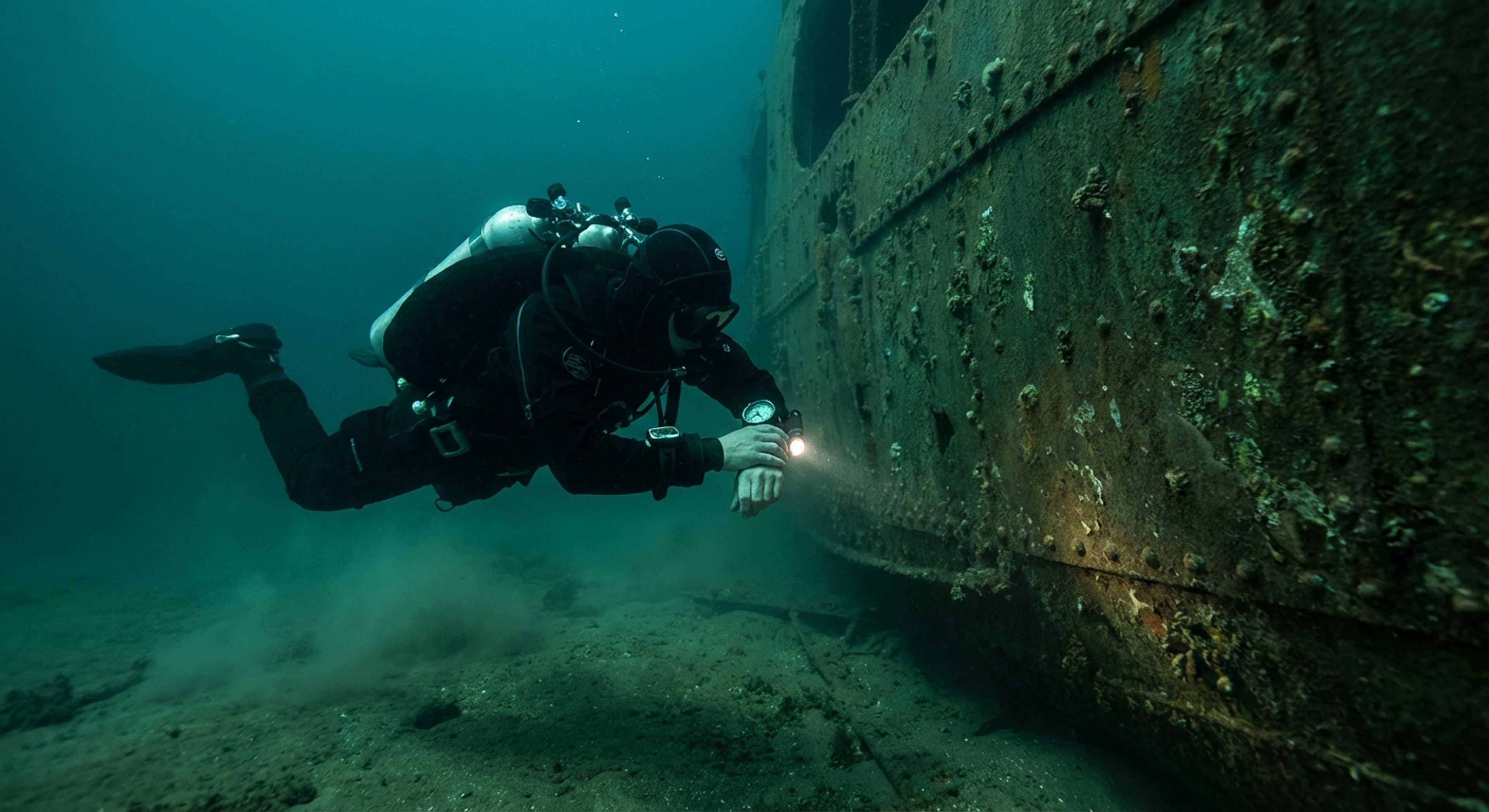
Do not touch the wreck. I cannot stress this enough. First, for your safety. Metal that has been submerged for seventy years creates a layer of "concretion." Beneath this, the structural integrity is often non-existent. It can be as sharp as a scalpel or as fragile as a biscuit. Bulkheads collapse. Railings snap.
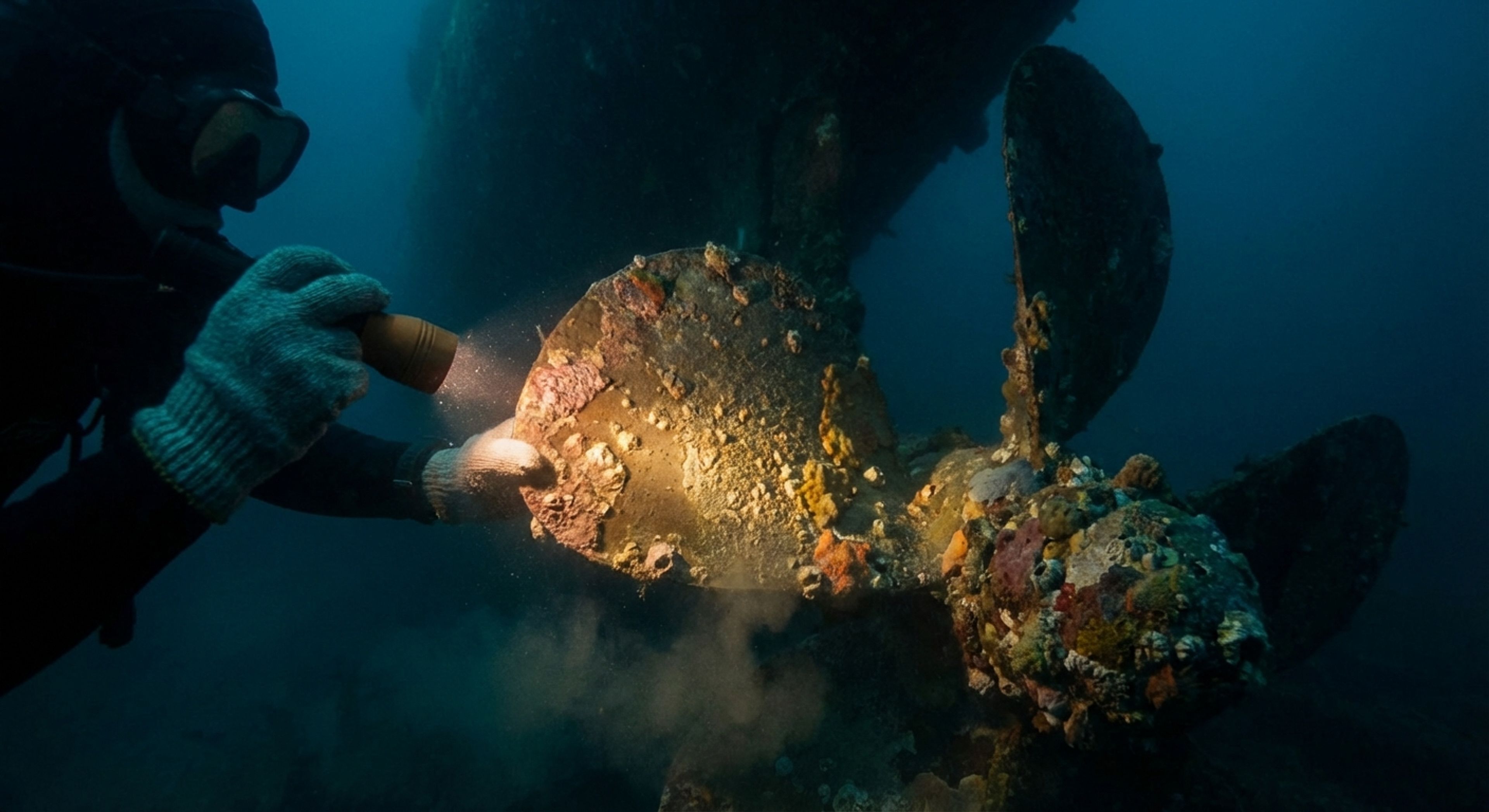
Second, for the biology. The oils on your gloves can damage the mucous membranes of the coral polyps. You are introducing foreign bacteria to a closed system.
Third, for the history. Removing artifacts is looting. I have no patience for divers who bring up brass portholes, shell casings, or dinner plates as souvenirs. That item belongs to the site. It is part of the archaeological context. When you move it, you destroy the data. A brass bell on a mantlepiece is just a piece of metal; a brass bell on a wreck is a coordinate in time.
Wrecks are finite resources. Every time a diver grabs a railing to steady themselves, they accelerate the corrosion. They crush the barnacles. They disturb the sediment. We must be ghosts ourselves, silent, weightless, passing through without leaving a mark.
If you cannot maintain neutral buoyancy to the point where you can hover centimeters from the rust without touching it, go back to the pool. The ocean will be waiting for you when you are ready.
Study the history. Respect the biology. Check your gauges.